Improve CD Sound By Shaving?

We always enjoy the odd things that people do to try to get better audio reproduction. Exotic cables, special amplifiers, and higher resolution digitization come to mind.  Most of this is dubious, at best, but [Techmoan] brings up something we must have missed back in the day: shaving CDs with a gadget that was marketed as the “CD Sound Improver.” The theory is that bad CD reproduction comes from light scatter of the laser. The solution, according to the maker of this vintage equipment, is to cut a 36-degree bevel to act as a light trap. You can see the gadget in the video below.

The device claims it reduced vibration, improved audio, and even helped DVDs playback better video. As you might imagine, this has little hope of actually working. The box is essentially a motor-driven turntable, a razor blade, and a port for a vacuum cleaner to suck up the mess. You were told to color the edge with a marker, too.


Continue reading “Improve CD Sound By Shaving?”

Linux Fu: Eavesdropping On Serial

In the old days, if you wanted to snoop on a piece of serial gear, you probably had a serial monitor or, perhaps, an attachment for your scope or logic analyzer. Today, you can get cheap logic analyzers that can do the job, but what if you want a software-only solution? Recently, I needed to do a little debugging on a USB serial port and, of course, there isn’t really anywhere to easily tie in a monitor or a logic analyzer. So I started looking for an alternate solution.

If you recall, in a previous Linux Fu we talked about pseudoterminals which look like serial ports but actually talk to a piece of software. That might make you think: why not put a piece of monitor software between the serial port and a pty? Why not, indeed? That’s such a good idea that it has already been done. When it works, it works well. The only issue is, of course, that it doesn’t always work.

Continue reading “Linux Fu: Eavesdropping On Serial”

Retrotechtacular: Oh Boy! We’re Radio Engineers!

It is a shame that there are fewer and fewer “nerd stores” around. Fry’s is gone. Radio Shack is gone. But the best ones were always the places that had junk. Silicon valley was great for these places, but they were everywhere. Often, they made their money selling parts to the repair trade, but they had a section for people like us. There’s still one of these stores in the Houston, Texas area. One of the two original Electronic Parts Outlets, or EPO. Walking through there is like a museum of old gear and parts and I am not ashamed to confess I sometimes drive the hour from my house just to wander its aisles, needing to buy absolutely nothing. It was on one of those trips that I spied something I hadn’t noticed before. A Remco Caravelle transmitter/receiver.

The box was clearly old and the styling of the radio was decidedly retro. You can tell it wasn’t catering to the modern market because it mentions: “play ham radio operator” which would surely mystify most of today’s kids. The unit was an AM receiver and a transmitter, complete with a morse code key and microphone. You can see a contemporary commercial for a similar unit from Remco, in the video below.

Continue reading “Retrotechtacular: Oh Boy! We’re Radio Engineers!”

Today’s The Day You Finally Learn Quaternions

If you’ve ever dealt with orbital mechanics or sophisticated computer graphics, you’ve probably run across the math term quaternions. [Anyleaf] has a guide to the practical use of this math concept which focuses more on practicality than theory. We like it!

Quaternions are one of at least two ways to model rotations in a 3D space. Most people are familiar with the classic Euler angles which cover yaw, pitch, and roll. However, this method is prone to some ambiguities — in other words, there are multiple ways to go from one Euler state to another and all are equally valid. In addition, Euler angles are prone to gimbal lock where two of the axes are parallel and, thus, don’t have a different effect on the object’s orientation. There are several ways to combat that including the use of quaternions.

Continue reading “Today’s The Day You Finally Learn Quaternions”

Nanoparticles Rip Hydrogen From Water

Hydrogen fuel is promising, and while there’s plenty of hydrogen in the air and water, the problem is extracting it. Researchers have developed a way to use aluminum nanoparticles to rip hydrogen out of water with no additional energy input. It does, however, require gallium to enable the reaction. The reaction isn’t unknown (see the video below), but the new research has some interesting twists.

Aluminum, of course, is cheap and plentiful. Gallium, not so much, but the process allows recovery and reuse of the gallium, so that makes it more cost-effective. There is a patent pending for the process and — of course — the real trick is making the aluminum nanoparticles. But if you have that, this is a simple way to extract hydrogen from water with no extra energy and at room temperature. Since the reaction of creating aluminum oxide and releasing hydrogen with gallium is pretty well-known, it appears the real research here is determining the optimal properties of the aluminum and the ratio of aluminum to gallium.

While gallium isn’t a common item around the typical hacker’s workshop — unless you count the stuff bound up in semiconductors — it isn’t that expensive and it is relatively easy to handle. Hydrogen, though, not so much — so if you do decide to use this method to produce hydrogen, be careful!

We’ve seen gallium robots and even an antenna. So if you do get some of the liquid metal, there are plenty of experiments to try.

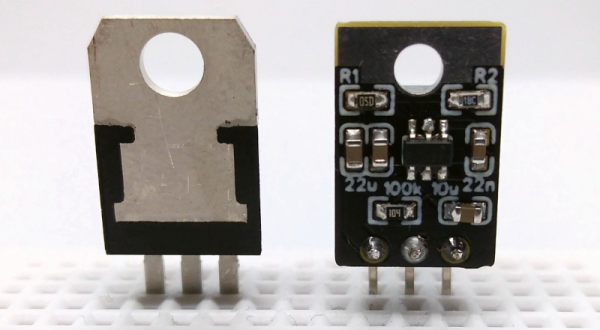
The 7805 Is Dead! Long Live The 7805!

The 78XX series of regulators are very handy to use. If you need, say, a 5V regulator, you grab a 7805, add a capacitor for stability, and send in enough voltage for the regulator to work with. Cheap and easy. However, the part is not without its faults.

A stock 7805 can’t convert 5.1V to 5V. You need to have a good bit more voltage coming in. But the more voltage you put in, the more the part is going to dump out as heat. So running from 9V is going to be cooler than running from 24V. All that heat isn’t very energy efficient on batteries, either. [Stefan] wanted to do better, so he made a drop-in replacement for these venerable regulators some time ago. But he’s recently made the board layouts available so you can build your own replacement, too.

The device accepts 4.5 to 16V, and you can select the output voltage using two resistors. You can draw up to 2A out of the regulator, which is more than you can say for a stock 7805.

Continue reading “The 7805 Is Dead! Long Live The 7805!”

It’s A Plane… It’s A Train… Um… It’s Both?

What kind of electric vehicle travels at 620 miles per hour (998 km/h)? According to Canadian and French company TransPot, their FluxJet will do it and they want to use it to virtually shrink the Great White North. An electric jet? Not exactly. The FluxJet is a magnetic levitation (maglev) train riding in a vacuum tube with contactless power delivery.

The company claims it can carry 54 passengers or 10 tons of cargo. You can see two videos about the concept below. Judging by the second video, the device might be controlled by a serial port — well, probably not, but we were still amused to see the directory of tty devices on the screen.

Pipe dream (no pun intended)? Maybe. But they did get $550 million in funding and a plan to build a line between Calgary and Edmonton that will take 45 minutes to traverse. Reports are that they did demonstrate a 1-ton 18-foot-long prototype, although we couldn’t find any actual video footage of that — just hints of it in the marketing videos.

Of course, this isn’t the first such system proposed as a “hyperloop” but they do seem to be building momentum financially. We aren’t clear what they are talking about with the “veillance flux,” but we also know that since they are a French-speaking organization, it may just be another way to say “sensors” because — we think —  veillance is a French word that means watching. We also aren’t sure how a train in a vacuum has much in common with an airplane. Maglev isn’t new, either.

Continue reading “It’s A Plane… It’s A Train… Um… It’s Both?”