Viewing Atoms With Electrons

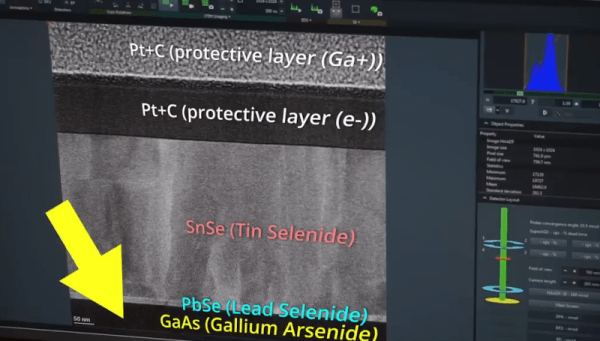
When we were in school, they always told us we can’t see atoms. If you have an electron microscope, then they were wrong. [AlphaPhoenix] has access to a scanning tunneling transmission electron microscope and he shows us some atoms in a very thin slice of a crystal.

Of course, you aren’t directly imaging the atoms. You are looking at the shadows of the atoms, but still. If you’ve never worked with a SEM or STEM before, there are plenty of little details that are interesting like the sample holders and the vacuum system.

Continue reading “Viewing Atoms With Electrons” →

Photovoltaic Cells In LTSpice

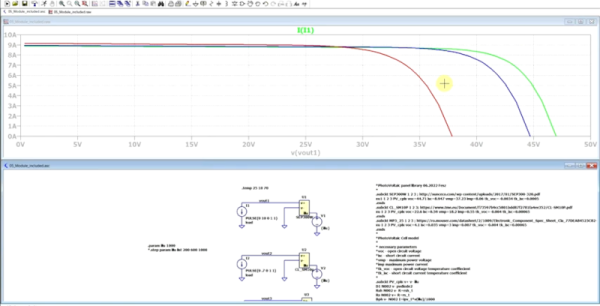
We like to build things using real parts. But we do think the more you can model using tools like LTSpice, the less time you can spend going down dead ends. If you need to model a common component like a resistor or even an active device, most simulators have great models and you can tweak them to have realistic parasitic effects. But what if the component you want isn’t in the library or doesn’t have the fidelity you want? [FesZ] wanted to model photovoltaic cells and had to build his own model. The resulting two videos are well worth watching.

Building your own models in Spice isn’t necessarily very difficult. However, knowing exactly what to add to model different real-world effects can be challenging. The videos do a good job of showing how to mutate a simple diode into one that produces current when exposed to light.

Continue reading “Photovoltaic Cells In LTSpice” →

Need A Linux Kernel Module? Scratch That

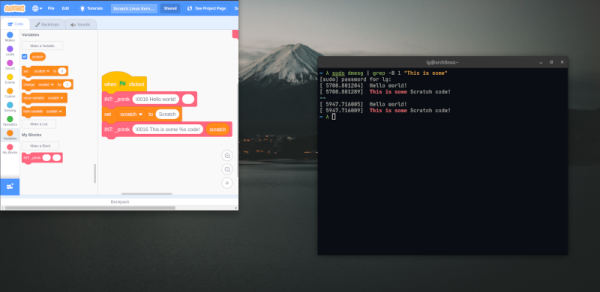
If you have been for (or against) Rust in the Linux kernel, get ready for a Linux kernel module written in… Scratch. That’s right. Scratch, the MIT-developed language with blocks popular for teaching kids to code. We didn’t mean “from scratch.” We meant IN Scratch. The bootstrap code and Makefile is out there on GitHub.

Of course, it is a simple module and the reason it is possible is because of the scratchnative system that lets you compile Scratch into C code. If you want to look at the decidedly simple code, you can open it in your browser.

Continue reading “Need A Linux Kernel Module? Scratch That” →

AJAX COMMAND Radio Is An Oldie But Goodie

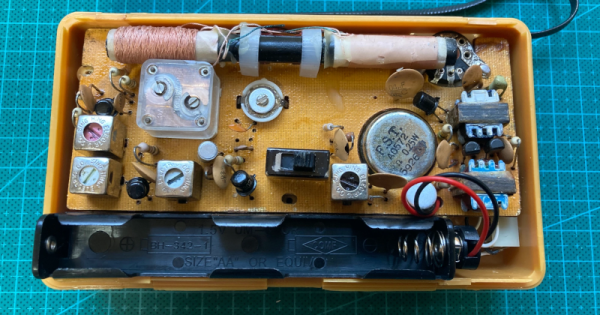
If you are a certain age, it is hard to wrap your head around the fact that an old radio might have transistors — the old ones all had tubes, right? But a radio from the 1960s or 1970s is reaching the 60+ year mark and people are restoring old transistor sets. [Adam] picked up his first old radio, a 1970s vintage Ajax Command S-74.

He was fortunate. The only repair needed was to replace a corroded battery holder and clean up the mess from the batteries. You can hear the radio doing its thing in the video below.

Continue reading “AJAX COMMAND Radio Is An Oldie But Goodie” →

Testing A Tube Without A Tube Tester

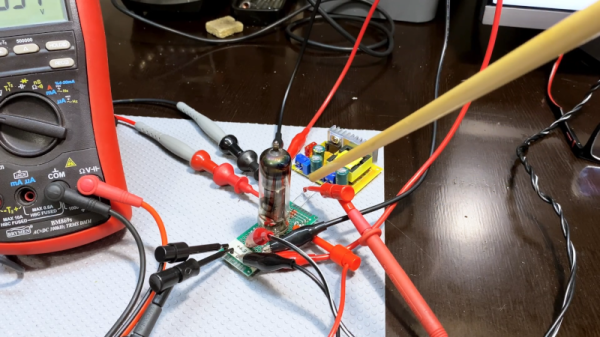
[M Caldeira] needed to test a tube and didn’t have a spare to do the old swap test. He also didn’t have a tube tester handy. Drawing inspiration from a 2015 video, he managed to cobble up an ad hoc tube tester using stuff around the workbench. You can see a video of the process below.

To duplicate his effort, you are going to need a few meters. Good thing they are relatively cheap these days. Usually, a tube tester has a way to adjust all the different parameters for the tube, but there’s no reason you can’t just set those parameters using your testbench power supplies.

Continue reading “Testing A Tube Without A Tube Tester” →

AI Image Generation Sharpens Your Bad Photos And Kills Photography?

We don’t fully understand the appeal of asking an AI for a picture of a gorilla eating a waffle while wearing headphones. However, [Micael Widell] shows something in a recent video that might be the best use we’ve seen yet of DALL-E 2. Instead of concocting new photos, you can apparently use the same technology for cleaning up your own rotten pictures. You can see his video, below. The part about DALL-E 2 editing is at about the 4:45 mark.

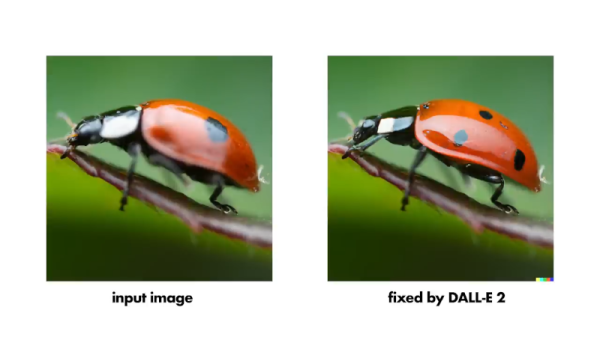
[Nicholas Sherlock] fed the AI a picture of a fuzzy ladybug and asked it to focus the subject. It did. He also fed in some other pictures and asked it to make subtle variations of them. It did a pretty good job of that, too.

Continue reading “AI Image Generation Sharpens Your Bad Photos And Kills Photography?” →

Injection Molds: Aluminum Or Resin?

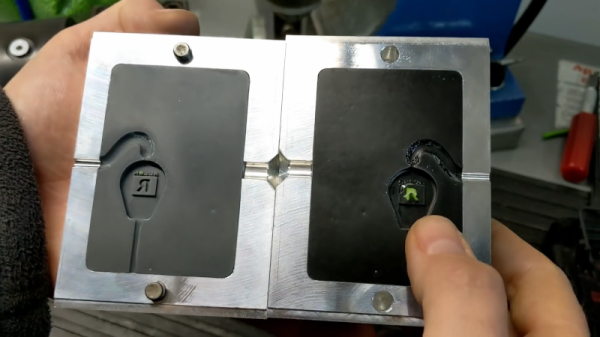
[JohnSL] and his friend both have injection molding machines. They decided to compare the aluminum molds they usually use with some 3D printed molds created with a resin printer. They used two different resins, one on each side of the mold. You can see a video of the results below.

One half of the mold used ordinary resin while the other side used a resin that is made to hold up to higher temperatures. As you might expect, the lower-temperature resin didn’t stand up well to molten plastic. However, the higher temperature resin did somewhat better. It makes sense, though, that an aluminum mold draws more heat out of the plastic which is helpful in the molding process.

The higher temperature — and more expensive — resin did seem to hold up rather well, though. Of course, this was just to test. In real life, you’d want to use the better resin throughout.

No surprise, the resin molds didn’t last nearly as long as a proper mold. After 70 shots, the mold was worn beyond what you’d want to use. So not necessarily something you’d want to use for a real production run, but it should be enough for a quick prototype before you go to the expense of creating a proper mold.

We wonder if there are some other tricks to get better results. A comment from [TheCrafsMan] suggests that clear resin UV cures better, and that might produce better results. In fact, there are a lot of interesting comments on the video from people who have varied experiences trying to do the same thing.

If nothing else, watching the mill cut through the aluminum around the 15-minute mark is always interesting to watch.  If you don’t already have an injection molding setup, you can always build one. We’ve seen more than one design.

Continue reading “Injection Molds: Aluminum Or Resin?” →