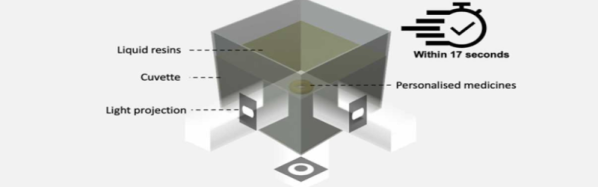
3D Printing Pills All At Once

To the uninitiated, it might seem like a gimmick to 3D print pharmaceuticals. After all, you take some kind of medicine, pour it in a mold, and you have a pill, right? But researchers and even some commercial companies are 3D printing drugs with unusual chemical or physical properties. For example, pills with braille identification on them or antibiotics with complex drug-release rates. The Universidade de Santiago de Compostela and the University College London can now 3D print pills without relying on a layer-by-layer approach. Instead, the machine produces the entire pill directly.

According to a recent report on the study, there are at least two things holding back printed pills. First, anything medical has to go through rigorous testing for approval in nearly any country. In addition, producing pills at typical 3D printing speeds is uneconomical. This new approach uses multiple beams of light to polymerize an entire tank of resin at once in as little as seven seconds.

With 3D printed drugs, it is possible to tailor release profiles for individual cases and make hybrid drugs such as a French drug that joins anticancer drugs with another drug to manage side effects. Is this a real thing for the future? Will doctors collect enough data to make it meaningful to tailor drugs to patients? Will regulators allow it? For hybrid medicine, is there really an advantage over just taking two pills? Only time will tell.

Sure, technology can help dispense pills. We know, too, that 3D printing can be useful for prostheses and medical devices. We aren’t so sure about pharmaceuticals, but in the meantime you can already order custom-printed vitamins.
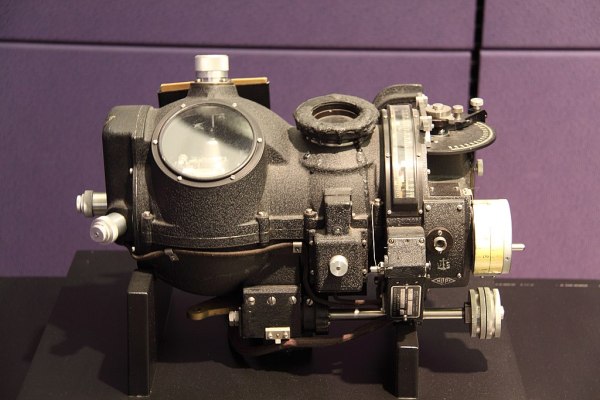
Less Is More — Or How To Replace A $25,000 Bomb Sight For 20 Cents

Depending on who you ask, the Norden bombsight was either the highest of high tech during World War II, or an overhyped failure that provided jobs and money for government contractors. Either way, it was super top secret in its day. It was also expensive. They cost about $25,000 each and the whole program came in at well over a billion dollars. The security was over the top. When not flying, the bombsight was removed from the plane and locked in a vault. There was a pyro device that would self-destruct the unit if it were in danger of being captured. So why did one of the most famous missions of World War II fly with the Norden replaced by 20 cents worth of machined metal? Good question.

You often hear the expression “less is more” and, in this case, it is an accurate idea. I frequently say, though, that “just enough is more.” In this case, though, less was actually just enough. There were three reasons that one famous mission in the Pacific theater didn’t fly the Norden. It all had to do with morale, technology, and secrecy.

Continue reading “Less Is More — Or How To Replace A $25,000 Bomb Sight For 20 Cents”

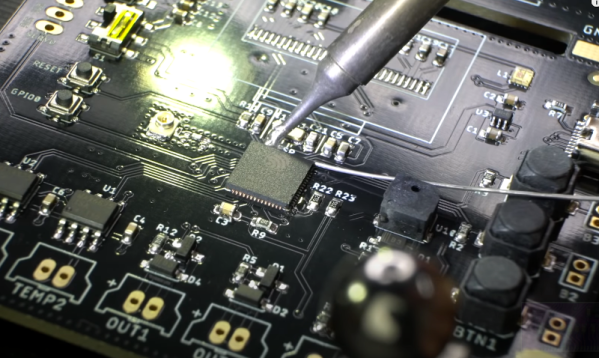
Versatile Reflow Oven Controller Uses ESP32-S2

[Maker.Moekoe] wanted a single controller board that was usable with different reflow ovens or hotplates. The result is a versatile board based on the ESP32-S2. You can see a video of the board’s assembly in the video below.

The board sports several inputs and outputs including:

  • 2x MAX6675 thermocouple sensor input
  • 2x Fan output with flyback diodes
  • 2x Solid state relay output
  • 3x Buttons
  • 1x LED
  • 1x Buzzer
  • 1x Servo motor output
  • 0.96 inch OLED display

You could probably find a use for the board for other similar applications, not just ovens.

The video is oddly relaxing, watching parts reflow. It is like watching a 3D printer, no matter how many times we see it, we still find it soothing to watch. You can also see how he integrated the board with a toaster oven.

Overall, the board looks great and the workmanship is also very good. If you’ve never seen anyone set heat-set threaded inserts into a 3D printed piece, be sure to watch around the four minute mark.

We’ve seen plenty of oven projects. You can even use an Easy Bake oven.

Continue reading “Versatile Reflow Oven Controller Uses ESP32-S2”

Reducing Warping In Metal 3D Prints

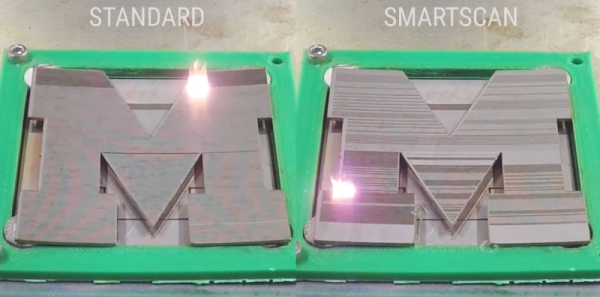
We are used to dealing with warping when printing with thermoplastics like ABS, but metal printers suffer from this problem, too. The University of Michigan has a new technology, SmartScan, that promises to reduce this problem. You can see a video about the technique, below.

The idea is to develop a thermal model of the printed part before laser sintering and then move the laser in such a way that heat doesn’t accumulate. The video shows how engraving metal in the traditional way causes the metal to warp as the laser heats up areas. Using the SmartScan thermal model, they were able to reduce deformation by almost half.

Continue reading “Reducing Warping In Metal 3D Prints”

Does Your Programmer Know How Fast You Were Going?

News reports were everywhere that an autonomous taxi operated by a company called Cruise was driving through San Francisco with no headlights. The local constabulary tried to stop the vehicle and were a bit thrown that there was no driver. Then the car moved beyond an intersection and pulled over, further bemusing the officers.

The company says the headlights were due to human error and that the car had stopped at a light and then moved to a safe stop by design. This leads to the question of how people including police officers will interact with robot vehicles.

Continue reading “Does Your Programmer Know How Fast You Were Going?”

Nixie Spectrum Display Has Seven Bands

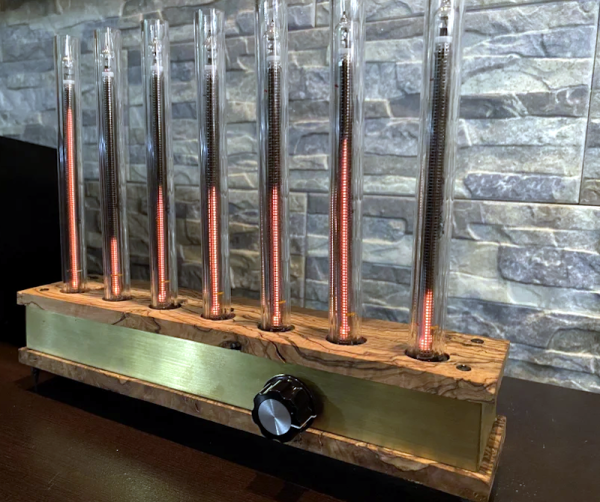
A spectrum visualizer is always a fun project, but we really liked [Yannick99]’s take on it since it uses seven IN-13 Nixie tubes for the display. The tubes, of course, need high voltage so part of the project is a high voltage power supply. The spectrum part is a little more ordinary using an op amp and an MSGEQ7 filter IC.

The chip feeds a microcontroller and the microcontroller, with a little help, drives the tubes. The results are great, as you can see in the video below. There are several other videos showing the testing and prototyping, too. The MSGEQ7 is a cute chip that offloads the usual FFT logic from the microcontroller. It does all the work and communicates in a very unusual way. You reset the device and then pulse the strobe input. This causes an analog voltage to appear on the output pin corresponding to the 63 Hz band level. Another strobe pulse selects the next band and you just repeat indefinitely, something the microcontroller is good at.

The only issue, of course, is locating IN-13 tubes. They are around if you look for them, but they may not be cheap. Expect to pay about $20 each for them, more or less. We wondered if you could make an LED look-alike replacement. If you are wondering about the lifespan of these tubes, someone’s already done the testing.

Continue reading “Nixie Spectrum Display Has Seven Bands”

Arming With An OS

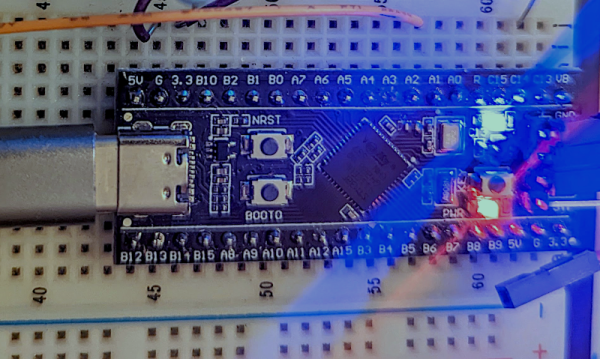
We see tons of projects with the infamous “Blue Pill” STM32 boards. They are cheap and plentiful and have a lot of great features, or at least they were before the chip shortage. I recently picked up a “Black Pill”, which is very similar but has an even more powerful processor. For a few bucks, you get an ARM CPU that can run at 100 MHz (but with USB, probably 96 MHz). There’s 512 kB of flash and 128 kB of RAM. There’s a USB type C port, and even a button and an LED onboard. The thing fits on a breadboard and you can program it with a cheap STLink dongle which costs about $10.

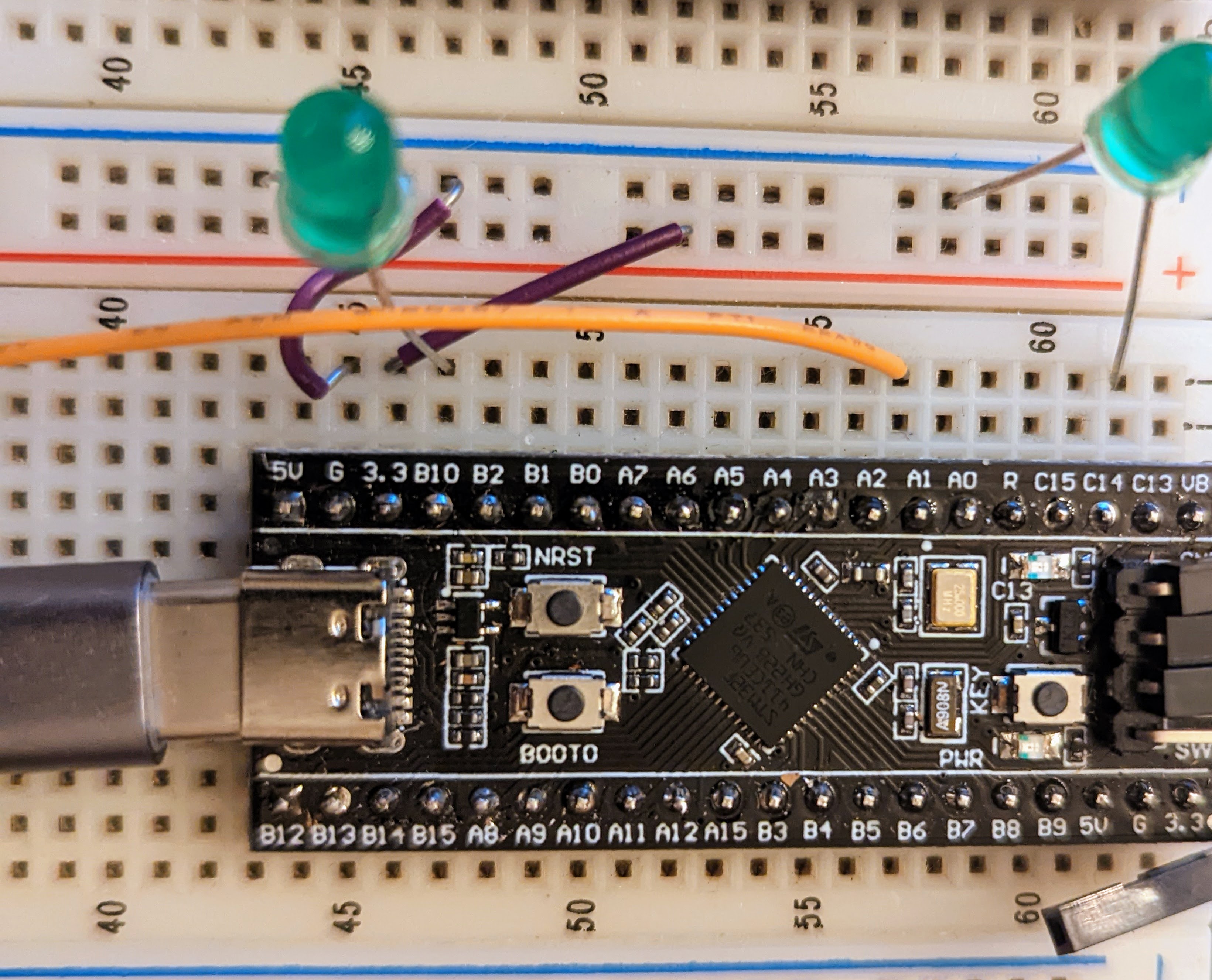
The Black Pill module on a breadboard.

Of course, you then have to consider the software. The STM32Cube stuff is a lot to set up and learn but it does let you do just about anything you can imagine. Then there is the STM32Duino plug-in that lets you use it as a beefy Arduino. That works and is easy enough to set up. However, there’s also Mbed. The only problem is that Mbed doesn’t work right out of the box. Turns out, though, it isn’t that hard to set up. I’ll show you how easy it is to get things going and, next time, I’ll show you a practical example of a USB peripheral that uses the mBed RTOS features.

First Steps

Obviously, you are going to need a Black Pill. There are at least two choices but for as cheap as they are there is little reason not to get the STM32F411 version that has more memory. The DIP form factor will fit in whatever breadboard you happen to have and a USB C cable will power the board so unless you are driving a lot of external circuitry, you probably don’t need an external supply.

Continue reading “Arming With An OS”