Unknown Quantum Effect Makes Insulator Oscillate

If there are two classes of matter that electronics people can agree on, its conductors and insulators. Electrically, conductors and insulators don’t have much in common. The same has held true in the quantum physics world until some research at Princeton has suggested that quantum oscillation — a phenomenon associated with metals — is taking place in an insulator. Scientists aren’t sure what’s really happening yet, but it may suggest there is a new quantum particle yet to be discovered.

In metals, electrons are very mobile which allows a relatively easy flow of electrical current. However, at low temperatures, a magnetic field can shift electrons to a quantum state causing its resistance to change in an oscillating pattern. Insulators generally do not exhibit this effect.

Researchers made a monolayer of tungsten ditelluride using the same kind of adhesive tape process you see to create graphene. In bulk, the material is a conductor but in a monolayer, tungsten ditelluride is an insulator.

Continue reading “Unknown Quantum Effect Makes Insulator Oscillate”

Circuit VR: Even More Op Amps

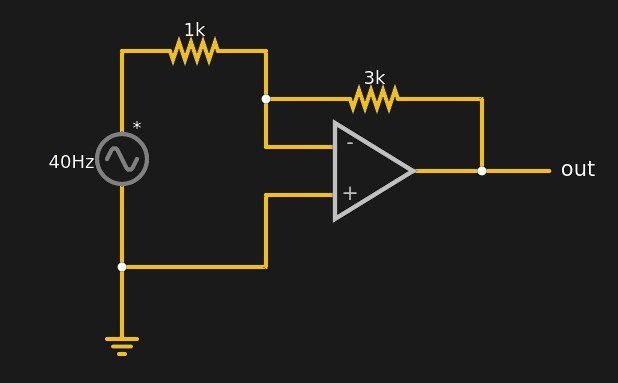
In the last Circuit VR we looked at some basic op amp circuits in a simulator, including the non-inverting amplifier. Sometimes you want an amplifier that inverts the signal. That is a 5V input results in a -5V output (or -10V if the amplifier has a gain of 2). This corresponds to a 180 degree phase shift which can be useful in amplifiers, filters, and other circuits. Let’s take a look at an example circuit simulated with falstad.

Remember the Rules

Last time I mentioned two made up rules that are good shortcuts for analyzing op amp circuits:

  1. The inputs of the op amp don’t connect to anything internally.
  2. The output mysteriously will do what it can to make the inputs equal, as far as it is physically possible.

As a corollary to the second rule, you can easily analyze the circuit shown here by thinking of the negative (inverting) terminal as a virtual ground. It isn’t connected to ground, yet in a properly configured op amp circuit it might as well be at ground potential. Why? Because the + terminal is grounded and rule #2 says the op amp will change conditions to make sure the two terminals are the same. Since it can’t influence the + terminal, it will drive the voltage through the resistor network to ensure the – terminal is at 0V.

Continue reading “Circuit VR: Even More Op Amps”

Programmable Filament For Multicolor Printing

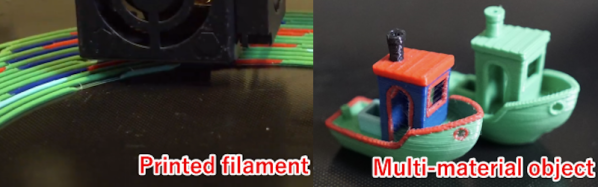
A recent research paper shows a way to create multicolor 3D prints using a single extruder if you are too lazy to babysit the machine and switch filament. The concept: print your own “programmable” filament that has the right colors in the right place. This is the same idea as manually splicing filament but presumably is more efficient since the process works with one color at a time and doesn’t repeat. In other words, to print the 64 squares of a chessboard you’d swap filament at least 64 times on each layer. Using programmable filament, you’d load one spool, print half of the filament, load another spool, print the other half, and then finally load the newly created filament and print the chessboard. Notice that the first two operations aren’t printing the chessboard. They are printing the spool of filament you feed through on the third pass.

There are machines made to do this, of course, although they generally just splice lengths of filament together for you automatically. Using one filament solves the problems of keeping multiple heads in alignment as well as the added cost and complexity. However, you now have different problems such as the transition between materials and knowing exactly how much material will be at each point in the print.

Continue reading “Programmable Filament For Multicolor Printing”

3D Printing Air Filter System Does A Lot

We know we aren’t supposed to eat a lot of sugar, but we still have ice cream. We also know we probably shouldn’t be inhaling solder smoke and 3D printer fumes, but we do that too. Not [Mike Buss]. His 3D printer has a major exhaust system.

We can sympathize with his process. He mentions he started out just wanting a fan running with some filters. Then he decided to add a way to turn the fan on and off when printing. Then he added sensors to detect fumes and fire. Data collection was almost an afterhthought.

Continue reading “3D Printing Air Filter System Does A Lot”

Is Your Echo Flex Listening?

We are always surprised that Amazon or Google doesn’t employ Kelsey Grammer — TV’s Frasier — as a spokesman for their smart home devices. After all, his catchphrase was, “I’m listening…” Maybe they don’t want to remind you that the device could, theoretically, be sending everything you say to them or a nefarious hacker or government agency. Sure, there’s a mute button and it lights up a red LED.

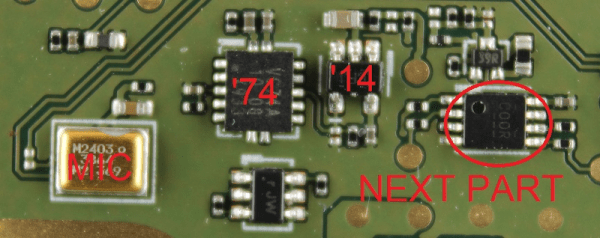
But if you are truly paranoid, that’s not enough. After all, the same people want to eavesdrop on you would be happy to fake a red light. [Electronupdate] had the same thought and decided to answer the question: does the mute button really mute your microphone? The answer required not only some case opening and analysis, but there was even some IC decapsulation.

We were impressed with the depth of the analysis. The tiny SMD parts are marked confusingly, and if you are really paranoid you don’t believe them anyway. But looking at the actual circuit die is pretty unambiguous. The  parts in question turned out to be a Schmitt trigger, a flip flop, and a NAND gate.

Continue reading “Is Your Echo Flex Listening?”

It Isn’t Rocket Science — Wait, Maybe It Is

We don’t know why, but for some reason, the more dangerous something is, the more hacker appeal it seems to have. We like to deal with high temperatures, high voltages, dangerous chemicals, and powerful lasers. So [Tech Ingredient’s] recent video about homemade rocket motors certainly caught our attention. You may need a little commitment, though. The first video (yes, there isn’t just one) is over an hour long.

Turns out, [Tech] doesn’t actually want to use the rockets for propulsion. He needed a source of highly-ionized high-velocity plasma to try to get more power from his magnetohydrodynamic project. Whatever you want to use it for, these are serious-sized motors. [Tech] claims that his design is both powerful and easy to build. He also has a “secret” rocket fuel that he shares. What is it? We won’t spoil the video for you, but it is a sweet surprise.

Continue reading “It Isn’t Rocket Science — Wait, Maybe It Is”

3D Printing In Five Axes Makes The World Flat

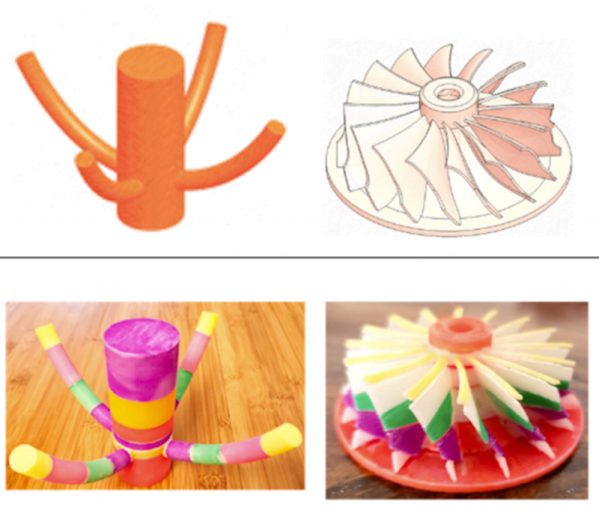
Just when you thought your 3D printer was hot stuff, along comes a 5D printer. Two doctoral students at Penn State want to add two more axes to get rid of overhangs. This means that instead of supports or breaking objects into pieces, the printer simply orients the print so each region of the part is printing as if it were flat. Of course, 5D printers aren’t really new, even though you don’t hear much about them. However, the paper details a new algorithm that eliminates manually defining print regions and rotations.

You do this all the time manually when you’re setting the print up. For example, if you want to print a letter T, you could print it with supports under the cross pieces or flip it upside down and print it with no support at all. The difference here is the printer can flip the workpiece itself to different angles and can change it on the fly during printing. The printer might print the shaft of the T, rotate it to draw half of the crossbar, then rotate it 180 degrees to print the other half. In all three zones, the print head is depositing materials flat with no overhang. In a simple case like a T that doesn’t really require a special machine or an algorithm, but in the general case, you often can’t just rotate a model to avoid using supports.

Continue reading “3D Printing In Five Axes Makes The World Flat”