Wipe Your Nozzle To Avoid Stringing

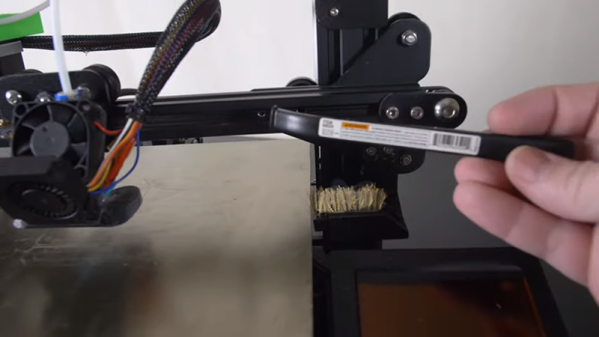
[Design Prototype Test] likes his Ender 3 printer. There was only one problem. When printing PETG — which is notorious for stringing — the hot end would pick up material and eventually ruin the print. The answer was to mount a cheap Harbor Freight brush somewhere and make the head pass over it after each layer. You can see the video of the design, below.

It sounds as though it worked well and after explaining the concept, he dives into the details of how he designed the fixture and how he mounted it. There’s a lot of good information in there about his particular toolchain and workflow.

Continue reading “Wipe Your Nozzle To Avoid Stringing”

AI Phone App Learns Baseball Signals

Watching a sport can be a bit odd if you aren’t familiar with it. Most Americans, for example, would think a cricket match looked funny because they don’t know the rules. If you were not familiar with baseball, you might wonder why one of the coaches was waving his hands around, touching his nose, his ears, and his hat seemingly at random. Those in the know however understand that this is a secret signal to the player. The coach might be telling the player to steal a base or bunt. The other team tries to decode the signals, but if you don’t know the code that is notoriously difficult. Unless you have the machine learning phone app you can see in the video below.

If you are not a baseball fan, it works like this. The coach will do a number of things. Perhaps touch his cap, then his nose, brush his left forearm, and touch his lips. However, the code is often as simple as knowing one attention signal and one action signal. For example, the coach might tell you that if they touch their nose and then their lips, you should steal. Touching their nose and then their ear is a bunt. Touching their nose and then the bill of their cap is something else. Anything they do that doesn’t start with touching their nose means nothing at all. If the signal is this easy, you really don’t even need machine learning to decode it. But if it were more complicated — say, the gesture that occurs third after they touch their nose unless they also kick dirt at which point it means nothing — it would be much harder for a human to figure out.

Continue reading “AI Phone App Learns Baseball Signals”

Hacking Surgery: Suspended Animation May Be Here

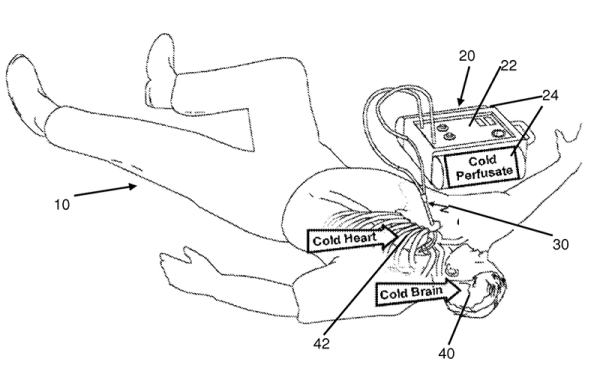
Suspended animation is a staple of science fiction. Need to take a 200 year trip to another star system? Go to sleep in some sort of high-tech coccoon and wake up at your destination. We saw it in Star Trek, 2001, and many other places. Doctors at the University of Maryland have reprtedly put at least one patient in suspended animation, and it isn’t to send them to outer space. The paper (behind a paywall, of course) is available if you have the medical background to wade through it. There’s also a patent that describes the procedure.

Trauma surgeons are frustrated because they often see patients who have been in an accident or have been shot or stabbed that they could save if they only had the time. A patient arriving at an ER with over half their blood lost and their heart stopped have a less than 5% chance of leaving the ER without a toe tag. By placing the patient in suspended animation, doctors can gain up to two hours to work on injuries that previously had to be repaired in mere minutes.

Continue reading “Hacking Surgery: Suspended Animation May Be Here”

University Makes Bulletproof 3D Prints

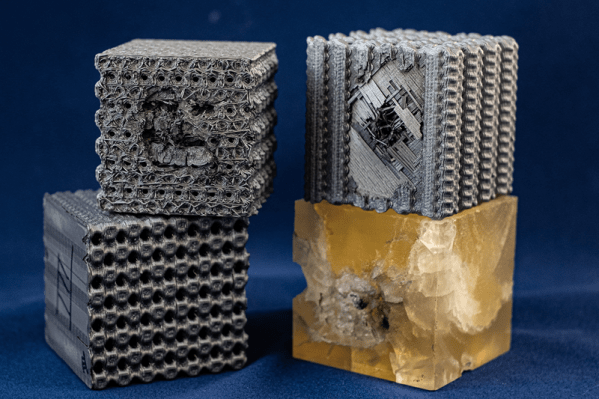
Researchers at Rice University are studying 3D printing plastic structures that mimic tubulanes — theoretical nanotube structures predicted to have extraordinary strength. The result has been very strong and very compressible structures that can actually resist bullets.

As an experiment, the researchers fired projectiles at 5.8 km/s at a block of plastic and at a block of simulated tubulanes. The structure of the tubulane block stopped the bullet at the second layer with no significant structural damage beyond the second layer. The reference block had a large hole and cracks throughout its volume.

Continue reading “University Makes Bulletproof 3D Prints”

Texas Tesla Tower Titillates

One of the nice things about a road trip is you often get to see something that really surprises you. A recent trip through Texas may have resulted in my second most surprising sighting. There’s a strange tower that looks oddly like a Tesla tower in the middle of rural Texas, right off the main interstate. What is it? Although Google did answer the question — sort of — I’m still not sure how legitimate its stated purpose is.

First Sighting

I was driving between Wimberly and Frisco — two towns that aren’t exactly household names outside of Texas. Near Milford, there’s a very tall structure that looks like a giant mechanical mushroom on top of a grain silo. If the mushroom were inverted or pointing towards the horizon, it would be easy to imagine it was some very odd antenna. This dish, however, is pointed right down its own odd-shaped mast. The top of the thing sure looks like the top of a Van de Graf generator.

Continue reading “Texas Tesla Tower Titillates”

Bamboo Skewers Launch Airship

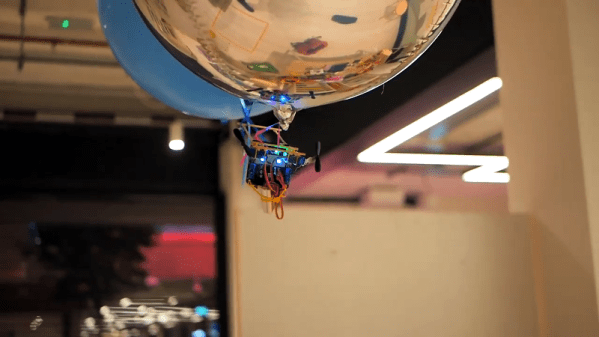
We have to admit, we like airships. There’s something about the image of a stately zeppelin floating over Manhattan that just makes us imagine the future. There are not many airships anymore, but you can always build your own. [Crafty Robot] shows how to use one of their boards to make a simple and easy controlled balloon. Honestly, they don’t give you many details, but we know how to turn motors and servos. We loved their construction with hot glue and bamboo. Effective, and fun to say.

The bamboo skewers are easy to find and make a lightweight frame. Some drone motors provide thrust and some simple RC servos control the angle of the props. Nice and simple.

Continue reading “Bamboo Skewers Launch Airship”

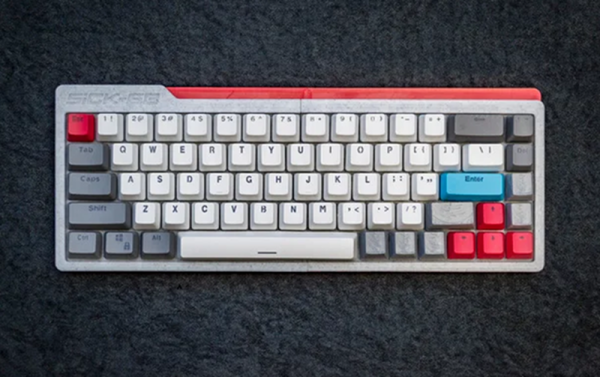
SiCK Mechanical Keyboard Is 3D Printed

We’ve noticed a rash of builds of [ FedorSosnin’s] do-it-yourself 3D-printed mechanical keyboard, SiCK-68 lately. The cost is pretty low — SiCK stands for Super, Inexpensive, Cheap, Keyboard. According to the bill of materials, the original cost about $50. Of course, that doesn’t include the cost of the 3D printer and soldering gear, but who doesn’t have all that already?

The brains behind this is a Teensy that scans the hand-wired key matrix. So the only electronics here are the switches, each with a companion diode, and the Teensy. The EasyAVR software does all the logical work both as firmware and a configuration GUI.

If you look at the many different builds, each has its own character. Yet they look overwhelmingly professional — like something you might buy at a store. This is the kind of project that would have been extremely difficult to pull off a decade ago. You could build the keyboard, of course, but making it look like a finished product was beyond most of us unless we were willing to make enough copies to justify having special tooling made to mold the cases.

PCBs are cheap now and we might be tempted to use one here. There are quite a few methods for using a 3D printer to create a board, so that would be another option. The hand wiring seems like it would be a drag, although manageable. If you need wiring inspiration, we can help.

For ultimate geek cred, combine this with Ploopy.