Bouncing Signals Off The Moon

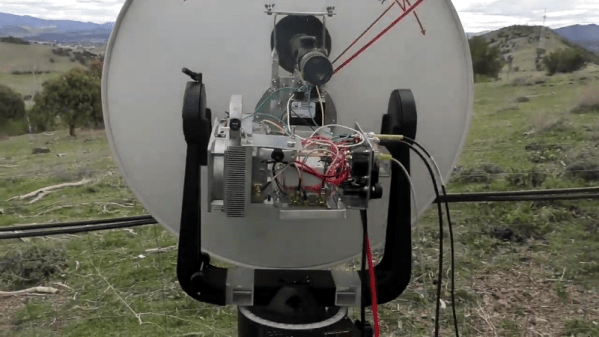
One of the great things about ham radio is that isn’t just one hobby. Some people like to chit chat, some like to work foreign countries, some prepare for emergencies, and there are several space-related activities. There are hundreds of different kinds of activities to choose from. Just one is moonbounce, and [Ham Radio DX] decided to replicate a feat many hams have done over the years: communicate with someone far away by bouncing signals from the moon.

The set up is pretty sophisticated but not as bad as you might imagine. You can see that they spend a lot of time getting the equipment aligned. A known reference point helps them set the position of the antenna. A GPS keeps both stations in sync for frequency and time.

Continue reading “Bouncing Signals Off The Moon”

Compiler Explorer, Explored

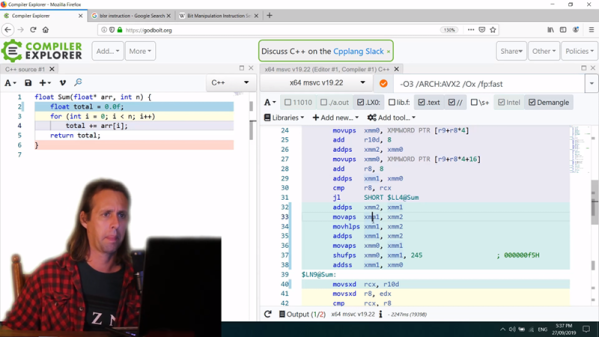
It wasn’t long ago that we introduced you to a web site, the Godbolt compiler explorer, that allows the visitor to compile code using a slew of compilers and compare their output. We suspect some number of readers said, “Wow! I can use that!”, while perhaps everyone else said, “Huh?” Well if you were in the second group, you ought to watch [What’s a Creel’s] video below where he walks through using the website. He looks at four different algorithms using four different compilers and it is a good example of how you might use the tool to make decisions about how you write software.

Continue reading “Compiler Explorer, Explored”

Take A Break From Arduinos, And Build A Radio Transmitter

When you start watching [learnelectronic’s] two-part series about making a radio transmitter, you might not agree with some of his history lessons. After all, the origin of radio is a pretty controversial topic. Luckily, you don’t need to know who invented radio to enjoy it.

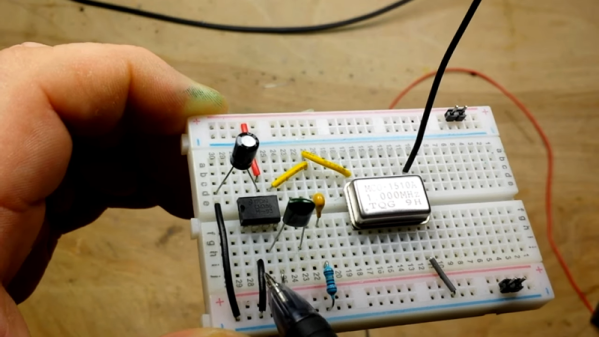
The first transmitter uses a canned oscillator, to which it applies AM modulation. Of course, those oscillators are usually not optimized for that service, but it sort of works. In part two he reduces the frequency to 1 MHz at which point it can be listened to on a standard AM radio, before adding an amplifier so any audio source can modulate the oscillator. There’s a lot of noise, but the audio is clearly there.

This is far from practical of course, but combined with a crystal radio it could make an awesome weekend project for a kid you want to hook on electronics. The idea that a few simple parts could send and receive audio is a pretty powerful thing. If you get ready to graduate to a better design, we have our collection.

Continue reading “Take A Break From Arduinos, And Build A Radio Transmitter”

Chinese Radio Telescope Hopes To Find Exoplanets FAST

People who enjoy radio are constantly struggling to find a place to erect a bigger and better antenna. Of course it’s a different story and the most hardcore end of the spectrum: radio astronomers. The Chinese are ready to open up a new radio telescope called FAST (Five-hundred-meter Aperture Spherical Radio Telescope). As the name implies, it is 500 meters in diameter which is about 1,600 feet — that five and a half American football fields or about four and half of the other kind of football field.

The new telescope will be the largest single-dish observatory in the world and will offer about twice the area of the next-largest single-dish instrument at Arecibo. The project is in a very remote location, presumably to reduce the level of local radio interference — it’s hard to find radio quiet zones in heavily populated areas.

Scientists hope the huge antenna will help solve the mystery of fast radio bursts and may even study exoplanets. In fact, earlier this year, the instrument detected hundreds of fast radio bursts from a source, many of which were too faint to be heard by lesser antennas. There are also plans to examine pulsars in an attempt to discover ripples in space-time. The location in the Dawodang depression of the Guizhou province uses about 4,400 panels and 2,000 mechanical winches to focus radio energy.

Other telescopes that use multiple dishes have more resolution and, in fact, FAST adds 3 dozen 5 meter commercial dishes to get an increase in resolution of 100 times. Of course, you could build your own, although to get up to 500 meters might be a stretch. If your backyard isn’t that big, you can build a tiny radio telescope too.

Darwin Approves: Berkeley Evolves Analog Design

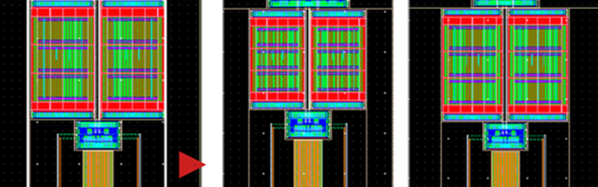
Digital design is hard. But in the right environment, digital circuits are more forgiving than analog. That 3.3V signal coming out of the chip has to drop a lot along the way to not be a logic level at the destination. If you are trying to push the boundary then digital design has much of analog design, but mostly you get a bit of a pass on many things that plague analog designers. Berkeley’s AI research group has been experimenting with using deep learning to evolve analog IC design.

Analog ICs are plagued with noise sources and often don’t have the margins that digital circuit designers enjoy. According to the post by [Kourosh Hakhamaneshi], designers often build a few blocks and attempt to lay them out in a way that should work and meet other requirements. Then they employ simulation, make changes as required, and simulate again. Accurate simulations can be very time intensive. You can read the actual paper, too, should you want to dig into the details.

Continue reading “Darwin Approves: Berkeley Evolves Analog Design”

Review: OSEPP STEM Kit 1, A Beginner’s All-in-One Board Found In The Discount Aisle

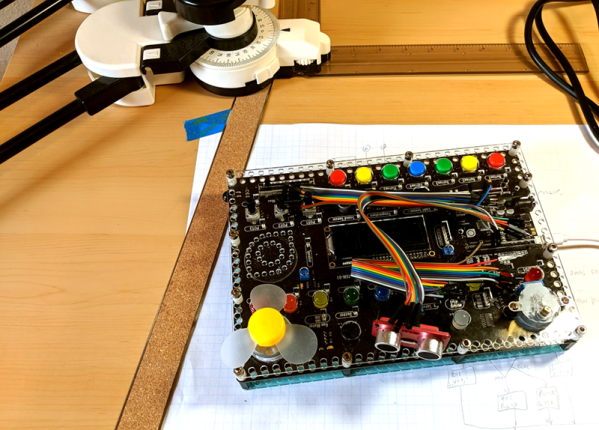
As the name implies, the OSEP STEM board is an embedded project board primarily aimed at education. You use jumper wires to connect components and a visual block coding language to make it go.

I have fond memories of kits from companies like Radio Shack that had dozens of parts on a board, with spring terminals to connect them with jumper wires. Advertised with clickbait titles like “200 in 1”, you’d get a book showing how to wire the parts to make a radio, or an alarm, or a light blinker, or whatever.

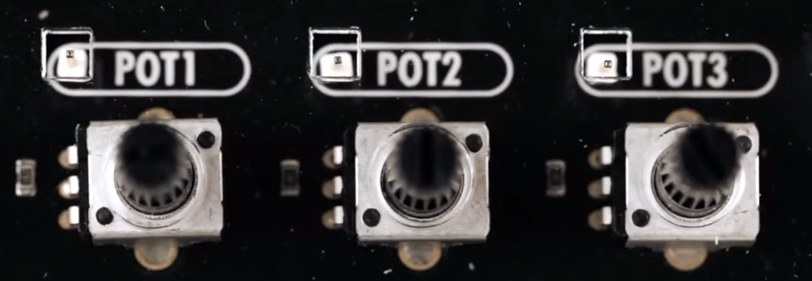
The STEM Kit 1 is sort of a modern arduino-powered version of these kits. The board hosts a stand-alone Arduino UNO clone (included with the kit) and also has a host of things you might want to hook to it. Things like the speakers and stepper motors have drivers on board so you can easily drive them from the arduino. You get a bunch of jumper wires to make the connections, too. Most things that need to be connected to something permanently (like ground) are prewired on the PCB. The other connections use a single pin. You can see this arrangement with the three rotary pots which have a single pin next to the label (“POT1”, etc.).
I’m a sucker for a sale, so when I saw a local store had OSEPP’s STEM board for about $30, I had to pick one up. The suggested price for these boards is $150, but most of the time I see them listed for about $100. At the deeply discounted price I couldn’t resist checking it out.

So does an embedded many-in-one project kit like this one live up to that legacy? I spent some time with the board. Bottom line, if you can find a deal on the price I think it’s worth it. At full price, perhaps not. Join me after the break as I walk through what the OSEPP has to offer.

Continue reading “Review: OSEPP STEM Kit 1, A Beginner’s All-in-One Board Found In The Discount Aisle”

Who Could Possibly Need An FPGA With 9M Logic Cells And 35B Transistors?

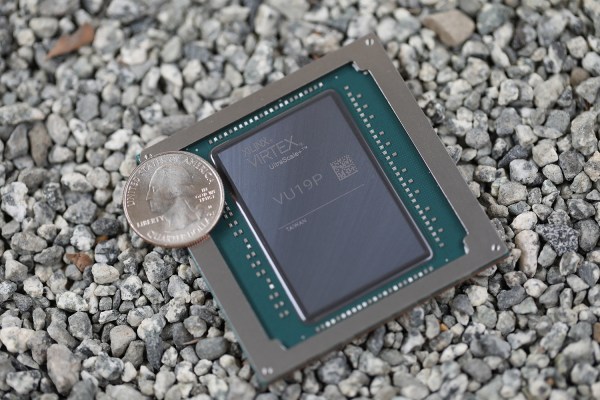
Xilinx recently announced the Virtex UltraScale+ VU19P FPGA. Of course, FPGA companies announce new chips every day. The reason this one caught our attention is the size of it: nearly 9 million logic cells and 35 billion transistors on a chip! If that’s not enough there is also over 2,000 user I/Os including transceivers that can move around 4.5 Tb/s back and forth.

To put things in perspective, the previous record holder — the Virtex Ultrascale 440 — has 5.5 million logic cells and an old-fashioned Spartan 3 topped out at about 50,000 cells — the new chip has about 180 times that capacity. For the record, I’ve built entire 32-bit CPUs on smaller Spartans.

That led us to wonder? Who’s buying these things? When I first heard about it I guessed that the price would be astronomical, partly due to expense but also partly because the market for these has to be pretty small. The previous biggest Xilinx part is listed on DigKey who pegs the Ultrascale 440 (an XCVU440-2FLGA2892E) at a cost of $55,000 as a non-stocked item. Remember, that chip has just over half the logic cells of the VU19P.

Continue reading “Who Could Possibly Need An FPGA With 9M Logic Cells And 35B Transistors?”