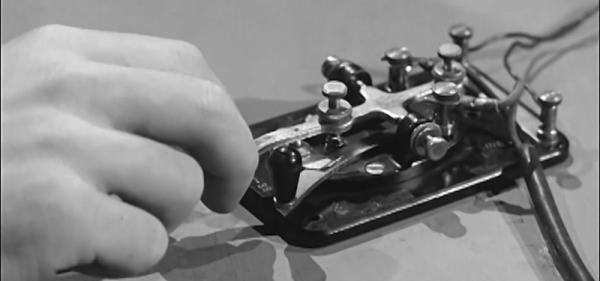
Morse Code Keyboard 1939 Style!

If you want to learn Morse code and you don’t have a teacher, you’d probably just head over to a website or download a phone app. Before that, you probably bought a cassette tape or a phonograph record. But how did you learn Morse if you didn’t have any of that and didn’t know anyone who could send you practice? Sure, you could listen to the radio, but in 1939 that might be difficult, especially to find people sending slow enough for you to copy.

Wireless World for August 3rd, 1939, has the answer in an article by [A. R. Knipe] on page 109. While you probably wouldn’t use it today, it is a great example of how ingenious you can be when you don’t have an Arduino and all the other accoutrements we take for granted today.

Continue reading “Morse Code Keyboard 1939 Style!”

Arduino Fights Fire With… Water?

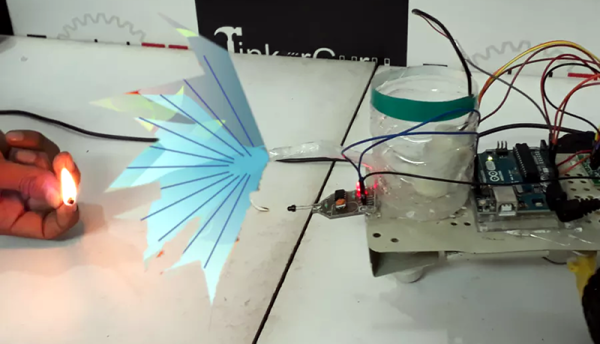
We don’t think we’d want to trust our fire safety to a robot carrying a few ounces of water, but as a demonstration or science project, [Tinker Guru’s] firefighting robot was an entertaining answer to the question: “What do I do with that flame sensor that came in the big box of Arduino sensors I bought from China?” You can see a video of the device below.

You can see, it is a pretty standard two-wheel robot with the drive wheels to the rear and a skid plate up front. There are a flame sensor and a water pump up forward, as well. You can probably guess, the device notices a flame and rushes to squirt water on it.

Continue reading “Arduino Fights Fire With… Water?”

All About Ham Satellites

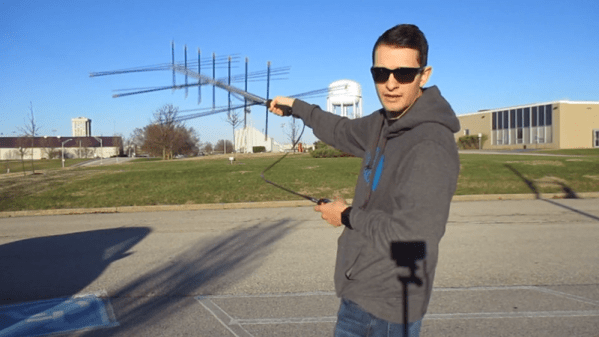
How hard is it to build a ground station to communicate with people via a satellite? Probably not as hard as you think. [Modern Ham] has a new video that shows just how easy it can be. It turns out that a cheap Chinese radio is all you need on the radio side. You do, however, benefit from having a bit of an antenna.

It isn’t unusual for people interested in technology to also be interested in space. So it isn’t surprising that many ham radio operators have tied space into the hobby. Some do radio astronomy, others bounce signals off the moon or meteors. Still others have launched satellites, though perhaps that’s not totally accurate since as far as we know all ham radio satellites have hitched rides on commercial rockets rather than being launched by hams themselves. Still, designing and operating a ham radio station in space is no small feat, but it has been done many times with each generation of satellite becoming more and more sophisticated.

Continue reading “All About Ham Satellites”

Software: It Is All In The Details

Who’s the better programmer? The guy that knows 10 different languages, or someone who knows just one? It depends. Programming is akin to math, or perhaps it is that we treat some topics differently than others which leads to misconceptions about what makes a good programmer, mathematician, or engineer. We submit that to be a great programmer is less about the languages you know and more about the algorithms and data structures you understand. If you know how to solve the problem, mapping it to a particular computer language should be almost an afterthought. While there are many places that you can learn those things, there is a lot more focus on how to write the languages,  C++ or Java or Python or whatever. We were excited, then, to see [Jeff Erickson] is publishing his algorithms book distilled from teaching at the University of Illinois, Urbana-Champaign for a number of years. The best part? You can read the preprint version online now and it will remain online even after the book goes to print.

When you were in school, you probably learned math in two ways: there was the mechanics (4×4=16) and then there were the word problems (Johnny has 10 candy bars and eats 4, how many are left?). Word problems are usually the bane of the student’s existence, yet they are much more realistic. Your boss has (probably) never come in your office and asked you what 147 divided by 12 is. If she did, you could hand her a calculator. The real value comes in being able to synthesize the right math for the right problem and — if you are lucky — gaining intuition about it (doubling the price will only increase profit by 10%). Software is pretty much the same, for example no one rushes into your cubicle and says “Quick! We need a for loop written!” You get a hazy set of requirements if you are lucky, and you then need to map that into something that computers can do. For that reason, we’ve always been more of a fan of learning about algorithms and data structures rather than specific language features.

Continue reading “Software: It Is All In The Details”

Green Hacking: Overclocking Photosynthesis

We think of hacking as bending technology to our will. But some systems are biological,  and we’re also starting to see more hacking in that area. This should excite science fiction fans used to with reading about cultures that work with biological tech, so maybe we’ll get there in the real world too.  Hacking farm crops and animals goes back centuries, although we are definitely getting better at it. A case in point: scientists have found a way to make photosynthesis better and this should lead to more productive crops.

We learned in school that plants use carbon dioxide and sunlight to create energy and produce oxygen. But no one explained to us exactly how that happened. It seems a protein called rubisco is what causes this to happen, but unfortunately it isn’t very picky. In addition to converting carbon (from carbon dioxide) into sugar, it also converts oxygen into toxic compounds called ROS (reactive oxygen species) that most plants then have to spend energy eliminating. Scientists estimate that if you could recover the calories lost in this process, you could feed an additional 200 million people worldwide at current production levels.

Continue reading “Green Hacking: Overclocking Photosynthesis”

Return Of The Logic Probe

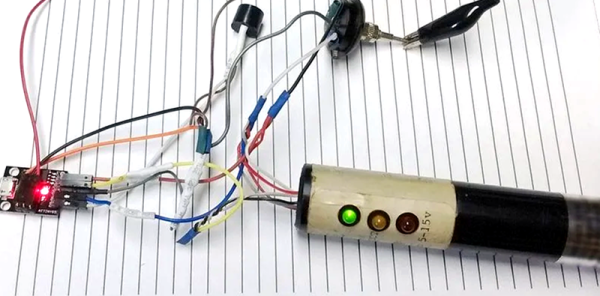
We live in a day when it is very inexpensive to buy an oscilloscope, especially one with modest performance that hooks to a laptop. However, there was a time when even a surplus scope was out of reach for many people who liked to build things. A common alternative was the logic probe. At the low end, this could be an inverter and an LED, although it was more common to have a little extra circuitry to actually do a comparison to a reference voltage and present some indication of fast pulses — you might not be able to tell the frequency of a clock, but you could tell it wasn’t stuck. Of course, today with a microcontroller you can make a very sophisticated probe with less circuitry than a classic probe. We’ve seen a few takes on this and the latest is the DigiLogicProbe from [TheRadMan].

The probe is just a ATtiny85 board with a handful of components. A resistor and diode help protect the probe and the circuit under test. There are also a few LEDs and a buzzer. The rest of the project is software.

Continue reading “Return Of The Logic Probe”

Superheterodyne Radios Explained

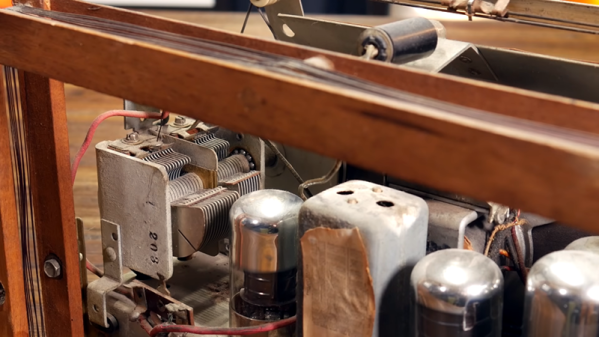
The general public thinks there is one thing called a radio. Sure, they know there are radios that pick up different channels, but other than that, one radio is pretty much like the other. But if you are involved in electronics, you probably know there are lots of ways a radio can work internally. A crystal set is very different from an FM stereo, and that’s different still from a communications receiver. We’d say there are several common architectures for receivers and one of the most common is the superheterodyne. But what does that mean exactly? [Technology Connection] has a casual explanation video that discusses how a superhet works and why it is important. You can see the video, below.

Engineering has always been about building on abstractions. This is especially true now when you can get an IC or module that does most of what you want it to do. But even without those, you would hardly start an electronics project by mining copper wire, refining it, and drawing your own wire. You probably don’t make many of your own resistors and capacitors, neither do you start your design at the fundamental electronic equations. But there’s one abstraction we often forget about: architecture. If you are designing a receiver, you probably don’t try to solve the problem of radio reception; instead you pick an architecture that is proven and design to that.

Continue reading “Superheterodyne Radios Explained”