If you want to explore machine learning, you can now write applications that train and deploy TensorFlow in your browser using JavaScript. We know what you are thinking. That has to be slow. Surprisingly, it isn’t, since the libraries use Graphics Processing Unit (GPU) acceleration. Of course, that assumes your browser can use your GPU. There are several demos available, include one where you train a Pac Man game to respond to gestures in your webcam to control the game. If you try it and then disable accelerated graphics in your browser options, you’ll see just what a speed up you can gain from the GPU.

Author: Al Williams4504 Articles
PID Control With Arduino
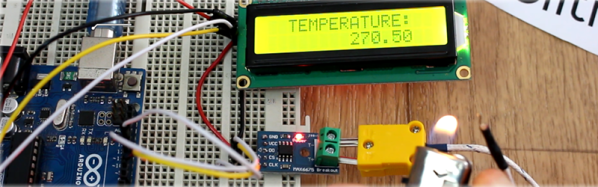
Experience — or at least education — often makes a big difference to having a successful project. For example, if you didn’t think about it much, you might think it is simple to control the temperature of something that is heating. Just turn on the heater if it is cold and turn it off when you hit the right temperature, right? That is one approach — sometimes known as bang-bang — but you’ll find there a lot of issues with that approach. Best practice is to use a PID or Proportional/Integral/Derivative control. [Electronoob] has a good tutorial about how to pull this off with an Arduino. You can also see a video, below.
The demo uses a 3D printer hot end, a thermocouple, a MAX6675 that reads the thermocouple, and an Arduino. There’s also an LCD display and a FET to control the heater.
Another Reason To Learn Morse Code: Kidnapping
Morse code — that series of dots and dashes — can be useful in the strangest situations. As a kid I remember an original Star Trek episode where an injured [Christopher Pike] could only blink a light once for yes and twice for no. Even as a kid, I remember thinking, “Too bad they didn’t think to teach him Morse code.” Of course odd uses of Morse aren’t just for TV and Movies. Perhaps the strangest real-life use was the case of the Colombian government hiding code in pop music to send messages to hostages.
In 2010, [Jose Espejo] was close to retirement from the Colombian army. But he was bothered by the fact that some of his comrades were hostages of FARC (the Revolutionary Armed Forces of Colombia; the anti-government guerrillas), some for as many as ten years. There was a massive effort to free hostages underway, and they wanted them to know both to boost morale and so they’d be ready to escape. But how do you send a message to people in captivity without alerting their captors?
Continue reading “Another Reason To Learn Morse Code: Kidnapping”
AlterEgo Listens To Your Internal Voice
Recent news reports have claimed that an MIT headset can read your mind, but as it turns out that’s a little bit of fake news. There is a headset — called AlterEgo — but it doesn’t actually read your mind. Rather, it measures subtle cues of you silently vocalizing words. We aren’t sure exactly how that works, but the FAQ claims it is similar to how you experience reading as a child.
If you read much science fiction, you probably recognize this as subvocalization, which has been under study by the Army and NASA. However, from what we know, the positioning of sensor electrodes is crucial and can vary not only by speaker, but also change for the same speaker. Perhaps the MIT device has found a way around that problem. You can see a video of the system, below.
Zephyr Adds Features, Platforms, And Windows
Zephyr is an open source real-time operating system (RTOS) that appeared on the scene a few years ago with support for a few boards. The new 1.11 release adds a lot of features, a lot of new boards, and also has a Windows development environment. But don’t worry, the environment is portable so it still runs on Linux and Mac, as well.
The OS has support for many ARM and x86 boards. It also supports ESP32, NIOS II, and can also target Linux which is useful for debugging or studying execution using desktop tools.
Continue reading “Zephyr Adds Features, Platforms, And Windows”
Need A Thousand Extra PWM Pins?
If your Arduino runs out of I/O lines, you can always add one of the several I/O expander chips that takes a serial interface to set its several pins. Or perhaps you could buy something like an Arduino Mega, with its extra sockets to fulfil your needs. But what would you do if you really needed more pins, say a thousand of them? Perhaps [Brian Lough] has the answer. OK, full disclosure: If you really need a thousand, the video isn’t exactly for you, as he shows you how to add up to 992 PWM outputs. The chip he uses works with any microcontroller (the video shows an ESP8266), and we suppose you could use two daisy chains of them and break the 1,000 barrier handily.
We like how short the video is (just two minutes; see below) as it gets right to the point. The PCA9685 chip gives you 16 12-bit PWM channels via an I2C interface. You can daisy chain up to 62 of the boards to get the 992 outputs promised.
Simple Quantum Computing In 150 Lines Of Python
What does it take to build a quantum computer? Lots of exotic supercooled hardware. However, creating a simulator isn’t nearly as hard and can give you a lot of insight into how this kind of computing works. A simulator doesn’t even have to be complicated. Here’s one that exists in about 150 lines of Python code.
You might wonder what the value is. After all, there are plenty of well-done simulators including Quirk that we have looked at in the past. What’s charming about this simulator is that with only 150 lines of code, you can reasonably read the whole thing in a sitting and gain an understanding of how the different operations really affect the state.
Continue reading “Simple Quantum Computing In 150 Lines Of Python”