The Forgotten Workstation: Sun JavaStation

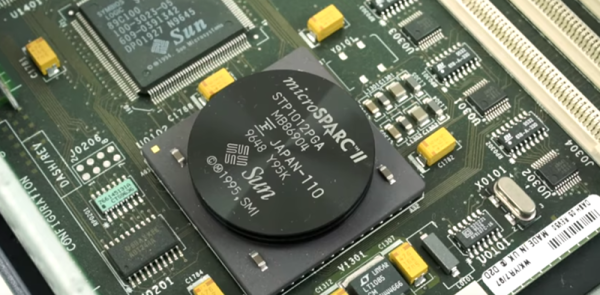
These days, conversations about Java tend to center around Oracle and Google fighting it out in court. But back in 1996, Sun was the keeper of Java and promoted it heavily. They even released a diskless workstation that only runs Java applets. The Sun JavaStation was affectionately called the “Mr. Coffee” and [Cameron Gray] wants to show you how it worked and what’s inside of it.

A single screw frees the innards from the small case. Inside looks like a dense PC from the era, although the parts inside are a far cry from a typical PC. The CPU was a 110 MHz microSPARC II soldered directly to the motherboard. The four RAM slots could take up to 64 megabytes of PC RAM.

Continue reading “The Forgotten Workstation: Sun JavaStation”
Who Made The First Human Audio Recordings? Edison? Not So Fast!

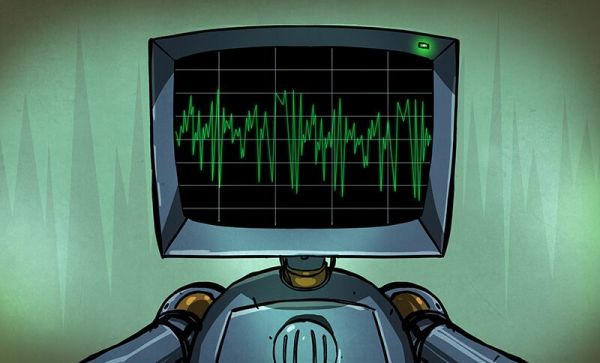
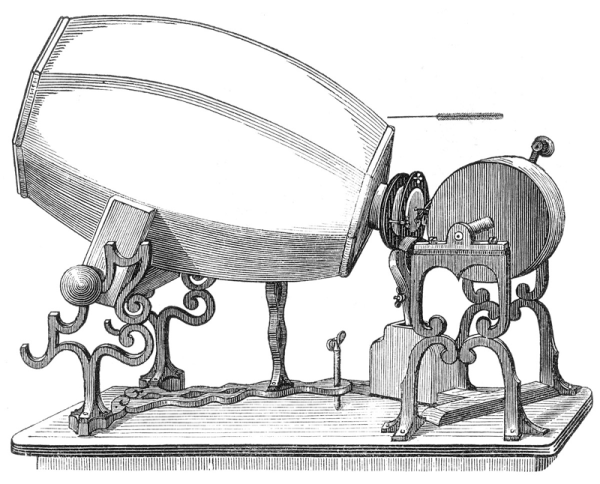
You probably learned in school that Thomas Edison was the first human voice recorded, reciting Mary Had a Little Lamb. As it turns out though, that’s not strictly true. Edison might have been the first person to play his voice back, but he wasn’t the first to deliberately record. That honor goes to a French inventor named Édouard-Léon Scott de Martinville. He wanted to study sound and created the phonautograph — a device which visualized sound on soot-covered paper. They were not made to be played back, but the information is there. These recordings were made around 1860. There’s a 9-part video series about how the recordings were made — and more interestingly — how they were played back using modern technology. Part 1 appears below.

We say around 1860 because there were some early recordings starting around 1857 that haven’t been recovered. Eventually, the recordings would have a tuning fork sound which allows modern playback since the known signal can estimate the speed of the hand-cranked cylinder. The date of the first recovered recording was today, April 9th, 158 years ago.

Continue reading “Who Made The First Human Audio Recordings? Edison? Not So Fast!”

Tiny Neural Network Library In 200 Lines Of Code

Neural networks have gone mainstream with a lot of heavy-duty — and heavy-weight — tools and libraries. What if you want to fit a network into a little computer? There’s tinn — the tiny neural network. If you can compile 200 lines of standard C code with a C or C++ compiler, you are in business. There are no dependencies on other code.

On the other hand, there’s not much documentation, either. However, between the header file and two examples, you should be able to figure it out. After all, it isn’t much code. The example in the repository directs you to download a handwriting number recognition dataset from the Internet. Once it trains that data, it shows you the expected output from the first item in the data set and then processes the first item and shows you the result.

Continue reading “Tiny Neural Network Library In 200 Lines Of Code”

Circuit VR: The Dickson Charge Pump

There was a time when taking a low DC voltage — say a single battery — and converting it to a higher voltage was painful. Now, however, cheap and easy-to-use DC to DC converters are readily available. For some small tasks, though, these can seem like overkill. For example, consider a case where you need to supply a higher voltage for a MOSFET gate that doesn’t draw much current. Perhaps you need that higher voltage to trigger a microcontroller’s programming mode and nothing else. The current draw is minimal, and a full-blown DC to DC converter is overkill. For cases like that, it is tempting to use some voltage multiplication scheme. There are many, but for this post, I’m going to take you inside a Dickson charge pump. This is Circuit VR because not only are we going to discuss the circuit, we’ll look at an LT Spice simulation you can try yourself.

The Dickson is interesting because it doesn’t require any AC conversion or transformers. Instead, it uses diodes or other switching elements to transfer charge between capacitors in stages. Each stage will effectively increase the voltage by the supply voltage — in theory. Reality isn’t so kind, though, as we’ll see.

Continue reading “Circuit VR: The Dickson Charge Pump”

Soldering Saves Data From Waterlogged Laptop

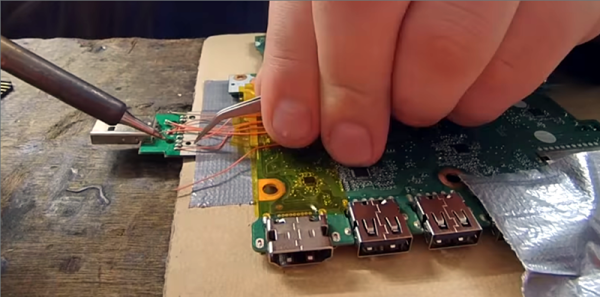
What happens when you drop your laptop in the pool? Well, yes, you buy a new laptop. But what about your data. You do have backups, right? No, of course, you don’t. But if you can solder like [TheRasteri] you could wire into the flash memory on the motherboard and read it one last time. You can see the whole exploit in the video below.

There’s really three tasks involved. First is finding the schematic and board layout for motherboard. Apparently, these aren’t usually available from the manufacturer but can be acquired in some of the seedier parts of the Internet for a small fee. Once you have the layout, you have to arrange to solder wires to the parts of the flash memory you need to access.

Continue reading “Soldering Saves Data From Waterlogged Laptop”

3D Printed Tank Tracks

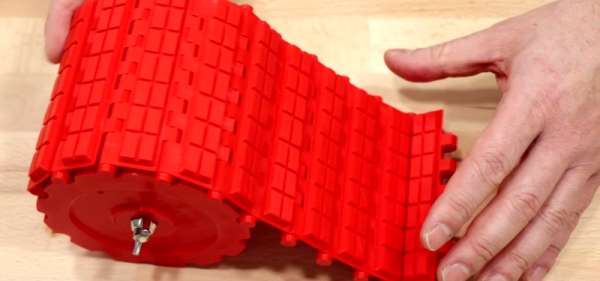
[Ivan] has been keeping his 3D printers busy with parts he’s experimenting with to build a tracked motion setup for a tank-like vehicle. His design uses several interlocking parts, so if you want to duplicate it, we hope your printer calibration is up to snuff. He’s still printing more parts and promises to release the files once the design proves out.

However, you can see he’s off to a good start. Small pieces fit together and accept a piece of filament as a sort of hinge. Some pins keep the filament from working out. Pads fit into the main parts and hold down with zip ties. The whole flexible tread locks into sprockets and a groove on a drive wheel.

Continue reading “3D Printed Tank Tracks”

Sharpening With Bluetooth

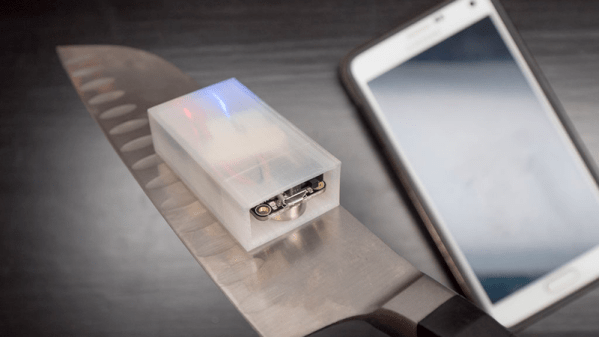
Few things are as frustrating in the kitchen as a dull knife. [Becky] and her chef friend collaborated to build a Bluetooth module to tell you when you are sharpening a knife at the optimum angle. That might sound a little specialized, but the problem boils down to one that is common enough in a lot of situations: how do you tell your exact orientation while in motion? That is, with the knife moving rapidly back and forth over the sharpening stone, how can you measure the angle of the blade reliably?

Looking for a challenge, [Becky’s] first attempt was to just use an accelerometer. It worked, but it wasn’t very precise. Her final answer turned out to be a full inertial measurement unit — the BNO055 — that combines an accelerometer, a magnetometer, and a gyroscope along with enough smarts to fuse the data into actual position data.

Continue reading “Sharpening With Bluetooth”