Linux Fu: Custom Bash Command Completion

If you aren’t a Linux user and you watch someone who knows what they are doing use Bash — the popular command line interpreter — you might get the impression they type much faster than they actually do. That’s because experienced Linux users know that pressing the tab key will tend to complete what they are typing, so you can type just a few characters and get a much longer line of text. The feature is very smart so you may not have realized it, but it knows a good bit about what you could type. For example, if you try to unzip a file, it knows the expected file name probably has a .zip extension.

How does that happen? At first, you might think, “who cares how it happens?” The problem is when you write a shell script or a program that runs on Linux, the completion gets dumb. Someone has to make Bash smart about each command line program and if you are the author then that someone is you.


Continue reading “Linux Fu: Custom Bash Command Completion”

Big Trak Gets A New Brain

If you were a kid in the 1980s you might have been lucky enough to score a Big Trak — a robotic toy you could program using a membrane keyboard to do 16 different motions. [Howard] has one, but not wanting to live with a 16-step program, he gave it a brain transplant with an Arduino and brought it on [RetroManCave’s] video blog and you can see that below.

If you want to duplicate the feat and your mom already cleaned your room to make it a craft shop, you can score one on eBay or there’s even a new replica version available, although it isn’t inexpensive. The code you need is on GitHub.

Continue reading “Big Trak Gets A New Brain”

Speech Recognition For Linux Gets A Little Closer

It has become commonplace to yell out commands to a little box and have it answer you. However, voice input for the desktop has never really gone mainstream. This is particularly slow for Linux users whose options are shockingly limited, although decent speech support is baked into recent versions of Windows and OS X Yosemite and beyond.

There are four well-known open speech recognition engines: CMU Sphinx, Julius, Kaldi, and the recent release of Mozilla’s DeepSpeech (part of their Common Voice initiative). The trick for Linux users is successfully setting them up and using them in applications. [Michael Sheldon] aims to fix that — at least for DeepSpeech. He’s created an IBus plugin that lets DeepSpeech work with nearly any X application. He’s also provided PPAs that should make it easy to install for Ubuntu or related distributions.

You can see in the video below that it works, although [Michael] admits it is just a starting point. However, the great thing about Open Source is that armed with a working set up, it should be easy for others to contribute and build on the work he’s started.

Continue reading “Speech Recognition For Linux Gets A Little Closer”

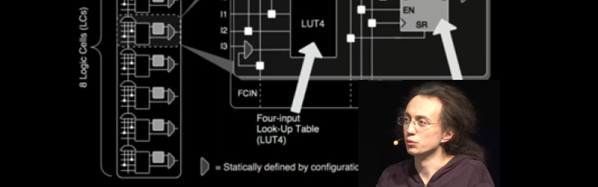
34C3: Reverse Engineering FPGAs

We once knew a guy who used to tell us that the first ten times he flew in an airplane, he jumped out of it. It was his eleventh flight before he walked off the plane. [Mathias Lasser] has a similar story. Despite being one of the pair who decoded the iCE40 bitstream format a few years ago, he admits in his 34C3 talk that he never learned how to use FPGAs. His talk covers how he reverse engineered the iCE40 and the Xilinx 7 series devices.

If you are used to FPGAs in terms of Verilog and VHDL, [Mathias] will show you a whole new view of rows, columns, and tiles. Even if you don’t ever plan to work at that level, sometimes understanding hardware at the low level will inspire some insights that are harder to get at the abstraction level.

Continue reading “34C3: Reverse Engineering FPGAs”

Custom Alexa Skill In A Few Minutes Using Glitch

As hackers, we like to think of ourselves as a logical bunch. But the truth is, we are as subject to fads as the general public. There was a time when the cool projects swapped green LEDs out for blue ones or added WiFi connectivity where nobody else had it. Now all the rage is to connect your project to a personal assistant. The problem is, this requires software. Software that lives on a publicly accessible network somewhere, and who wants to deal with that when you’re just playing with custom Alexa skills for the first time?

If you have a computer that faces the Internet, that’s fine. If you don’t, you can borrow one of Amazon’s, but then you need to understand their infrastructure which is a job all by itself. However, there is a very simple way to jump start an Alexa skill. I got one up and running in virtually no time using a website called Glitch. Glitch is a little bit of everything. It is a web hosting service, a programming IDE for Node.js, a code repository, and a few other things. The site is from the company that brought us Trello and helped to start Stack Overflow.

Glitch isn’t about making Alexa skills. It is about creating web applications and services easily. However, that’s about 90% of the work involved in making an Alexa skill. You’ll need an account on Glitch and an Amazon developer’s account. Both are free, at least for what we want to accomplish. Glitch has some templates for Google Home, as well. I have both but decided to focus on Alexa, for no particular reason.

Continue reading “Custom Alexa Skill In A Few Minutes Using Glitch”

Iro3d 3D Prints In Powdered Metal

Printing with plastic and even resin is getting fairly common. Metal printing, though, is still in the realm of the exotic. A company called Iro3D is aiming to change that with a steel printer that you can buy in beta for about $5000. That seems steep when you can get plastic printers for under $200, but it is sheer bargain basement for something that can print in real metal.

Of course, there’s a catch. The printer doesn’t create a solid metal object right away. What it does is prepares a crucible using sand and metal powder. You then place the crucible in a kiln and what comes out is the final product. You can see a video review of their prototype machine, below from [3D Printing Nerd]. The company’s promotional video that shows a part coming out of the kiln is also below.

Continue reading “Iro3d 3D Prints In Powdered Metal”

3D Print A Home Automation Switch

If you are the kind of person who won’t use cheap Sonoff modules to control AC powered devices, we don’t blame you and you should probably stop reading now. However, if you don’t mind a little exposed AC wiring and you have a 3D printer, you might be interested in the second generation of [530 Project’s] in-wall light switch.

The 3D printed switch fits a standard box and uses the guts of a Sonoff controller. These work with all the popular ecosystems such as Alexa and Google Home. And they are cheap. Like, really cheap. If you already have a 3D printer, even counting the cost of the filament these are going to be a small fraction of the cost of a commercial switch. You can see a video about the device, below.

Continue reading “3D Print A Home Automation Switch”