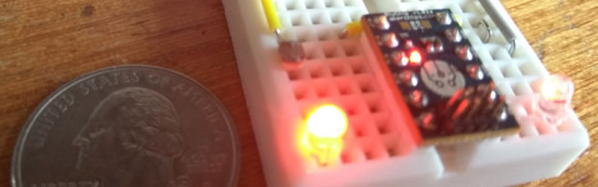
It’s Curtains For Blu Chip

In theory, there is no reason you can’t automate things all over your house. However — unless you live alone — you need to consider that most people won’t accept your kludgy looking circuits on a breadboard hanging everywhere. Lighting has become easy now that there are a lot of commercial options. However, there are still plenty of things that cry for automation. For [jeevanAnga], the curtains were crying out for remote control.

Since cellphones are ubiquitous, it makes sense to use the phone as a controller and BlueTooth Low Energy (BLE) is perfect for this kind of application. But you can’t hang a big ugly mess of wires off the curtain rods. That’s why [jeevanAnga] used a tiny (16.6 x 11.5 mm) BLE board knows as a BluChip.

We didn’t verify it, but [jeevanAnga] claims it is the smallest BLE board available, and it is certainly tiny. You can see the result in the video below.


Continue reading “It’s Curtains For Blu Chip”

Christal Gordon: Sensors, Fusion, And Neurobiology

Some things don’t sound like they should go together, but they do. Peanut butter and chocolate. Twinkies and deep frying. Bacon and maple syrup. Sometimes mixing things up can produce great results. [Dr. Christal Gordon’s] expertise falls into that category. She’s an electrical engineer, but she also studies neuroscience. This can lead to some interesting intellectual Reese’s peanut butter cups.

At the 2017 Hackaday Superconference, [Christal] spoke about sensor fusion. If you’ve done systems that have multiple sensors, you’ve probably run into that before even if you didn’t call it that. However, [Christal] brings the perspective of how biological systems fuse sensor data contrasted to how electronic systems perform similar tasks. You can see a video replay of her talk in the video below.

Continue reading “Christal Gordon: Sensors, Fusion, And Neurobiology”

OpenCV Never Forgets A Face

All the cool phones now are doing facial recognition. While that sounds like a big job, you can add face detection and recognition easily to your projects if you can support the OpenCV library. [LinuxHint] has a great tutorial that steps you from the basics of OpenCV to actually acquiring and identifying faces. It is aimed at Ubuntu users, but the code would apply to any OpenCV-supported platform. You can also see a less detailed tutorial to learn more about installing OpenCV on the Pi Zero from [DanishMalhotra].

Of course, any facial recognition system is going to need a camera. The nice thing about the first tutorial is that it assumes you know nothing about OpenCV, so it covers the basics on up to using the face-related libraries.

Continue reading “OpenCV Never Forgets A Face”

Hands On With PocketBeagle

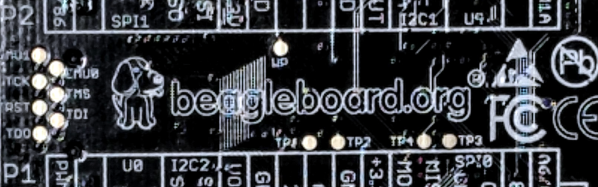
[Ken Shirriff] is no stranger to the pages of Hackaday. His blog posts are always interesting, and the recent one talking about the PocketBeagle is no exception. If you are old enough to remember the days when a Unix workstation set you back tens of thousands of dollars, you won’t be able to help yourself marveling at a Linux computer with 45 I/O pins, 8 analog inputs, 512M of RAM, and a 1 GHz clock, that fits in your pocket and costs $25. What’s more the board’s CPU has two 200 MHz auxiliary CPUs onboard to handle I/O without having to worry about Linux overhead.

These last parts are significant, and although the Beagles have had this feature for years ([Ken] talked about it earlier), the access and communication methods for using these slave processors has become easier. [Ken] shows a small snippet of C code that outputs a 40 MHz square wave no matter what the Linux OS is doing. In this way you can use Linux for the parts of your application that are not that critical, and use the slave processors to handle real time processing.

Continue reading “Hands On With PocketBeagle”

PLCs In Your Browser

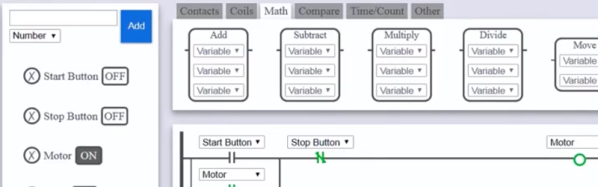
If your usual tools are the Arduino and the Raspberry Pi, you might find it surprising that the industrial world tends to run on Programmable Logic Controllers, or PLCs. You can think of a PLC as a very rugged industrial Arduino, but it’s best not to take that analogy too far. Some PLCs are very simple and some are quite complex, but one thing they do have in common is they are usually programmed using ladder logic. If you’ve ever wanted to learn how to program PLCs — a very marketable job skills in some places — you can now build and simulate ladder logic in your browser. [Garry Shortt] has a video walkthrough of the tool, that you can see below.

If you are used to conventional programming, you may find ladder logic a little frustrating. Originally, it was a documentation tool for relay logic but has grown to handle modern cases. It may actually help you to not think of it so much as a programming language, instead as a tool for drawing relay schematics. Contacts can be normally open or closed and in series or parallel to form AND and OR gates, for example, while coils can activate contacts.

Continue reading “PLCs In Your Browser”

When Is A 10-bit A/D An 8-bit A/D?

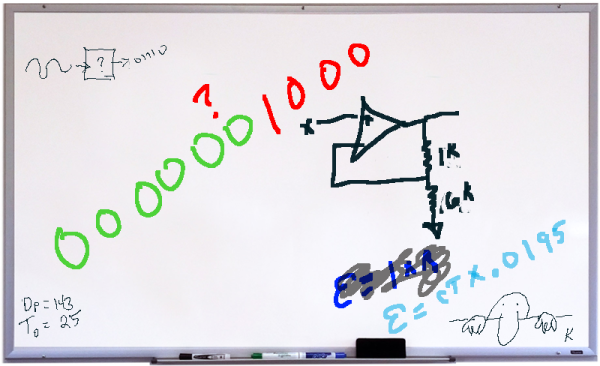
Marketing guys love bigger numbers. Bigger is better, right? After all, Subway called it a “footlong” not an 11-incher. So when it comes to analog to digital (A/D) conversion, more bits are better, right? Well, that depends. It is easy to understand that an A/D will have a low and high measurement and the low will be zero counts and the high will result in the maximum count for the number of bits. That is, an 8-bit device will top out at 255, a 10-bit at 1023, and so on.

The question is: are those bits meaningful? The answer depends on a few factors. Like most components we deal with, our ideal model isn’t reality, but maybe it is close enough.

Continue reading “When Is A 10-bit A/D An 8-bit A/D?”

EasyEDA Two Years Later

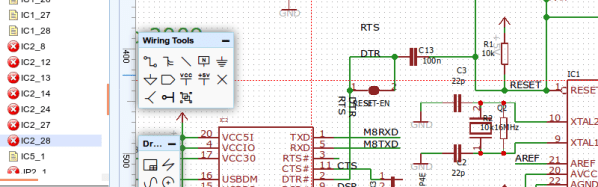
Some people want everything on the cloud, while others refuse to put even the smallest scrap of data on the Internet. Most of us fall somewhere in between. A few years ago, we talked about a few cloud-based PCB layout programs including one called EasyEDA. We were impressed because it was a full package: schematic capture, simulation, and PCB layout. It was free to use, although they would give you a quote for producing your boards, though you were under no obligation to buy them. Of course things change in two years, so if you are curious how EasyEDA is doing, [Yahya Tawil] posted an in-depth review.

Some of the new features include an autorouter and the ability to order parts from a BOM directly, not just PCBs. The cloud aspect is handy, not only because you don’t have to install and update software to use it anywhere, but because it is very natural to collaborate with others on projects. We did notice, though, that the autorouter can run in the cloud, or you can download and run it local because it apparently loads the server significantly.

Continue reading “EasyEDA Two Years Later”