Graphene Biosensors Are Extra Quiet

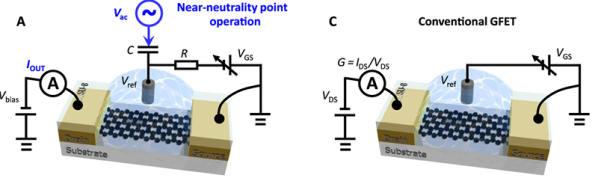
Graphene has attracted enormous interest for electrically detecting chemical and biological materials. However, because the super material doesn’t act like a normal semiconductor, transistors require multiple layers of the material, and that’s bad for 1/f noise especially when the transistors operate at maximum transconductance. Researchers have found a way to operate graphene transistors at a neutral point, significantly reducing 1/f noise while not impacting the sensor’s response.

The team created a proof-of concept sensor that could detect an HIV-related DNA hybridization. The sensor was able to detect very tiny concentrations of the material.

Continue reading “Graphene Biosensors Are Extra Quiet”

Quick And Easy Solar Hot Air Balloon

[Becky Stern] likes to harness the power of the Sun. Most of us will immediately think of solar cells and other exotic solar energy techniques. But [Becky] shows how to make a hot air balloon using nothing but tape and garbage bags.

The idea is quite simple. You form a large envelope from black trash bags and fill it with air. Becky does that by just running with it, tying it off, and topping off with a little manual blowing. Once the sun heats the black bag, it floats.

Continue reading “Quick And Easy Solar Hot Air Balloon”

Wireless Oscilloscope Review

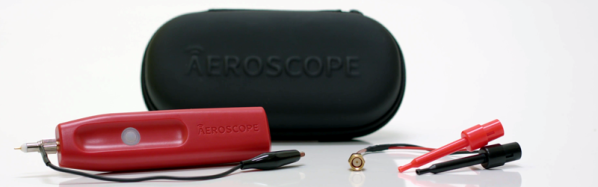
[Martin Rowe] over at EDN recently put a $200 wireless oscilloscope to the test. The Aeroscope 100A is a single channel scope in a probe body that communicates back to an Apple smartphone or tablet via Bluetooth LE. You can see the video from the post, below.

The original prototype of the device had a high bandwidth, but the production model only manages to have a 20 MHz bandwidth at 100 megasamples per second: nothing earth-shattering.

Continue reading “Wireless Oscilloscope Review”

Hollow State Memory

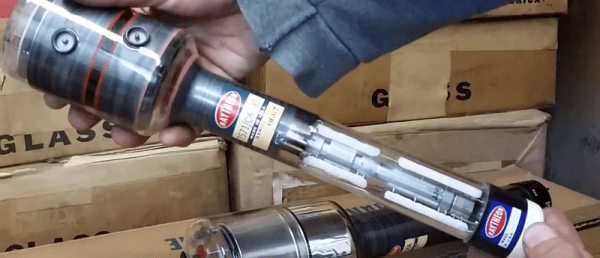
A lot of people like tubes either for their audio sound or their collectible value. [Uniservo] likes oddball tubes. His recent video (see below) shows a radechon — a computer memory tube. These were apparently widely used in RADAR sets until recently and has some similarity to a Williams tube.

The tube is essentially a CRT that illuminates a sheet of mica or another dielectric instead of a phosphor screen. The dielectric has a fine mesh grid in contact with it. By depositing charge on the mica, the tube can store an analog value. In theory, the tube could store about 16 kbits of information, but in practice, the resolution was less.

Continue reading “Hollow State Memory”

FPGA Metastability Solutions

Gisselquist Technology recently posted a good blog article about metastability and common solutions. If you are trying to learn FPGAs, you’ll want to read it. If you know a lot about FPGAs already, you might still pick up some interesting tidbits in the post.

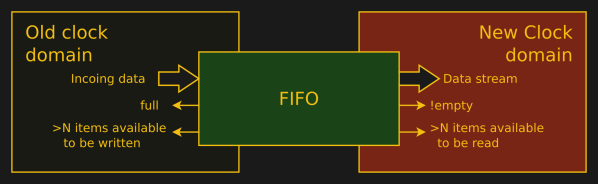
Don’t let the word metastability scare you. It is just a fancy way of saying that a flip flop can go crazy if the inputs are not stable for a certain amount of time before the clock edge and remain stable for a certain amount of time after the clock edge. These times are the setup and hold times, respectively.

Normally, your design tool will warn you about possible problems if you are using a single clock. However, any time your design generates a signal with one clock and then uses it somewhere with another clock, metastability is a possible problem. Even if you only have one clock, any inputs from the outside world that don’t reference your clock — or, perhaps, any clock at all — introduce the possibility of metastability. Continue reading “FPGA Metastability Solutions”

Alas, Poor Yorick! He Hath Not Amazon Prime

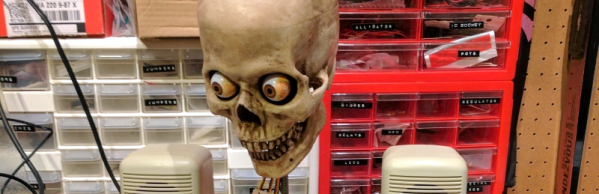
If you are looking around for a Halloween project, you might consider The Yorick Project from [ViennaMike]. As you can see in the video below, it marries a Raspberry Pi acting as an Amazon Alexa with an animatronic skull.

This isn’t the most technically demanding project, but it has a lot of potential for further hacking. The project includes a USB microphone, a servo controller, and an audio servo driver board. It looks like the audio servo board is controlling the jaw movement and based on the video, we wondered if you might do better running it completely in software.

Continue reading “Alas, Poor Yorick! He Hath Not Amazon Prime”

FPGA Design From Top To Bottom

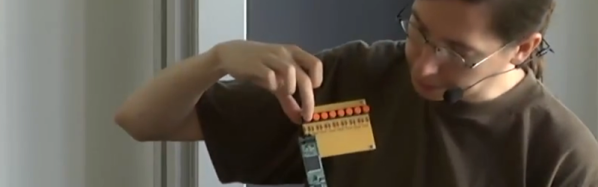
[Roland Lutz] gave a talk about FPGA design using the free tools for Lattice devices at the MetaRheinMainChaosDays conference this year. You can see the video below. It’s a great introduction to FPGAs that covers both the lowest-level detail and some higher level insight. If you’re getting started with these FPGAs, this video is a must-see.

[Roland] starts with the obligatory introductory material. He then jumps into an actual example before zooming back out to look at the internal details of the Lattice FPGA. For instance, this FPGA supports multiple bitstreams, so you can switch between different “programs” on the fly.

Continue reading “FPGA Design From Top To Bottom”