Getting Started With Blinking Lights On Old Iron

If you ever go to a computer history museum, you’ll be struck by how bland most modern computers look. Prior to 1980 computers had lights and switches, and sometimes dials and meters. Some had switchboard-like wiring panels and some even had oscilloscope-like displays. There’s something about a machine with all those switches and lights and displays that gets your hacker juices flowing. Have you ever wanted to get started in retrocomputing? Is it difficult? Do you need a lot of money? That depends on what your goals are.

There are at least three ways you can go about participating in retrocomputing: You can pony up the money to buy actual antique computers, you can build or buy old computers recreated with anywhere from zero to one hundred percent of period-authentic components, or you can experiment with emulators that run on a modern computer. As a hybrid of the second and third option there are also emulations in FPGAs.

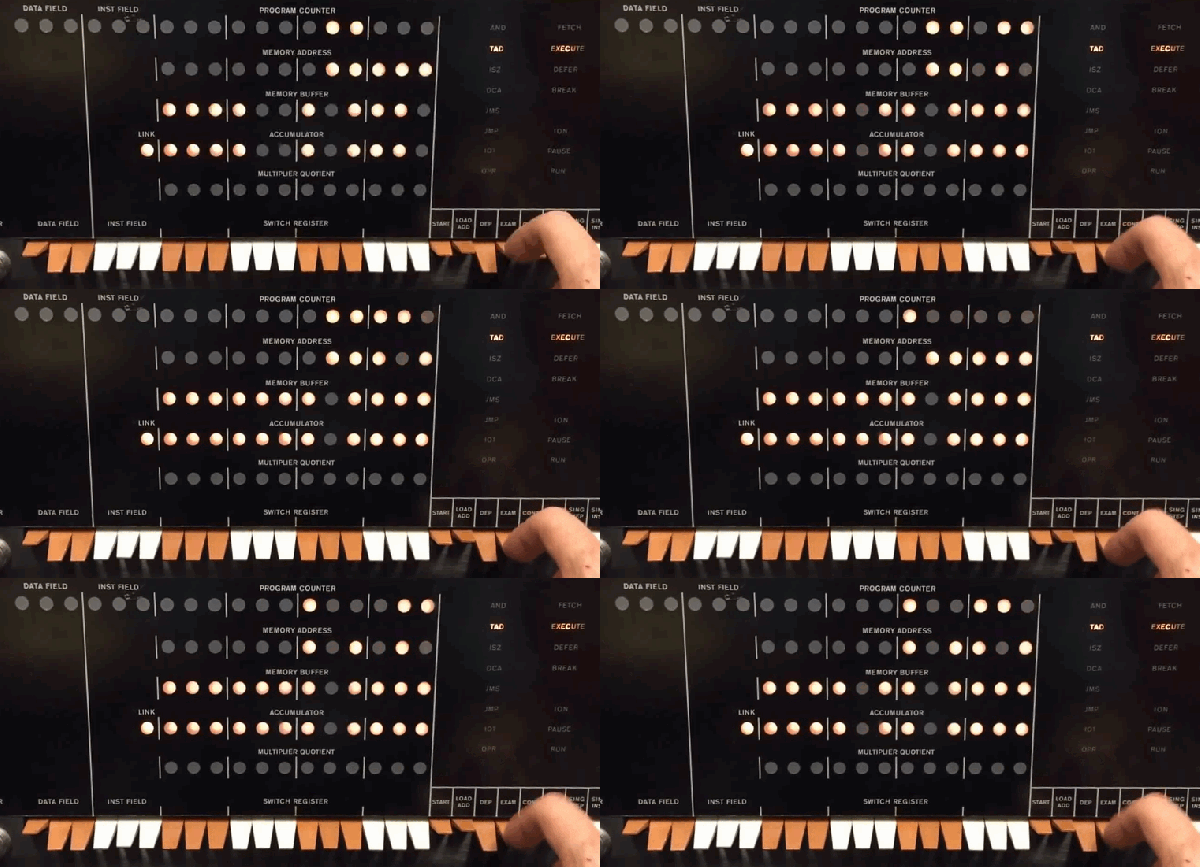
You can see that the first option can be very expensive and you will probably have to develop a lot of repair and restoration skills. Watching [Mattis Lind] twiddle the bits on an actual PDP-8 in the clip above is great, but you’ll need to work up to it. The two techniques which get you going without the original hardware don’t have to break the bank or even cost anything presuming you already have a PC.

Although some sneer at emulation, for some machines it is almost the only way to go. You couldn’t buy the original EDSAC, for example. It is also a good way to get started without a lot of expense or risk. But regardless of how you do it, there’s one thing in common: you have to know how to operate the thing.

Continue reading “Getting Started With Blinking Lights On Old Iron”
Synthetic Biology Creates Living Computers

Most people have at least a fuzzy idea of what DNA is. Ask about RNA, though, and unless you are talking to a biologist, you are likely to get even more handwaving. We hackers might have to reread our biology text books, though, since researchers have built logic gates using RNA.

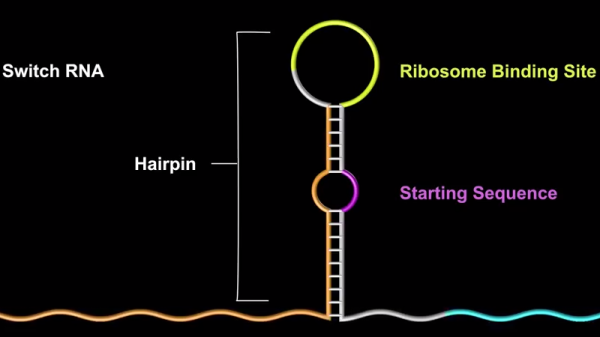
Sometimes we read these university press releases and realize that the result isn’t very practical. But in this case, the Arizona State University study shows how AND, OR, and NOT gates are possible and shows practical applications with four-input AND gates and six-input OR gates using living cells. The key is a construct known as an RNA toehold switch (see video below). Although this was worked out in 2012, this recent study shows how to apply it practically.

Continue reading “Synthetic Biology Creates Living Computers”

Quick Robin! The Bat Keychain!

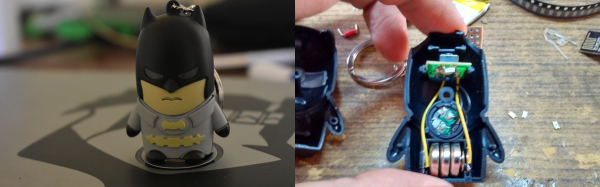
We don’t know if Batman has a keychain for the keys to the Bat mobile, the Bat copter, and all his other vehicles. But we are guessing if he did, it didn’t look like the one [krishnan793] picked up cheap. It had a little button that lit up some LEDs and played a little tune. [Krishnan] thought he could do better with an ESP8266. After chopping up some headphones and adding a LiPo battery, he wound up with an improved key chain you can see in the video below. The first video is the before video. The second is after the modification. Sure, it is only a small improvement on LEDs and a simple tune, but now it is hackable to do more interesting things if you want to take the trouble to do so.

Continue reading “Quick Robin! The Bat Keychain!”

ColibriNANO USB SDR Receiver Reviewed

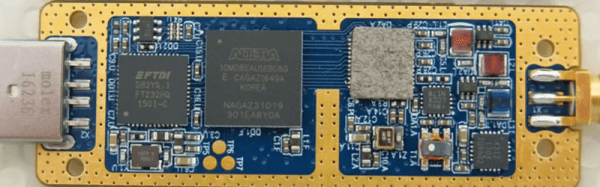
At first glance, the ColibriNANO SDR looks like another cheap SDR dongle. But after watching [Mile Kokotov’s] review (see video below), you can see that it was built specifically for software defined radio service. When [Mile] takes the case off, you notice the heavy metal body which you don’t see on the typical cheap dongle. Of course, a low-end RTL-SDR is around $20. The ColibriNANO costs about $300–so you’d hope you get what you pay for.

The frequency range is nominally 10 kHz to 55 MHz, although if you use external filters and preamps you can get to 500 MHz. In addition to a 14-bit 122.88 megasample per second A/D converter, the device sports an Altera MAX10 FPGA.

Continue reading “ColibriNANO USB SDR Receiver Reviewed”

ATMega328 3D!

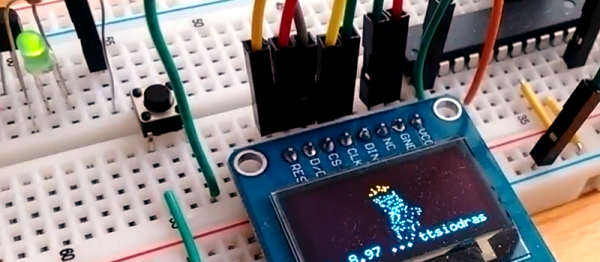
Small OLED displays are inexpensive these days–cheap enough that pairing them with an 8-bit micro is economically feasible. But what can you do with a tiny display and not-entirely-powerful processor? If you are [ttsiodras] you can do a real time 3D rendering. You can see the results in the video below. Not bad for an 8-bit, 8 MHz processor.

The code is a “points-only” renderer. The design drives the OLED over the SPI pins and also outputs frame per second information via the serial port.

Continue reading “ATMega328 3D!”

Touchscreen Oscilloscope

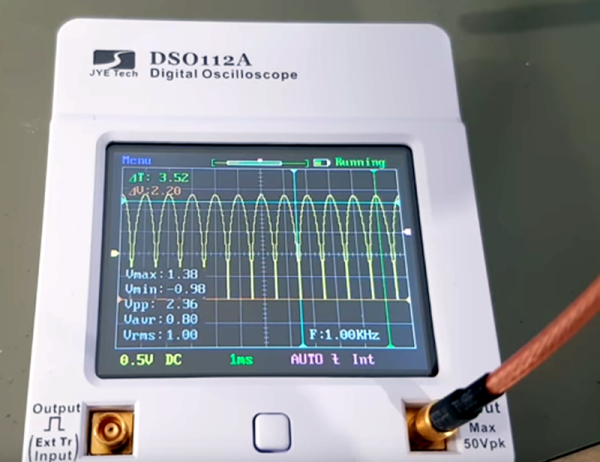
[Marco Reps] didn’t want to lug a full-sized oscilloscope around to measure his ECG while running. He decided to check out the DSO112A which is a tiny touchscreen scope from the usual China sources. The tiny one channel scope can go to 2mV/division at 2MHz and can save and recall up to 24 configurations. It also has access to the data via a serial port so you can use it as a fancy data logger. [Marco’s] video appears below.

Apparently, there is was an older model without the A on the end that was not as sensitive and had some other missing features. The price is about $70–fairly inexpensive, although not throw-away cheap.

[Marco] noted that one of the two small connectors can act as an external trigger input or a function generator. There’s the typical LiPo battery inside and a shielded input section. [Marco] tears the board down and looks at the chips on the board. Inside are two Atmel CPUs and a 20 megasample per second analog to digital converter.

The color screen looks surprisingly good in the video although, as [Marco] points out, with one channel, the colors aren’t super useful. The device also has cursors and a nice selection of measurements that work both live and on stored data.

At the end of the video, [Marco] shows a simple ECG amplifier he built from an open source schematic. We’ve covered simple ECG circuits before if you want to read more.

Last year we looked at two small inexpensive scopes. Like everything else, each year the bar gets higher. Although, in fairness, those scopes had a (reported) 25 MHz bandwidth. We’d love to see that kind of front end with the user interface of the DSO112A.

Continue reading “Touchscreen Oscilloscope”

One Transistor RTL-SDR Upconverter

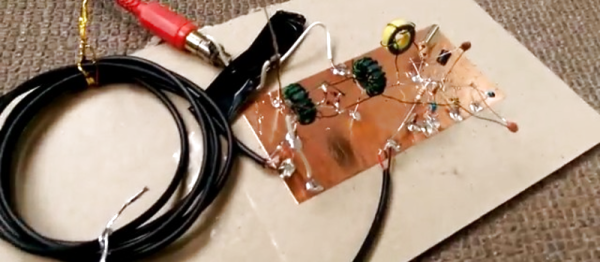
Even if you haven’t used one, you’ve probably seen the numerous projects with the inexpensive RTL-SDR USB dongle. Originally designed for TV use, the dongle is a software defined radio that many have repurposed for a variety of radio hacking projects. However, there’s one small issue. By default, the device only works down to about 50 MHz or so. There are some hacks to change that, but the cleanest way to get operation is to add an upconverter to shift the frequency you want higher. Sounds complicated? [Qrp-Gaijin] shows how to do it with a single transistor. You can see some videos of the results, below.

Actually, [Qrp-Gaijin] built an earlier version but wasn’t satisfied with the performance. He found that his original oscillator was driving an overtone crystal at its fundamental frequency. The device worked, but only because the oscillator was putting out harmonics, including the third harmonic at the actual needed frequency (49.8 MHz).

Continue reading “One Transistor RTL-SDR Upconverter”