Touchscreen Oscilloscope

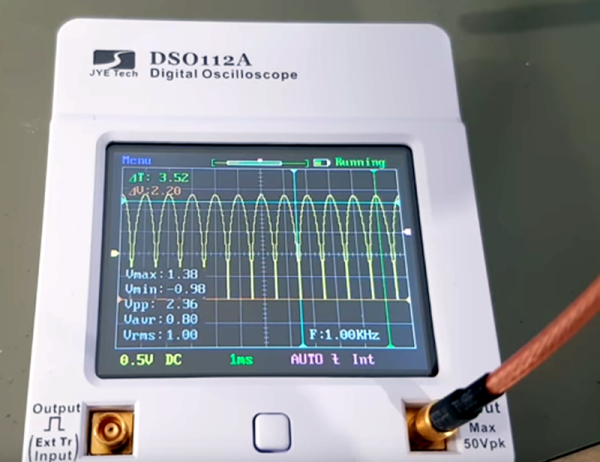
[Marco Reps] didn’t want to lug a full-sized oscilloscope around to measure his ECG while running. He decided to check out the DSO112A which is a tiny touchscreen scope from the usual China sources. The tiny one channel scope can go to 2mV/division at 2MHz and can save and recall up to 24 configurations. It also has access to the data via a serial port so you can use it as a fancy data logger. [Marco’s] video appears below.

Apparently, there is was an older model without the A on the end that was not as sensitive and had some other missing features. The price is about $70–fairly inexpensive, although not throw-away cheap.

[Marco] noted that one of the two small connectors can act as an external trigger input or a function generator. There’s the typical LiPo battery inside and a shielded input section. [Marco] tears the board down and looks at the chips on the board. Inside are two Atmel CPUs and a 20 megasample per second analog to digital converter.

The color screen looks surprisingly good in the video although, as [Marco] points out, with one channel, the colors aren’t super useful. The device also has cursors and a nice selection of measurements that work both live and on stored data.

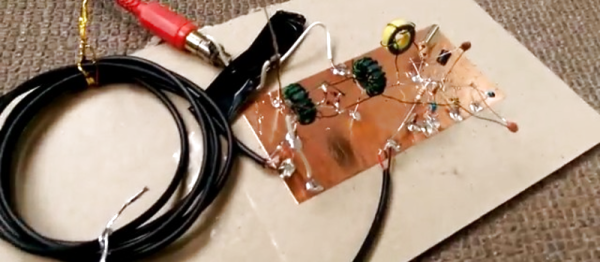
At the end of the video, [Marco] shows a simple ECG amplifier he built from an open source schematic. We’ve covered simple ECG circuits before if you want to read more.

Last year we looked at two small inexpensive scopes. Like everything else, each year the bar gets higher. Although, in fairness, those scopes had a (reported) 25 MHz bandwidth. We’d love to see that kind of front end with the user interface of the DSO112A.
Continue reading “Touchscreen Oscilloscope”

One Transistor RTL-SDR Upconverter

Even if you haven’t used one, you’ve probably seen the numerous projects with the inexpensive RTL-SDR USB dongle. Originally designed for TV use, the dongle is a software defined radio that many have repurposed for a variety of radio hacking projects. However, there’s one small issue. By default, the device only works down to about 50 MHz or so. There are some hacks to change that, but the cleanest way to get operation is to add an upconverter to shift the frequency you want higher. Sounds complicated? [Qrp-Gaijin] shows how to do it with a single transistor. You can see some videos of the results, below.

Actually, [Qrp-Gaijin] built an earlier version but wasn’t satisfied with the performance. He found that his original oscillator was driving an overtone crystal at its fundamental frequency. The device worked, but only because the oscillator was putting out harmonics, including the third harmonic at the actual needed frequency (49.8 MHz).

Continue reading “One Transistor RTL-SDR Upconverter”

Take The Blue Pill And Go Forth

Forth has a long history of being a popular hacker language. It is simple to bootstrap. It is expressive. It can be a very powerful system. [jephthal] took the excellent Mecrisp Forth and put it on the very inexpensive STM32 “blue pill” board to create a development system that cost about $2. You can see the video below.

If you have thirty minutes, you can see just how easy it is to duplicate his feat. The blue pill board has to be programmed once using an STM32 programmer. After that, you can use most standard Forth words and also use some that can manipulate the low-level microcontroller resources.

Continue reading “Take The Blue Pill And Go Forth”

Neural Nets In The Browser: Why Not?

We keep seeing more and more Tensor Flow neural network projects. We also keep seeing more and more things running in the browser. You don’t have to be Mr. Spock to see this one coming. TensorFire runs neural networks in the browser and claims that WebGL allows it to run as quickly as it would on the user’s desktop computer. The main page is a demo that stylizes images, but if you want more detail you’ll probably want to visit the project page, instead. You might also enjoy the video from one of the creators, [Kevin Kwok], below.

TensorFire has two parts: a low-level language for writing massively parallel WebGL shaders that operate on 4D tensors and a high-level library for importing models from Keras or TensorFlow. The authors claim it will work on any GPU and–in some cases–will be actually faster than running native TensorFlow.

Continue reading “Neural Nets In The Browser: Why Not?”

TinyFPGA Is A Tiny FPGA Board

We recently noticed an open source design for TinyFPGA A-Series boards from [Luke Valenty]. The tiny boards measure 18 mm by 30.5 mm and are breadboard friendly. You can choose a board that holds a Lattice Mach XO2-256 or an XO2-1200, if you need the additional capacity.

The boards have the JTAG interface on the side pins and also on a top header that would be handy to plug in a JTAG dongle for programming. The tiny chips are much easier to work with when they are entombed in a breakout board like this. Bigger boards with LEDs and other I/O devices are good for learning, but they aren’t always good for integrating into a larger project. The TinyFPGA boards would easily work in a device you were prototyping or doing a small production run.

Continue reading “TinyFPGA Is A Tiny FPGA Board”

Find Instructions Hidden In Your CPU


There was a time when owning a computer meant you probably knew most or all of the instructions it could execute. Your modern PC, though, has a lot of instructions, many of them meant for specialized operating system, encryption, or digital signal processing features.

There are known undocumented instructions in a lot of x86-class CPUs, too. What’s more, these days your x86 CPU might really be a virtual machine running on a different processor, or your CPU could have a defect or a bug. Maybe you want to run sandsifter–a program that searches for erroneous or undocumented instructions. Who knows what is lurking in your CPU?

Continue reading “Find Instructions Hidden In Your CPU”

OpenEMS Makes Electromagnetic Field Solving… Merely Difficult

To ordinary people electronics is electronics. However, we know that the guy you want wiring your industrial furnace isn’t the guy you want designing a CPU. Neither of those guys are likely to be the ones you want building an instrumentation amplifier. However, one of the darkest arts of the electronic sects is dealing with electromagnetic fields. Not only is it a rare specialty, but it requires a lot of high-powered math. Enter OpenEMS, a free and open electromagnetic field solver.

We would like to tell you that OpenEMS makes doing things like antenna analysis easy. But that’s like saying Microsoft Word makes it easy to write a novel. In one sense, yes, but you still need to know what you are doing. In fairness, though, the project does provide a good set of tutorials, ranging from a simple wave guide to a sophisticated phased array of patch antennas. Our advice? Start with the waveguide and work your way up from there.

The software uses Octave or MATLAB for scripting, plotting, and support. You can download it for Windows or Linux.

If you want to start with something more intuitive for electromagnetic field visualization, this might help. If you prefer your models more concrete and less abstract, perhaps you should work at Lincoln Lab.