One Bit, One Instruction Discrete CPU

There is a certain benefit to being an early adopter. If you were around when Unix or MSDOS had a handful of commands, it wasn’t hard to learn. Then you learn new things as they come along. If you started learning Linux or Windows today, there’s a huge number of details you have to tackle. You have the same problem trying to learn CPU design. Grappling with the design of a 16-bit CPU with a straightforward data path is hard enough. Throw in modern superscalar execution, pipelining, multiple levels of microcode, speculative execution, and all the other features modern processors have and you’ll quickly find yourself lost in the details.

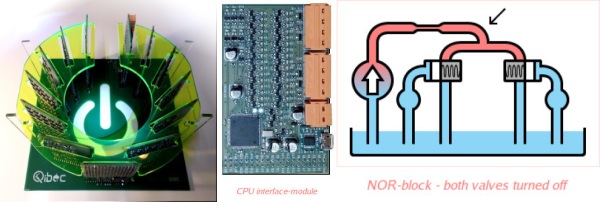
[Michai Ramakers] wanted to build an educational CPU and he took a novel approach. The transistor CPU uses only one instruction and operates on one bit at a time. Naturally, this leads to a small data path, which is a good thing if you’re only using discrete transistors. His website is a ground-up tutorial in building and using the tiny computer.

Continue reading “One Bit, One Instruction Discrete CPU”

Game Controller Cuts The Rug

There’s an iconic scene from the movie Big where [Tom Hanks] and [Robert Loggia] play an enormous piano by dancing around on the floor-mounted keys. That was the first thing we thought of when we saw [jegatheesan.soundarapandian’s] PC joystick rug. His drum playing (see the video below) wasn’t as melodious as [Hanks] and [Loggia] but then again they probably had a musical director.

At the heart of the project is, of course, an Arduino. An HC-05 provides a Bluetooth connection back to the PC. We thought perhaps an Arduino with USB input capability like the Leonardo might be in use, but instead, [jegatheesan] has a custom Visual Basic program on the PC that uses SendKeys to do the dirty work.

The switches are more interesting made with old CDs, foil, and sponges. The sponge holds the CDs apart until you step on them and the foil makes the CDs conductive. He uses a lot of Fevicol in the project–as far as we can tell, that’s just an Indian brand of PVA glue, so Elmer’s or any other white glue should do just as well.

Continue reading “Game Controller Cuts The Rug”

Start Your Path To Becoming An Antenna Guru

We’ve known a few people over the years that have some secret insight into antennas. To most of us, though, it is somewhat of a black art (which explains all the quasi-science antennas made out of improbable elements you can find on the web). There was a time when only the hams and the RF nerds cared about antennas, but these days wireless is everywhere: cell phones, WiFi, Bluetooth, and even RF remote controls all live and die based on their antennas.

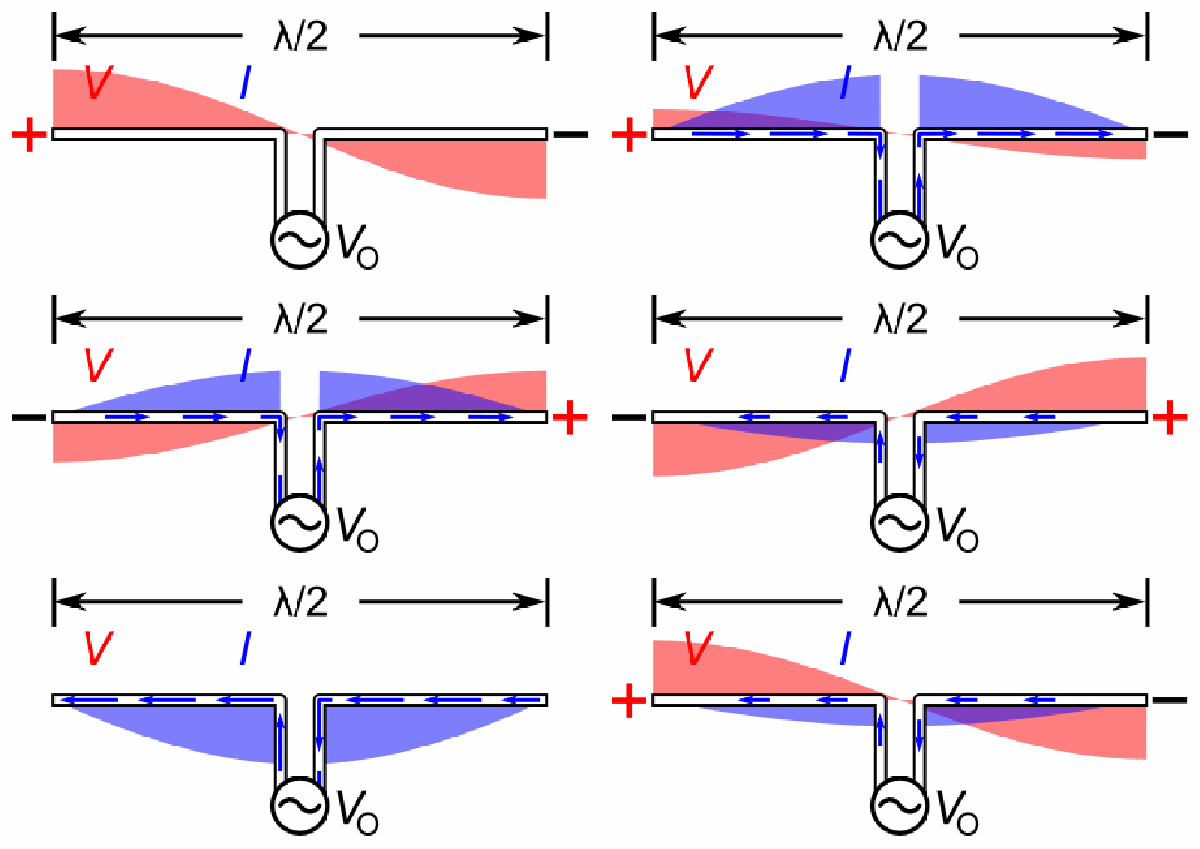
You can find a lot of high-powered math discussions about antennas full of Maxwell’s equations, spherical integration and other high-power calculus, and lots of arcane diagrams. [Mark Hughes] recently posted a two-part introduction to antennas that has less math and more animated images, which is fine with us (when you are done with the first part, check out part two). He’s also included a video which you can find below.

The first part is fairly simple with a discussion of history and electromagnetics. However, it also talks about superposition, reflection, and standing wave ratio. Part two, though, goes into radiation patterns and gain. Overall, it is a great gateway to a relatively arcane art.

We’ve talked about Smith charts before, which are probably the next logical step for the apprentice antenna wizard. We also covered PCB antenna design.

Continue reading “Start Your Path To Becoming An Antenna Guru”

CNC Dummies For Routers

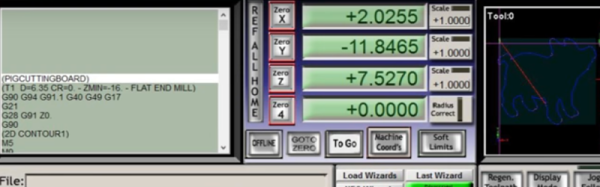
[This Old Tony] has a few videos that have made appearances on Hackaday. His latest one is CNC Dummies for Routers (see below). The subtitle, CNC Basics, is an honest one. If you’re already well versed in GCode and Mach 3, you probably won’t make it through the 14 minute video (although Tony is pretty entertaining even if you know what he’s talking about).

By his own admission, this is really CNC basics for hobby-grade CNC routers and mills. He starts off talking about his custom-built machine along with some common machines in the $500-$5000 range. He then gives a simple sketch of what GCode looks like.

Continue reading “CNC Dummies For Routers”

Raspberry Pi Radio Makes The Sweet Music Of Bacteria

We’ve noticed a lot of musical groups are named after insects. Probably has something to do with the Beatles. (If you study that for a while you’ll spot the homophonic pun, and yes we know that the Crickets inspired the name.) There’s also Iron Butterfly, Adam Ant, and quite a few more. A recent art project by a Mexican team — Micro-ritmos — might inspire some musical groups to be named after bacteria.

The group used geobacter — a kind of bacteria found in soil — a Raspberry Pi, an Arduino, and a camera to build an interesting device. As it looks at the bacteria and uses SuperCollider to create music and lighting from the patterns. You can see a video of Micro-ritmos, below.

Continue reading “Raspberry Pi Radio Makes The Sweet Music Of Bacteria”

Neural Network Keeps It Light

Neural networks ought to be very appealing to hackers. You can easily implement them in hardware or software and relatively simple networks can perform powerful functions. As the jobs we ask of neural networks get more complex, the networks require more artificial neurons. That’s why researchers are pursuing dense integrated neuron chips that could do for neural networks what integrated circuits did for conventional computers.

Researchers at Princeton have announced the first photonic neural network. We recently talked about how artificial neurons work in conventional hardware and software. The artificial neurons look for inputs to reach a threshold which causes them to “fire” and trigger inputs to other neurons.

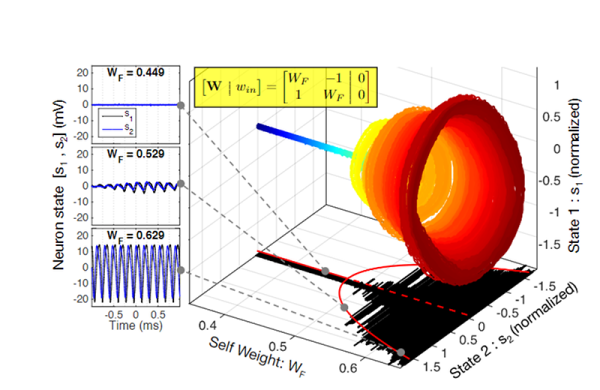
To map this function to an optical device, the researchers created tiny circular waveguides in a silicon substrate. Light circulates in the waveguide and, when released, modulates the output of a laser. Each waveguide works with a specific wavelength of light. This allows multiple “inputs” (in the form of different wavelengths) to sum together to modulate the laser.

The team used a 49-node network to model a differential equation. The photonic system was nearly 2,000 times faster than other techniques. You can read the actual paper online if you are interested in more details.

There’s been a lot of work done lately on both neural networks and optical computing. Perhaps this fusion will advance both arts.

Open Source Pancakes

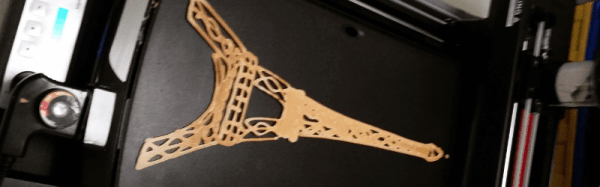
It is definitely a first world problem: What do you do when creating a custom pancake requires you to put a design on an SD card and plug it into your pancake printer? This is what was nagging at [drtorq]. Granted, since he works for a publication called “The Stack” maybe a pancake printer isn’t so surprising. [drtorq] built the custom PancakeBOT software on Linux as a start to his hacking on the flapjack creating robot.

[drtorq] promises more hacking on the printer in the future, so this is just step one. We expect the mods will be a lot like a typical 3D printer, except the heated bed is absolutely necessary on this model. The printer is more like a CNC engraver than a 3D printer since it is basically an XY carriage with a nozzle that flows batter instead of polymer.

Continue reading “Open Source Pancakes”