There’s A Bug In My Robot

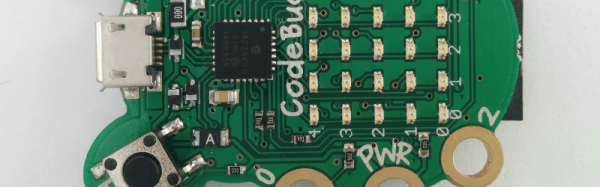
What has six legs, 25 LEDs, a Microchip CPU, can be sewn into clothing, and even plugged into a Raspberry Pi? The answer, it turns out, is the CodeBug–a low cost computer board aimed at the educational market. These board were crowdfunded and are now available for general purchase. [Mike Redrobe] took one of the boards, connected a few servos and used the CodeBug’s Scratch-like language to create a small robot.

You can see the robot in the video below. Programs download via USB (the board looks like a USB drive). You can also send commands over USB to operate in tether mode, or you can directly plug the board into a Raspberry Pi.

Continue reading “There’s A Bug In My Robot”

Visualizing The Fourier Transform

If you do any electronics work–especially digital signal processing–you probably know that any signal can be decomposed into a bunch of sine waves. Conversely, you can generate any signal by adding up a bunch of sine waves. For example, consider a square wave. A square wave of frequency F can be made with a sine wave of frequency F along with all of its odd harmonics (that is, 3F, 5F, 7F, etc.). Of course, to get a perfect square wave, you need an infinite number of odd harmonics, but in practice only a few will do the job.

Like a lot of abstract concepts, it is easy to understand the basic premise and you could look up any of the mathematical algorithms that can take a signal and perform a Fourier transform on it. But can you visualize why the transform works the way it does? If you can’t (or even if you can), you should check out [Mehmet’s] MATLAB visualization of harmonic circles. If you don’t have MATLAB yourself, you can always check out the video (see below).

Continue reading “Visualizing The Fourier Transform”

Hack Your Rib Cage With Titanium 3D Printing

A Spanish hospital recently replaced a significant amount of a man’s rib cage and sternum with a titanium replacement. Putting titanium inside people’s chests is nothing new, but what made this different was the implant was 3D printed to match his existing bone structure.

An Australian company, Anatomics, created the 3D print from high-resolution CT scans of the patient. They used a printer provided by an Australian Government corporate entity, CSIRO, that helps bring technology to Australian companies.

Biomedical printing has been in the news quite a bit lately and we’ve covered CT scan to 3D model conversions more than once. Is this the dawn of the age of the cyborg? Maybe it’s really mid morning. Many people walk around with pacemakers, Vagus nerve stimulators, and plenty of more conventional titanium hardware in them now.

While the ethics of replacing a cancer patient’s rib cage is pretty clear, the real issue will be when people want enhancements just for the sake of it (think of the controversy surrounding runners with prosthetic legs, for example). It might seem far-fetched, but as replacements become better than originals, some people will want to opt for replacements for perfectly good body parts.

Continue reading “Hack Your Rib Cage With Titanium 3D Printing”

Radio Receiver Or Art? Why Not Both?

We’ve heard it said before that you should build things twice. Once to learn how to build it and the second time to build it right. [AA7EE] must agree. He was happy with his homebrew regenerative receiver that he called Sproutie. But he also wanted to build one more and use what he learned to make an even better receiver. The Sproutie Mark II was born.

This isn’t some rip off of an old P-Box kit either. [AA7EE] used a four-device RF stage with FET isolation back to the antenna and a regulated power supply. Plug in coils allow reception on multiple bands ranging from about 3 to 13 MHz. There’s an audio stage with multiple selectable audio filters, and–the best part–a National HRO tuning dial that is a work of art all by itself.

Continue reading “Radio Receiver Or Art? Why Not Both?”

How To Build A Pocket-Sized MBed Signal Generator

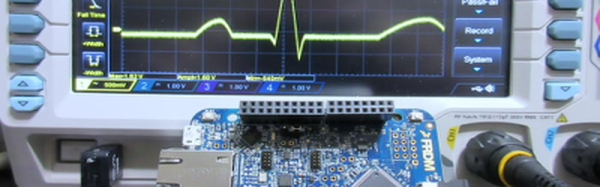
Last month, I talked about how to get started with mBed and ARM processors using a very inexpensive development board. I wanted to revisit mBed, though, and show something with a little more substance. In particular, I often have a need for a simple and portable waveform generator. It doesn’t have to be too fancy or meet the same specs as some of the lab gear I have, but it should be easy to carry, power off USB, and work by itself when required.

My requirements mean I needed a slightly more capable board. In particular, I picked up a K64F board. This is very similar to the KL25Z board but has a bit more of everything–speed, memory, etc. What I really wanted, though, was the SD card slot. I did, however, do my early testing on a KL25Z, so if you have one, you can still work through the code, although standalone operation won’t be possible. The price jumps from $13 to $35, but you get a lot more capability for the price.

Continue reading “How To Build A Pocket-Sized MBed Signal Generator”

Mechanical Keyboard Goes BLE

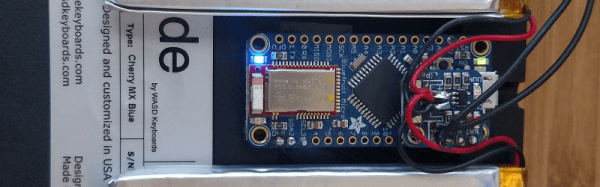
Like many programmers, [Daniel Nugent] loves his old mechanical keyboard (a WASD Code Keyboard). What he didn’t love was the cord. Sure, you can get a modern wireless keyboard, but it won’t be the same as the keyboard you’ve spent so much time with. Armed with a Bluetooth Low Energy (BLE) module, a rechargeable battery and some coding, he kept his keyboard but got rid of the wires.

Although he has some specific handling for the WASD, the code would very likely handle any PS/2 keyboard. The PS/2 interface is a simple synchronous serial port with a single clock and single data line. Handling it with a microcontroller isn’t very difficult.

Continue reading “Mechanical Keyboard Goes BLE”

Arduino Masters Ham Radio Digital Mode

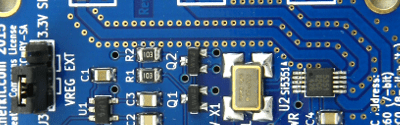
[jmilldrum] really gets a lot of use out of his Si5351A breakout board. He’s a ham [NT7S], and the Si5351A can generate multiple square waves ranging from 8 kHz to 160 MHz, so it only stands to reason that it is going to be a useful tool for any RF hacker. His most recent exploit is to use the I2C-controllable chip to implement a Fast Simple QSO (FSQ) beacon with an Arduino.

FSQ is a relatively new digital mode that uses a form of low rate FSK to send text and images in a way that is robust under difficult RF propagation. There are 32 different tones used for symbols so common characters only require a single tone. No character takes more than two tones.

Continue reading “Arduino Masters Ham Radio Digital Mode”