Ask any airline executive what their plans were back in January 2020, and you’d probably get the expected spiel about growing market share and improving returns for shareholders. Of course, the coronovirus pandemic quickly changed all that in the space of just a few months. Borders closed, and worldwide air travel ground to a halt.
Suddenly, the world’s airlines had thousands of planes and quite literally nowhere to go. Obviously, leaving the planes just sitting around in the open wouldn’t do them any good. So what exactly is involved in mothballing a modern airliner?
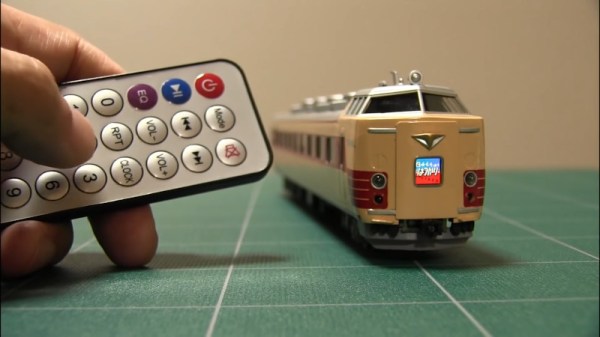
When catching public transport, it’s very helpful if the bus or train in question has a large display indicating the route or destination. While many transit lines now rely on flipdot or LED displays, the classic rollsign still gets the job done. [diorama111] wanted to emulate this on a model railroad, and set about building a simulacrum at tiny scale.
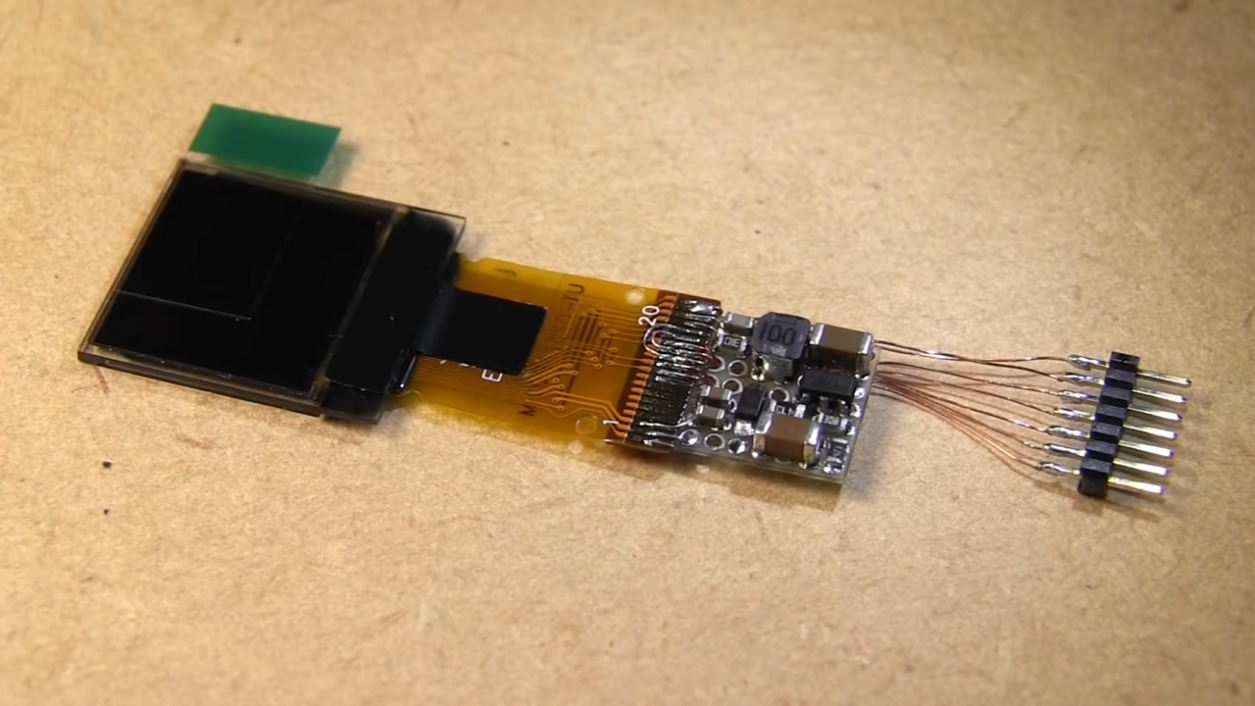
Intended to suit an HO-scale model train, the build makes use of a tiny 0.6 inch NHD-0.6-6464G OLED display. It’s wired up with a boost converter for power and hooked up to a tiny circuit consisting of an ATMEGA328p and an infrared receiver. The microcontroller is responsible for receiving commands from the remote control, and displaying the appropriate image on the screen. The hidden beauty of this one is well shown in the video below as [diorama111] cleanly and meticulously assembles the circuit on protoboard with just an iron and tweezers.
What makes this project great is how neatly it’s integrated into the body of the train. Nestled inside the locomotive, it almost looks like a stock part of the model. While the nature of the OLED display does come across a touch anachronistic, implementing the vertical scroll really does add a lot to the final effect.
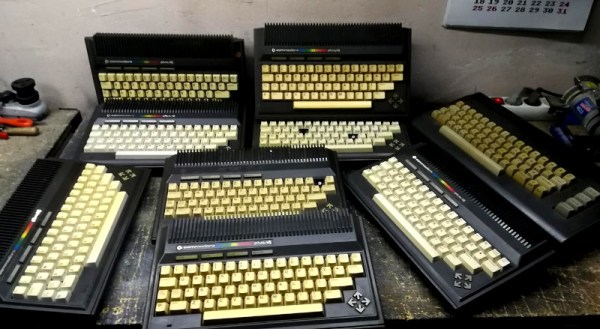
The Commodore Plus/4 was not loved by the marketplace after its launch in 1984. Despite its namesake feature of having productivity programs built in, its lack of compatibility with Commodore 64 software and oddball status meant that it struggled to find acceptance. However, like so many retro computers, it maintains a following to this day. [Drygol] had collected a total of eight neglected units, and set to giving them a full workover.
First on the docket is cleaning, and [Drygol] makes short work of disassembling the computers and removing decades of dirt and dust. Keycaps are treated with Retrobright to restore their original color. The black styling of the case means it gets a simple wash down instead, and then a rub with thin oil to restore the plastic’s original sheen.
[Drygol] steps through various popular hacks for the platform too, from 6510 CPU replacements for the often-failing 7501 and 8501, to SD2IEC card interfaces to replace the much-maligned storage original storage options. Damaged keyboard studs are replaced with hacked-up Amiga parts, while LEDs that are long out of production are swapped out for cut-down modern parts.
The impressive thing is just how much community support there is for an also-ran Commodore that never truly caught the public’s eye. Efforts are ongoing, too, with projects like THED aiming to reproduce some of the custom chips used on the platform.
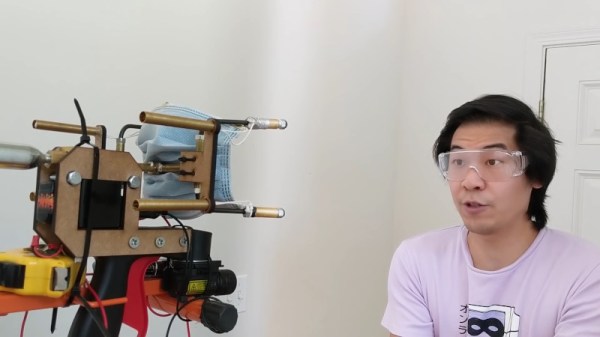
One of the most effective ways to slow the spread of pathogens like the novel coronavirus is to have individuals wear facemasks that cover the nose and mouth. They’re cheap, and highly effective at trapping potentially infectious aerosols that spread disease. Unfortunately, wearing masks has become a contentious issue, with many choosing to go without. [Allen Pan] was frustrated by this, and set out to make a launcher to quite literally shoot masks directly onto faces.
To fire the masks, Allan built a pneumatic system that gets its power from a compact CO2 canister. This is hooked up to a solenoid, which is fired by the trigger. The high-pressure CO2 then goes through a split to four separate barrels cleverly made out of brake line ([Allen] says it’s faster to get parts from the automotive supply than the home store these days). Each barrel fires a bola weight attached to one of the strings of the mask, in much the same way a net launcher works. The mask is then flung towards the face of the target, and the weights wrap around the back of the neck, tangling and ideally sticking together thanks to neodymium magnets.
Amazingly, the mask worked first time, wrapping effectively around a dummy head and covering the nose and mouth. Follow-up shots were less successful, however, but that didn’t deter [Allen] from trying the device on himself at point-blank range. Despite the risk to teeth and flesh, the launcher again fires a successful shot.
While it’s obviously never meant to be used in the real world, the mask launcher was a fun way to experiment with pneumatics and a funny way to start the conversation about effective public health measures. We’ve featured similar projects before, too. Video after the break.
It’s not uncommon to happen across vintage measurement equipment at the local flea market or garage sale. Often with an irresistible aesthetic, and built to last decades, these tools nonetheless tend to be sidelined when modern multimeters are available. [Build Comics] had just such a piece on hand, and decided to repurpose it with some modern hardware instead.
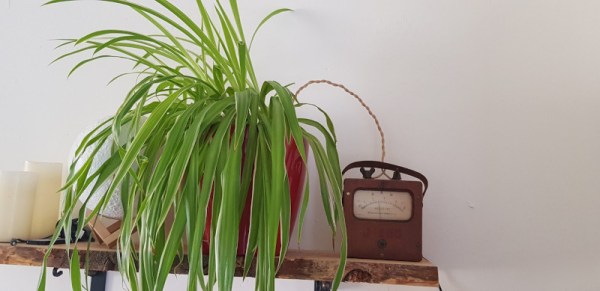
The build begins with a Hartmann & Braun 60 amp ammeter. Replete in a nice wooden box, it’s the perfect candidate for a modern refit. The device uses an indicator of the moving iron type. Intending to turn the device into a soil moisture monitor, [Build Comics] began by removing the original heavy-wound coil. In its place, a custom coil was installed instead, wound on a 3D printed bobbin using a modified sewing machine. This allows the meter to be easily driven by an Arduino with little more than a transistor on a GPIO pin. To detect moisture, a Iduino ME110 moisture probe was used. Complete with cloth-covered wire to maintain the vintage look. The original meter plate was also photographed, modified, and reprinted, to read moisture levels instead of current.
If you’re interested in these gauge restoration techniques but don’t have a green thumb, no worries. [Build Comics] used similar tricks to put together a gorgeous weather station that would look great on your desk.
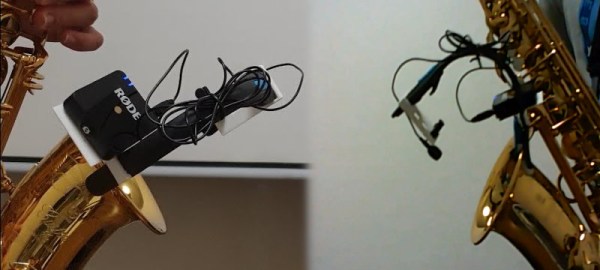
Sometimes, economies of scale don’t work in our favor. While guitarists and singers will find themselves well catered to by the accessories market, players of fancier, less popular instruments will often have to dig deeper in their pockets to get what they need. [Henry Goh] found himself in need of a saxophone mic. However, off-the-shelf solutions were a touch expensive, and thus he decided he could probably whip something up himself. (Video, embedded below.)
Parts of a saxophone, for the uninitiated. The microphone should be placed a good distance from the center of the bell to pick up the best sound.
It’s a simple solution, one that we could imagine any maker quickly whipping up with junkbox parts. Not one to skimp on quality, [Henry] picked a Rode Wireless Go paired with a lavalier mic for a quality wireless microphone solution. The real problem would be mounting the device, intended to be worn on a shirt, to the right position in front of the saxophone’s bell.
To achieve this, most dedicated sax mics used a bendable arm to allow the position to be readily changed. Instead, [Henry] whipped up some mounts on the 3D printer that would allow him to mount the Rode wireless mic hardware on an bendy Energizer LED torch. The torch even comes with a clamp allowing it to be easily attached to the instrument, making fitment a cinch.
[Henry] estimates the solution saved him up to $800 SGD. The final result is cost effective, and gives quality easily good enough for amateur and community performances. As a bonus, the hack is non-destructive, meaning you can repurpose the lavalier mic for other work as needed.
You’ve built a brand new project, and it’s a wonderful little thing that’s out and about in the world. The only problem is, you need to know its location to a decent degree of accuracy. Thankfully, GPS is a thing! With an off-the-shelf module, it’s possible to get all the location data you could possibly need. But how do you go about it, and what parts are the right ones for your application? For the answers to these questions, read on! Continue reading “How To Choose The Right GPS Module For Your Project”→