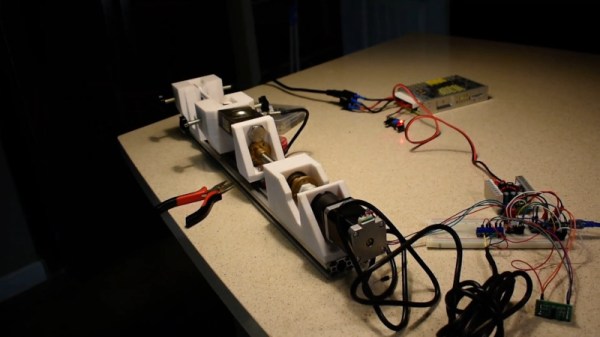
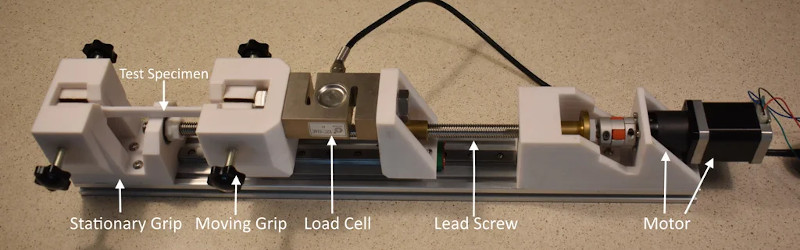
If you’re serious about engineering the things you build, you need to know the limits of the materials you’re working with. One important way to characterize materials is to test the tensile strength — how much force it takes to pull a sample to the breaking point. Thankfully, with the right hardware, this is easy to measure and [CrazyBlackStone] has built a rig to do just that.
Built on a frame of aluminium extrusion, a set of 3D printed parts to hold everything in place. To apply the load, a stepper motor is used to slowly turn a leadscrew, pulling on the article under test. Tensile forces are measured with a load cell hooked up to an Arduino, which reports the data back to a PC over its USB serial connection.
It’s a straightforward way to build your first tensile tester, and would be perfect for testing 3D printed parts for strength. The STEP files (13.4 MB direct download) for this project are available, but [CrazyBlackStone] recommends waiting for version two which will be published this fall on Thingiverse although we didn’t find a link to that user profile.
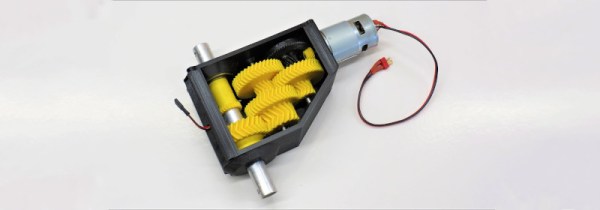
Typically, when we think of 3D printed parts, we think of unique parts with complex geometries that would be hard to fabricate with other techniques. Strength is rarely the first thing that comes to mind, due to the limitations of thermoplastics and the problem of delamination between layers. However, with smart design, it’s possible to print parts capable of great feats, just as [Brian]’s high-torque gearbox demonstrates.
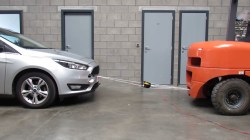
Pulling a car is a great way to show off the strength of your build.
The gearbox consists of entirely 3D-printed gears, along with the enclosure, with the only metal parts being a few bearings and shafts. Capable of being produced out of PLA on a regular FDM printer, [Brian] has successfully tested the gearbox up to 132 kg∗cm. The suspicion is that there may be more left in it, but some slippage was noticed in the gear train when trying to tow a Ford Focus with the handbrake still on.
Even better, with the addition of a potentiometer, the gearbox can be used as an incredibly tough servo. [Brian] demonstrates this by lifting 22 kg at a distance of 6 cm from the center of the output shaft. The servo does it with ease, though eventually falls off the bench due to not being held down properly.
It’s a build that shows it’s possible to use 3D-printed parts to do some decently heavy work in the real world, as long as you design appropriately. [Brian] does a great job of explaining what’s involved, discussing gear profile selection and other design choices that affect the final performance. We’ve seen similar work from others before, too. Video after the break.
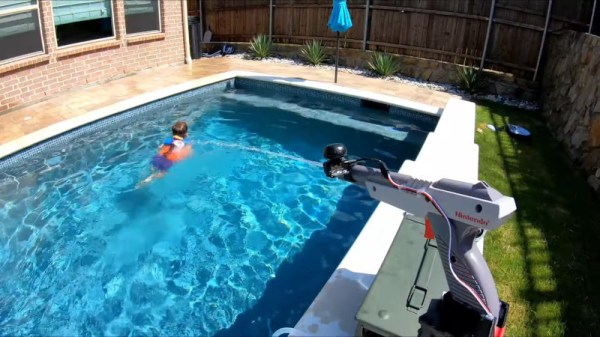
Super Soakers were great fun back in the day, but adults tend to get tired of the manual labour of pumping pretty quickly. [Sean] decided to build something a touch more modern, coming up with this head-tracking water blaster.
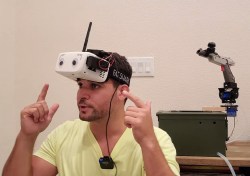
The water spray tracks the movement of the wearer’s head. With a camera mounted on the nozzle, this allows the user to simply look to designate targets. Similar technology is used in military fighter jets.
To eliminate pumping, the build instead enlists the services of an electric pump, powered by a 12 V battery. Pushing water through a tube into a 3D printed nozzle, it provides a fat stream of water with around 5 meters range, with little effort from the user. The nozzle is fitted into a NES Zapper, and attached to a servo pan-tilt platform. The camera is mounted on the water gun, and hooked up to a set of Fat Shark FPV goggles with an IMU unit. When the user looks around, the water gun moves in sync with their head movements. This allows for the user to look at targets to hit them with the water stream, a very intuitive method of aiming.
It’s a fun build that’s perfect for the summer, and an easy one to recreate for anyone with some spare servos and FPV gear. Of course, with a little face-tracking software, it would be easy to hit targets automatically. Video after the break.
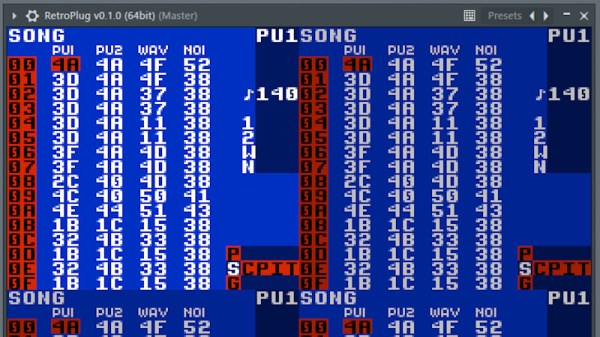
The Gameboy is one of the biggest platforms in the chiptune scene. While it’s possible to play a show with a single handheld, many artists choose to use two or even more to fatten their sound and rock the crowd. To ease the workflow of creating songs for such a setup, [tommitytom] created Retroplug and you can see him walk through the features in the demo video after the break.
Retroplug is a VST wrapper for the Sameboy Gameboy emulator. This makes it possible to run multiple emulated Gameboy instances within digital audio software like Ableton or Fruityloops. Rather than having to juggle multiple 30-year old Gameboys and the associated batteries and link cables, instead, it can all be done within a hosted VST window.
Presently, the software works only with 64-bit Windows and VST2, however source is available for those eager to peek under the hood. It fully implements MIDI support for mGB, and works well with LSDJ and Arduinoboy setups. *.sav files are created for each emulated instance too, so when you’re done composing, you can throw your songs onto real hardware when you go out and perform!
We see no shortage of fresh projects, from Genesis chiptune players to MIDI control for Gameboys. As its adherents always say, chiptune will never die. We’d love to see a similar project done with a C64 emulator, NES, or even the Genesis. If you happen to put it goether, drop us a line!
Tiny remote control cars burst onto the scene from time to time, often sold from mall kiosks and covered in garish stickers. However, sometimes it’s more fun to build than to buy. [diorama111] clearly fits into this camp, building a tiny 1:150 scale RC car from the ground up.
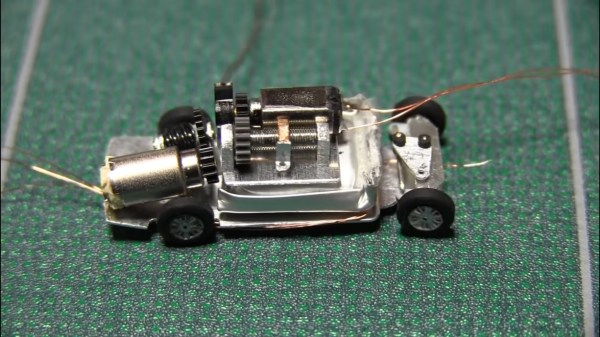
The build starts with a Tomy 1:150 model Toyota Crown / Avalon. However, only the outer shell remain. From giving the wheels rubber tires and fabricating a delicate steering assembly, to adding motors for both locomotion and turning, the mechanical build is on point. But seeing the ATtiny1616 is deadbugged with a DRV8835 motor driver, with the SMD parts hooked up with magnet wire to save the most space possible is equally impressive. A PIC79603 IR module is used to receive the commands to drive the car.
When lost hiking out in the back country, a cell phone might not seem like the most useful tool. Absent a signal from the cellular network, it’s not possible to make outgoing calls for help. However, carrying your phone may just make it a lot easier for rescuers to find you, and [Eric] is making a tool to do the job.
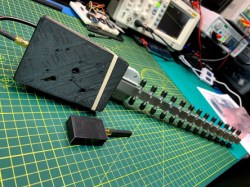
The handheld version of ResQ features a directional Yagi antenna to help pinpoint the location of the signal.
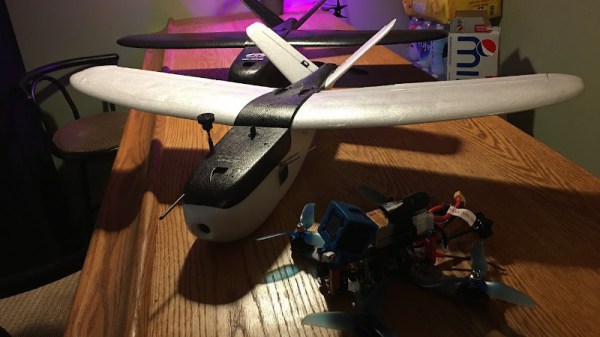
[Eric]’s project is named ResQ, and aims to find lost hikers by detecting the beacon packets from a cellphone’s WiFi adapter. The project comes in two forms; a handheld unit with a directional Yagi antenna, and a drone-mounted unit that can overfly terrain to scan for signals.
ResQ is built around the ESP8266, which is a cheap and accessible way to build a custom WiFI scanner. Currently, the system is able to detect WiFi devices and log MAC addresses along with timestamps and GPS location data to an SD card to help rescuers locate lost individuals. Future plans involve adding a live downlink to the drone such that any pings can be reported live for rescuers to investigate.
Similar systems exist commercially, primarily working with cell signals rather than WiFi. Costs are prohibitively high for many organisations though, so we can see ResQ filling in gaps as a useful tool to have. We’ve featured other radio gear for search and rescue before, too. Video after the break.
In the fast food industry, speed is everything. The concept has never just been about cooking quickly. Players in this competitive space spend huge fortunes every year on optimizing every aspect of the experience, from ordering, to queueing, to cleaning up afterwards. And while fast food restaurants are major employers worldwide, there’s always been a firm eye cast over the gains that automation has to offer.
Flipping Burgers
In the West, fast food most commonly brings burgers to mind. Preparing a quality burger requires attention to the grade of meat, fat content, as well as the preparation steps before it hits the grill. Then it’s all about temperature and time, and getting just the right sear to bring out the natural flavors of the beef. While a boutique burger joint will employ a skilled worker to get things just right, that doesn’t fly for fast food. Every order needs to be preparable by whichever minimum-wage worker got the shift, and be as repeatable as possible across entire countries, or even the world, to meet customer expectations.
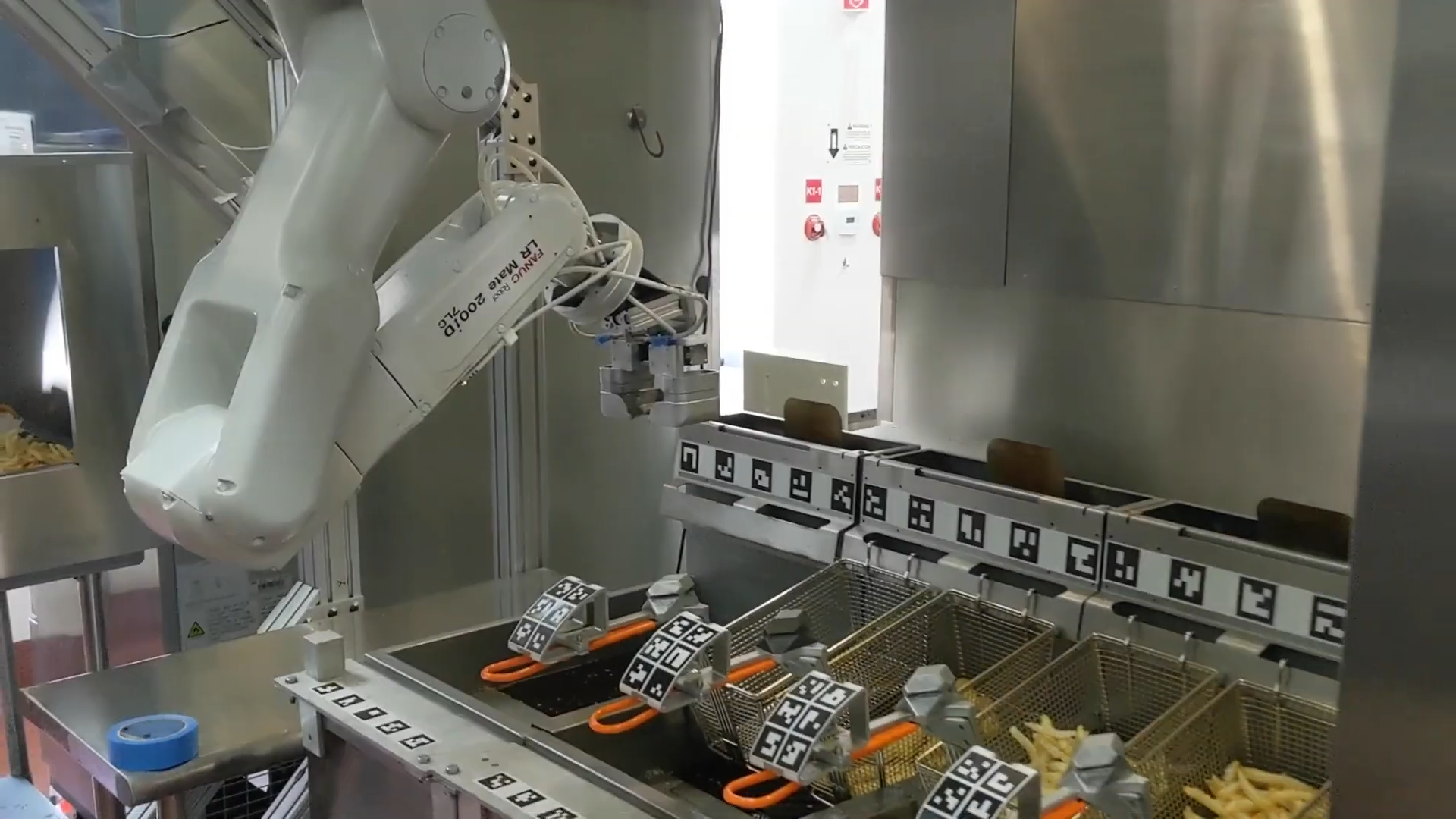
Flippy ROAR (Robot On A Rail) at work on the fryers in a White Castle in Chicago.
In their efforts to improve efficiency, White Castle have taken the bold step of installing a robotic burger flipper, imaginitively named Flippy. Built by Miso Robotics, the robot hangs from a ceiling rail to minimise the space taken up in the kitchen area. Based on a Fanuc robot arm, the system uses artificial intelligence to manage kitchen resources, Flippy is capable of managing both the grill and fryers together to ensure fries don’t get cold while the burgers are still cooking, for example. Currently undergoing a trial run in Chicago, White Castle has ambitions to roll the technology out to further stores if successful.
We’ve seen other robotic burger systems before, too. In late 2018, our own [Brian Benchoff] went down to check out Creator, which cooks and assembles its burgers entirely by machine. Despite suspicions about the business model, Creator have persisted until the present day with their unique blend of technology and culinary arts. Particularly impressive were their restaurant modifications in the face of COVID-19. The restaurant received an overhaul, with meals being robotically prepared directly in a take-out box with no human contact. Take-out meals are double-bagged and passed to customers through an airlock, with a positive-pressure system in the restaurant to protect staff from the outside world.
Pizzabots
Pizza is a staple food for many, with high demand and a stronger dependence on delivery than other fast food options. This has led to the industry exploring many avenues for automation, from preparation to order fulfillment.
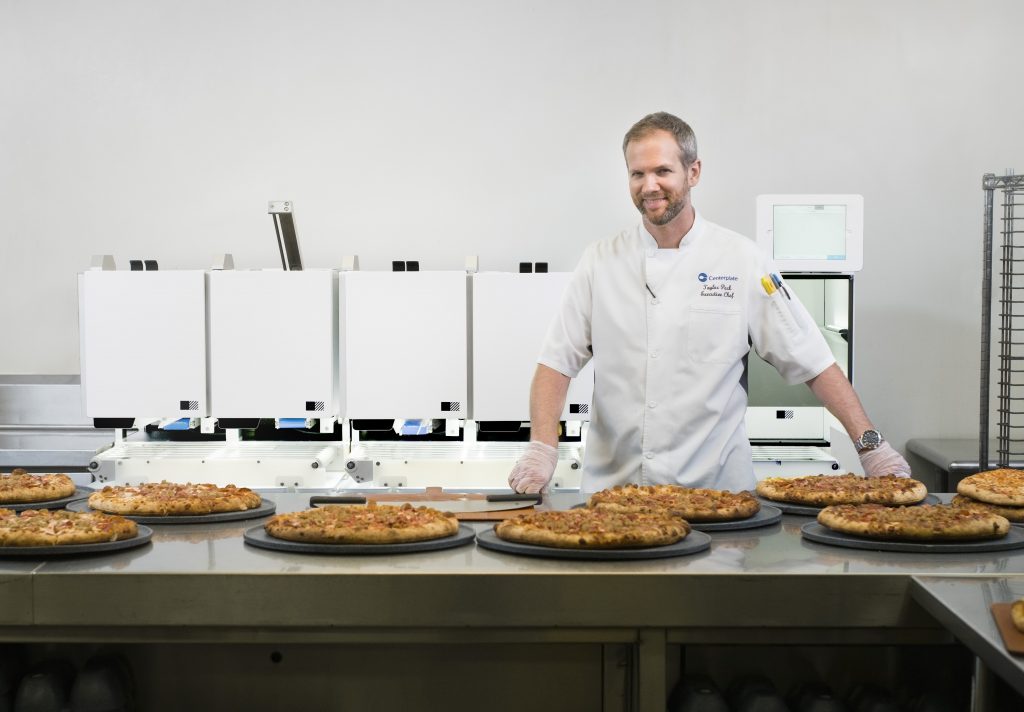
In terms of outright throughput, Zume were a startup that led the charge. Their system involves multiple robots to knead dough, apply sauce and place the pie in the oven. Due to the variable nature sizes and shapes of various toppings, these are still applied by humans in the loop. Capable of turning out 120 pizzas per hour, a single facility could compete with many traditional human-staffed pizza shops. They also experimented with kitchens-on-wheels that use predictive algorithms to stock out trucks that cook pizzas on the way to the customer’s door. Unfortunately, despite a one-time $4 billion USD valuation, the startup hit a rocky patch and is now focusing on packaging instead.
Picnic aim to make lots of pizza, fast. Their business model involves working directly with existing restaurants, rather than creating their own fast-food brand from scratch.
Picnic have gone further, claiming an output rate of up to 300 twelve-inch pies an hour. The startup aims to work with a variety of existing pizza restaurants, rather than striking out as their own brand. One hurdle to overcome is the delivery of a prepared pizza into the oven. There are many varieties and kinds of pizza oven used in commercial settings, and different loading techniques are required for each. This remains an active area of development for the company. The company has a strong focus on the emerging ghost kitchen model, where restaurants are built solely to fulfill online delivery orders, with no dining area.
Domino’s is one of the largest pizza companies in the world, and thus far have focused their efforts on autonomous delivery. The DRU, or Domino’s Robotic Unit, was launched to much fanfare, promising to deliver pizzas by a small wheeled robotic unit. Equipped with sensors to avoid obstacles and GPS navigation, the project has not entered mainstream service just yet. However, between this and the multitude of companies exploring drone delivery, expect to see this become more of a thing in coming years.
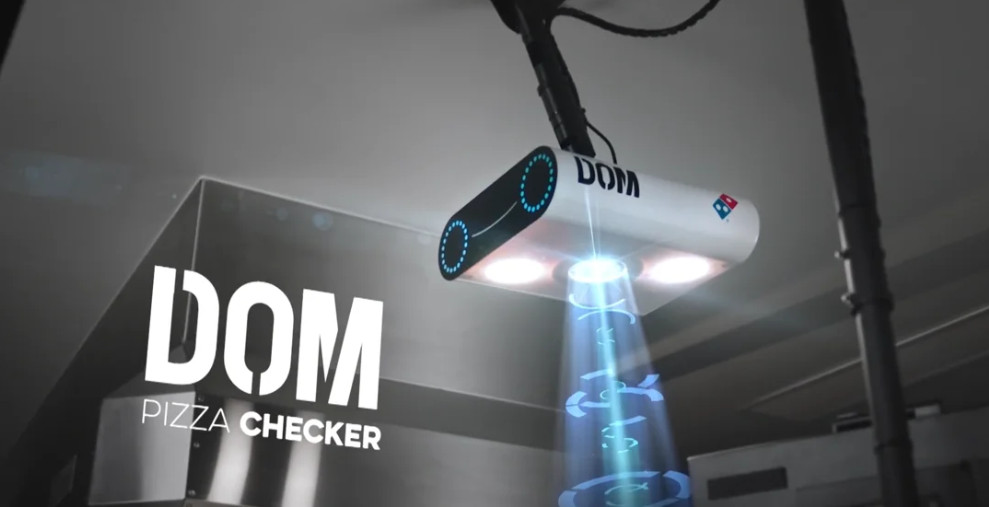
Despite the marketing sizzle, the DOM Pizza Checker does not project holograms.
A more immediate innovation from Domino’s has been the DOM Pizza Checker. With customer complaints about pizza quality plaguing the chain, the pizza checker is an AI-powered visual system. It’s responsible for determining if the correct pizza has been made, with the right toppings and good distribution. An impressive practical use of AI imaging technology, it sounds an alarm if the pizza isn’t up to scratch, prompting it to be remade. However, it has come under scrutiny as a potential method to harass franchisees and workers. Additionally, the limitations of the system mean that Domino’s are still perfectly capable of turning out a bad pizza on occasion.
Other Efforts
One of the most visible examples of fast food automation is the widespread adoption of order kiosks by McDonalds, which kicked off in earnest in 2015. The majority of stores in the US now rely on these to speed up the ordering process, while also enabling more customization for customers with less fuss. Over-the-counter ordering is still possible at most locations, but there’s a heavy emphasis on using the new system.
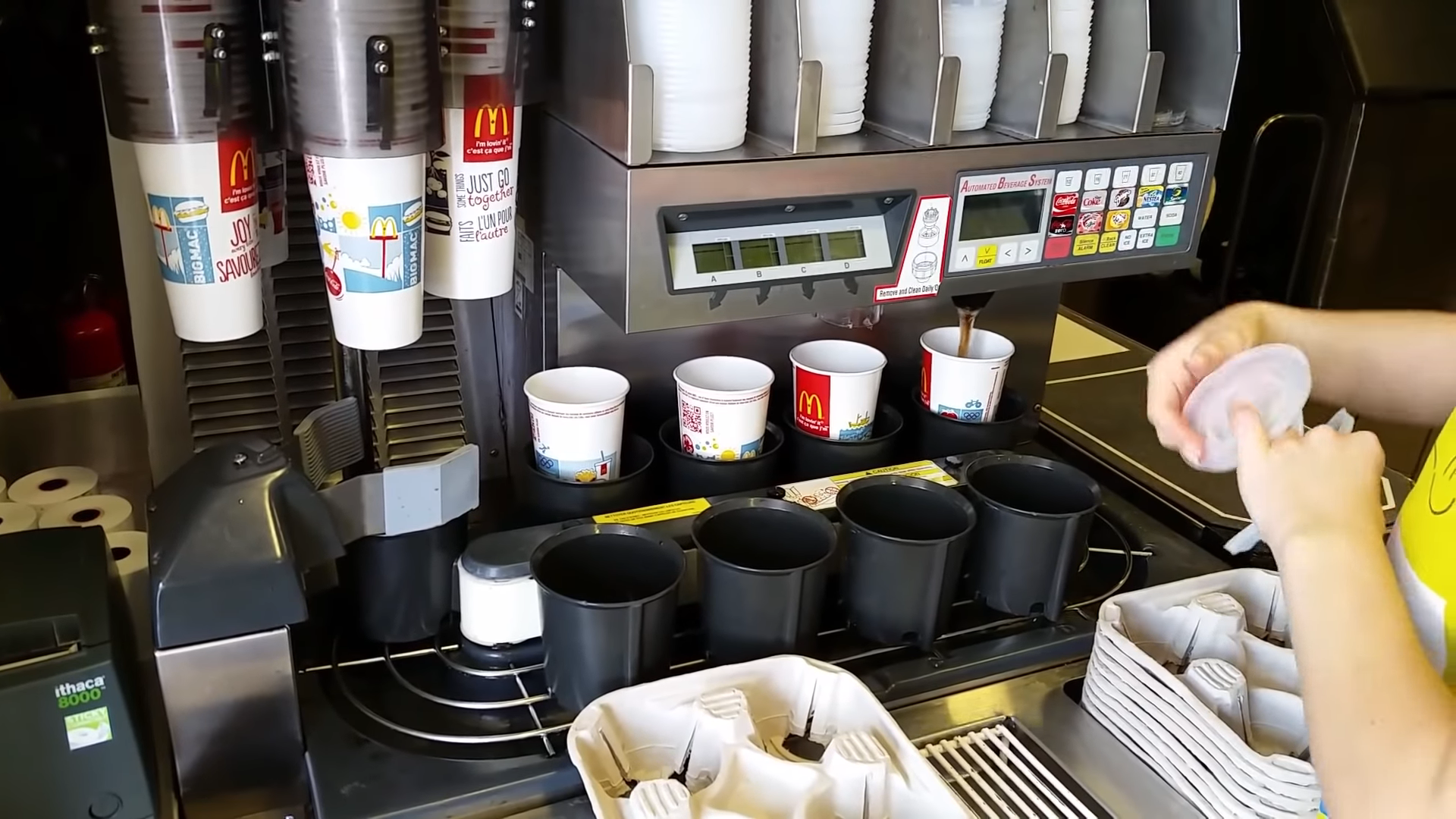
McDonald’s automated beverage dispenser will be a familiar sight to many. Considered a great help when it works, and a great hindrance when it jams, spills, or simply shuts down.
In general, online ordering and delivery has become the norm, where ten years ago, the idea of getting McDonalds delivered was considered magical and arcane. This writer made seven attempts to take advantage of an early version of the service in China in 2015, succeeding only once, largely due to a lack of understanding of addresses written in non-Latin characters. However, due to the now-ubiquitous nature of services like Ubereats, Postmates, and Menulog, it’s simple for any restaurant to largely automate their ordering and fulfillment process, and reach customers at a distance from their brick-and-mortar locations.
Other efforts are smaller in scope, but contribute to great efficiency gains back-of-house. McDonalds and other chains have widely adopted automated beverage systems. Capable of automatically dispensing cups and the requisite fluids, they take instructions directly from the digital ordering system and take the manual labor out of drink preparation. They’re also great at slightly underfilling the cups, in a way that any human would consider incredibly rude.
Conclusion
Robots in the fast-food kitchen stand to reduce or eliminate tedious, repetitive work. Robots don’t get sick, and less human labour means fewer rostering hassles. It seems to be a foregone conclusion that more automation is on the way, and while some startups may falter, others will surely succeed. Your next meal may just yet be entirely prepared by a robot, even if it’s still delivered by a tired grad student on a moped. Come what may!

 The build starts with a Tomy 1:150 model Toyota Crown / Avalon. However, only the outer shell remain. From giving the wheels rubber tires and fabricating a delicate steering assembly, to adding motors for both locomotion and turning, the mechanical build is on point. But seeing the ATtiny1616 is deadbugged with a DRV8835 motor driver, with the SMD parts hooked up with magnet wire to save the most space possible is equally impressive. A PIC79603 IR module is used to receive the commands to drive the car.