Delicious Optics, A Chocolate Diffraction Grating

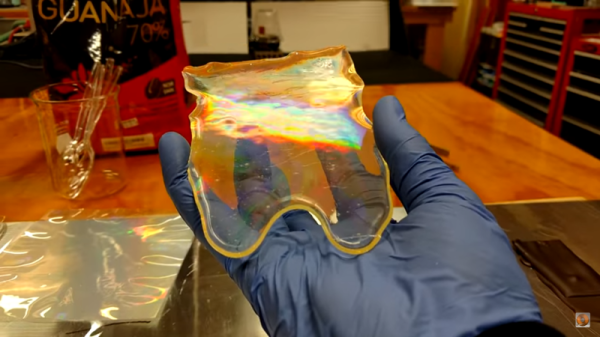
Diffraction gratings are curious things. Score a series of equally spaced tiny lines in a surface, and it will cause reflected or transmitted light to bend and separate into its component wavelengths. This ability gives them all manner of important applications in the field of optics, but they’re also fun to play with. [Tech Ingredients] has done the hard work to find out how to make them out of candy!

The video starts with a basic discussion on the principles of diffraction gratings. The basis of the work is a commonly available diffraction grating, readily available online. It’s a plastic sheet with thousands of microscopic ridges scored into the surface. The overarching method to create a candy version of this is simple — coat the ridged surface in liquid chocolate or sugar syrup, to transfer the impression on to the candy surface when it solidifies. However, the video goes further, explaining every step required to produce a successful end result. The attention to detail is on the level of an industrial process, and shows a mastery of both science and candy processing techniques. If you’ve ever wondered how to properly crystallize chocolate, this video has the knowledge you need.

It’s not often we see candy optics, but we like it — and if you fail, you can always eat your mistakes and try again. If you’re wondering what you can do with a diffraction grating, check out this DIY USB spectrometer.


Magic 8 Ball Business Card Will Answer All Your Questions

The PCB business card has long been a staple amongst the freelance EE set. It’s a way to show potential clients that you can do the job, as well as leave a great first impression. Some are simple blinkenlights devices, others have contact information on USB storage. We reckon that [Seamus] has really hit it out of the park with this one, though.

That’s right- this business card riffs on the classic Magic 8-ball toy. Ask a question, shake the card, and it’ll light an LED with the corresponding answer to your query. Use it as a desk toy, or break deadlocks in meetings by looking to the card for the correct course of action.

It’s a very tasteful build, showing off [Seamus]’s minimalist chops – consisting of just a decade counter, a tilt sensor, and some LEDs. When the card is shaken, the tilt sensor outputs a series of pulses to the clock line of the decade counter, whose outputs are the 8 LEDs. When the tilt sensor settles, it lands on the final answer.

We think it’s a great card, which shows off both fundamental technical skills as well as a certain flair and creativity which can be key to landing exciting projects. It doesn’t hurt that it’s good fun, to boot. For another take on the Magic 8-ball, check out this build that can give you a Yes/No answer on demand.

Lazy Hacker Checks Fuel System For Leaks, The Easy Way

Old cars are great. They represent a different time, reflecting the state of society at the point of their design and manufacture, and can charm and delight while also providing useful transport. Except, well… old cars are great, except when they’re not.

With my Volvo 740 hitting its thirtieth birthday and cresting over 200,000 miles, to say its a little worse for wear is an understatement. The turbo dadwagon has suffered transmission issues, and cold starting woes… but most frustrating is the sudden spike in fuel use. After some work, my humble daily driver had slid from using an acceptable 21 miles per gallon, to getting just 15. Add on the fact that the turbocharged engine demands premium fuel, and you can understand my consternation.

Now that I was haemorrhaging cash on a gargantuan weekly fuel bill, I had plenty of motivation to track down the problem. Busy, and eager for a quick solution, I deferred to a mechanic recommended as the local expert in all things Volvo. Sadly, the results were inconclusive — initial appearances were that all the engine’s electronic controls were functioning to specifications, and I was told that it was “probably a bad batch of fuel”.

Unfortunately, several expensive tanks later, sourced from all over town, revealed that the problem was in fact real. With a supposedly reliable report that the fuel mixture was correct, thus ruling out culprits like the oxygen sensor, I began to wonder, was I simply pouring fuel out the tank?

Continue reading “Lazy Hacker Checks Fuel System For Leaks, The Easy Way” →

3D Print A Thinner Car Key

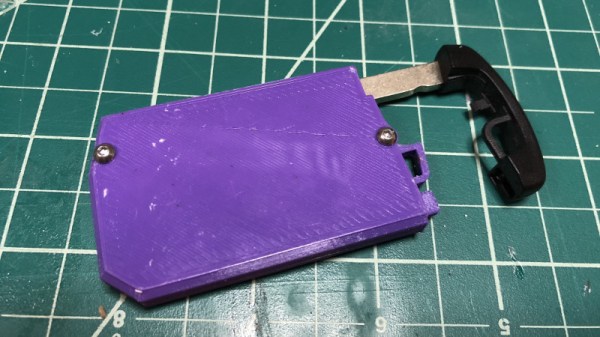
Almost all modern cars come with keyless entry, some even come with keyless start. Of course, the price you pay for this technology is a bulky plastic keyfob that is an absolute pain to remove from your pockets, and generally spoils the lines of your carefully chosen outfit. [Jeremy] decided enough was enough.

The project begins with a careful disassembly of the original key. This is important to avoid damaging the PCB inside, particularly if there are any delicate wire links between different sections of the keyfob. With the piece disassembled, it was then time to start designing a replacement encasement to hasten escapement while pacing the pavement.

The 3D printer really is the perfect tool for the job here, and [Jeremy] employs it well. With this being a proximity-based keyfob, the buttons are only necessary if you want to operate the locks at a distance. They simply took up too much vertical space, so they had to go. In the end, with a redesigned housing for the PCB, and while retaining the backup mechanical key, the new fob is just 11mm, down from 18mm – a nearly 40% saving in thickness!

It’s a tidy way to clean up your pockets and make life easier. We’ve seen similar work before, too.

Handheld Propulsion Is Noisy, Awesome

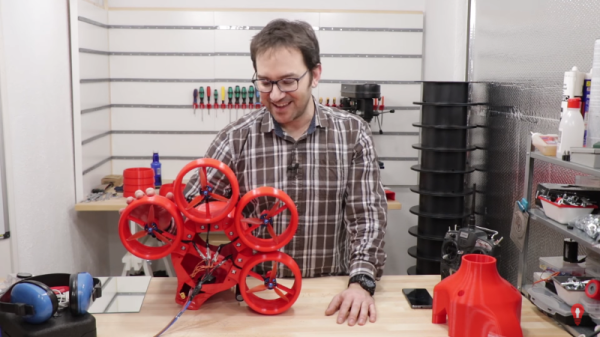
Lithium batteries are ubiquitous, cheap, and incredibly powerful. Combine them with some brushless DC motors and you’ve got serious power in a compact package. [Ivan Miranda] decided to use this to his advantage, building the Handheld Self Propelling System #1. 

Yes, we’ll come right out and say it – it’s a giant fan, and it blows. Or more accurately, it’s four moderately sized fans in one fetching wrist-mounted package. The one thing that seems completely absent from the video is an answer to the obvious question – why? Other than doing damage to the hearing of anyone nearby in an enclosed space, [Ivan] demonstrates its use with the help of a skateboard in the back end of the video.

It’s built with off-the-shelf RC parts and the body is 3D printed. This is the kind of print you want to get right first time – it takes several days to print and uses a significant amount of filament.

Overall, it’s a terrifying device that promises to do something awesome when finished. [Ivan]’s just finished the thrust test and we can’t wait to see what comes next. 

If you’re looking for another way to propel yourself on a skateboard, well – there’s always the more conventional electric path.

https://youtu.be/WmMkUWvBC64

Giant F1 Car Is 3D Printed And Radio Controlled

The OpenRC F1 car is a radio control car you can 3D print and assemble yourself. You make the parts, glue them together, and then add your RC gear. That’s all well and good, but could it be done… bigger? [3D Printing Nerd] decided to tackle this one at 4x scale.

It goes without saying that this took some work. The model has to be carved up into sections that would actually fit on the printers to hand. This can take some planning to ensure the parts still come out nicely, as they may be printed in different orientations or with different slicer settings than originally intended.

That’s just the start, though. Once they’re printed, the parts need to be accurately aligned and glued together, which is a whole extra set of challenges. Urethane, epoxy and superglue adhesives are all pressed into service here to get the job done.

It’s a multipart build, as it’s a huge undertaking to 3D print anything on this scale. It’s a great example of taking a fun project, and turning up the silly factor to 11. And of course, at the end of the day, you’ve got a gigantic RC car to play with. Perhaps the only bigger RC cars we’ve seen have been… actual cars.

Pepper Mill Locks Your Door

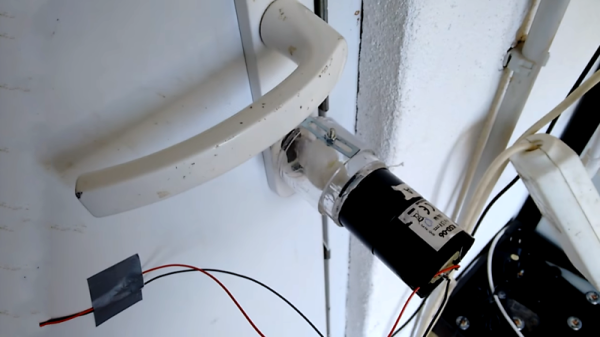
Pepper! If you’ve ever tried to grind it, you’ve probably noticed it takes a bit of elbow grease. It’s actually possible to source electric pepper mills to grind it for you, in fact. It just so happens that [MarioM66] had one to hand, and a door lock that needed automating.

Seeing as grinding pepper requires at least as much torque as turning an average key in an average lock, the electric pepper mill makes perfect sense to use as a lock actuator. This build actually uses the electric pepper mill to directly turn the key in the lock, courtesy of an adapter to couple the square output shaft to the key. The adapter was crafted out of a moldable plastic called MultiMorph. The pepper mill is being used for its high-torque motor & gearbox, which makes it absolutely perfect for this application.

The rest of the project leans heavily on the hacker’s go-to, an Arduino and some off-the-shelf gesture recognition modules. Now, it’s possible to lock and unlock the door at the press of a button or the wave of a hand! Video after the break.

It’s great to see run-of-the-mill objects hacked into useful parts for new projects. In the same vein, check out this car that lets you fistbump to unlock.

Continue reading “Pepper Mill Locks Your Door” →