In a move that’s no doubt going to trigger a lot of confusion and nostalgia, Mklinux is back, in a sense. As the announcement makes clear, this is multikernel Linux, not microkernel Linux, which is an experimental OS designed to run the Linux kernel as a user-space server running on top of OS X’s Mach kernel.
Naming overlap niggles aside, this neo-mklinux lets multiple independent Linux kernels run simultaneously on bare metal. There is still a host kernel which handles the carving up of hardware resources to the newly spawned kernels, but unlike with a hypervisor there are no abstraction or translation layers.
In theory this should mean basically perfect isolation between kernels, which is one of the main selling points along with increased performance. Compared to running KVM guests the provided benchmarks show much lower latency, at between parity to two times faster.
A website is provided with instructions to get started, along with architectural details if that’s your thing.
The Honda Goldwing is one of the more famous motorcycles ever produced. It’s known for its reliability and comfort, but also for being one of the first motorcycles Honda rolls out new technology with. It was the first to have a factory-installed airbag as well as integrated GPS, and is now largely associated for being a sort of two-wheeled RV with how many creature comforts it supports for long-distance riders. [Matt] has a Goldwing of his own, and is taking that RV-like feeling to the extreme with a rooftop camper for this motorcycle.
Of course, motorcycles don’t have roofs, but if this Goldwing had one this camper would definitely be above that. Goldwings are already heavy enough without an enormous weight dramatically increasing the center of gravity, and [Matt] certainly had his problems with that along the way. But before this adventure he had modified it into a hill climber, removing a lot of the extraneous equipment from it. Attaching some metal frame and a lightweight camper shell to it didn’t seem like too much of a stretch from there, so he got to work with a welder. At the end he has a box that’s just barely big enough for him to sleep in but is more or less functional as a camper.
Perhaps unsurprisingly, [Matt] dropped this more than once on its maiden voyage, and one of those falls damaged a wiring harness that caused his battery to drain in the night. Luckily he was not too far from home on the test drive. We’d tend to think that this camper won’t be one that [Matt] keeps working on (although we’d imagine a tricycle kit might solve his center of gravity issues) but since he’s built some other interesting campers in the past we’re not too sure we’d count this one out just yet.
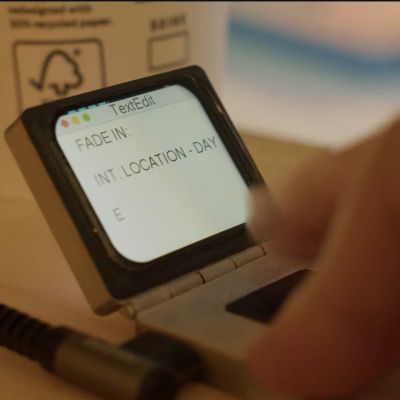
Recently [Tucker Osman] brought to life what once was just a meme created by the BBC as it poked fun at Apple’s push for ever smaller devices that also dropped many features along the path towards questionable innovation. This ‘Mactini’ was a super-small laptop, with just a single button that did everything, befitting the overpriced more-money-than-sense status symbol vibe that [Jony Ive] brought to Apple.
The input method suggested in the BBC video involves convoluted patterns using the single button, which would be functional, albeit cumbersome. Even as [Tucker] set out on this mission to make the Mactini real, he had to answer a lot of questions, while sticking to the rules that it had to follow the rough form factor of the original and have the same features.
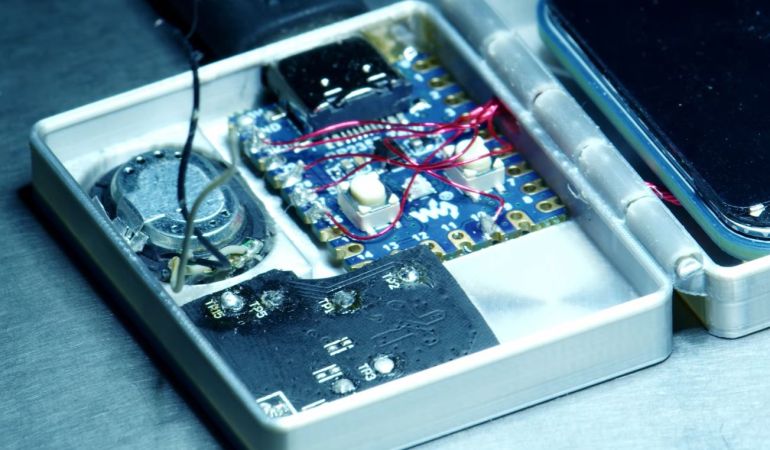
In lieu of overcomplicating things, he opted to use a 1.69″ ST7789V2-based SPI LCD along with a small RP2350-based board from Waveshare for the brains. Rather than just slapping the LCD example for the Pico board on it as firmware, he actually used DMA to do the screen data copying, freeing up a lot of CPU cycles.
The rest of the hardware was cobbled together from e-waste parts, including an iPad speaker and an audio amplifier from a scrap board. Video was handled using Motion JPEG decoding for a not-horrible-framerate. All of this was put into a 3D printed case that was designed in FreeCAD, to make the Mac that [Ive] could only have dreamed of back in the 2000s.
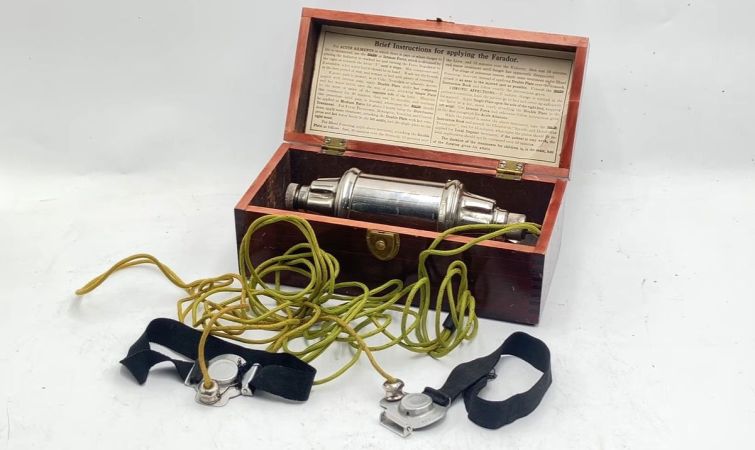
Over the centuries there have been an incredible number of purported medical devices released onto the market, with some having more outrageous claims than others. Released in the 1910s and produced into the 1920s, the Farador electrotherapeutic device claimed to be a thermoelectric device that would cure all disease conditions. In a recent video over at the [Our Own Devices] channel we get an in-depth look at this device and its usage instructions.
It’s a thermoelectric generator. Sort of. (Credit: Our Own Devices, YouTube)
On the Smithsonian’s website you can see the version they’ve got. It’s not identical, but the working principle remains the same — after bypassing the whole ‘is this the right treatment’ questionnaire because it’s a cure-all device, you take the main metal device and its connected electrodes out of the box.
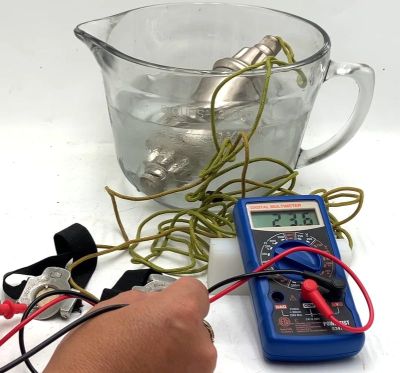
Unlike similar devices of the era that applied an actual electrical current using batteries or similar, this Farador purportedly uses thermoelectric power generation, but there’s no clear hot or cold side to what would be the generator. Despite this, about 20-30 mV can be measured across the electrodes, so surely it’s working?
As it turns out, the Farador is just one of many fake medical devices that cloned the original Electropoise. Naturally such devices have been disassembled by many over the past decades, and as it turns out they are all empty inside, or at least devoid of any mechanisms. Much like many of such fake medical devices today, they mostly bank on the placebo effect. This placebo effect can be so strong that it’s even a confounding factor in real medical trials and medicine.
The more involved and complex the purported medical treatment seems, the stronger the effect tends to be. For the Farador the complex instructions, apparently high-tech thermoelectric generator and such all help to create the illusion and could thus be construed to be the main feature of this product.
Anyone whose first computing experience came in the form of an 8-bit home computer will tell you about booting straight into a BASIC interpreter. The machine invited you to program it, and no doubt many of our middle aged readers are here today because they ran with that.
Modern computers with their fancy 64-bit multitasking supercomputer operating systems may have lost that experience, but now thanks to [Tarjan] you can bring it back. They’ve produced Thoreau BASIC, a bootable bare-metal BASIC interpreter for x86 machines with UEFI.
It’s largely GW-BASIC compatible, but with a few upgrades for the 21st century. The available memory is now whatever the system reports, so imagine a BASIC machine with gigabytes of the stuff. And while it has all the old-style BASIC you know and love, it also has high-res 24-bit graphics, and can load bitmaps. There can even be multiple text windows, it’s BASIC as you have never seen it before.
We are not sure how many will take this interpreter and run with it, after all maybe those modern 64-bit operating systems can be rather useful at times. But we’re guessing there will be plenty who’ll at least have a play with it for old time’s sake. Meanwhile, BASIC is not the only piece of UEFI goodness we’ve brought you.
The phones! They were one of the basic utilities of the 20th century, and were just about as reliable as death and taxes. Even when then power grid went down, you still had a fair shot of getting a phone call through thanks to the reliability of the Plain Old Telephone Service.
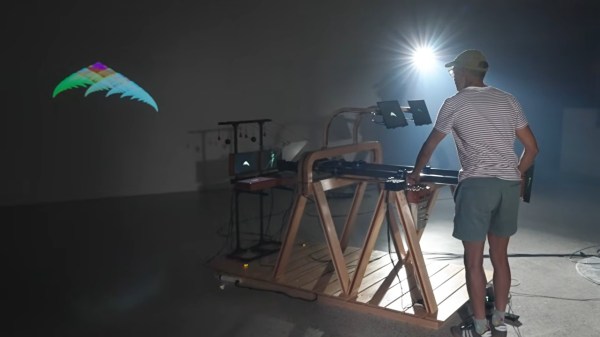
For users of a certain age, fractal patterns and computers are nearly synonymous. Typing in BASIC programs and seeing the Mandelbrot set or other fractals slowly render on screen is a key memory for some of us. Others will have generated recursive patterns mucking about: point an analog camera at the screen showing its video feed, and you’d better believe you get recursion. It’s called video feedback, and it looks a lot better than audio feedback sounds, especially in the hands of a master like [The Light Herder] who has now found a way to take this vintage art into the 4K resolution of the 21st century.
Physically this build is very similar to the “God Machine II” sculpture we covered previously, which in turn built on the first 720p version of his art piece. Getting analog video feedback in HD was hard enough — you need to be able to adjust the hue, saturation, brightness and contrast of the monitor as you go in order to have the full control of the resulting image. Most old TVs had those back in the SD era, but once HD came around it was rare; [The Light Herder] despaired of ever finding a screen that would to this in 4K.
As it turns out, the answer was to embrace digital — all the knobs on his analog control board feed into a Teensy, which is communicating via RS-232 with the LCD driver boards to alter the desired display properties. Obviously judicious selection of driver boards was required. If you watch the build video embedded below, you’ll find there’s an awful lot of tech in this analog, ‘no computer’ setup. If you want to skip the how-to and a master’s explanation of video feedback and just see pretty pictures he’s got a demo video as well. It really has to be seen to be believed.
If you want to create a colorful analog light show that isn’t quite so self-referential and a lot simpler to build, you could always try soap. Actually, we’d love to see him start the feedback with some soap-film colors. The result would likely be as was once said “totally far out, man”.



 Recently [Tucker Osman]