Hackaday Podcast Episode 249: Data By Laser And Parachute, Bluetooth Hacks, Google’s Gotta Google

‘Twas the podcast before Christmas, and all through the house, the best hacks of the week are dancing around Elliot and Tom’s heads like sugar-plums. Whatever that means.

I’d just like to interject for a moment. What you’re referring to as Christmas is, in fact, Happy/Holidays.

Before settling their brains in for a long winter’s nap, they’ll talk about the open source software podcast that now calls Hackaday home, the latest firmware developments for Google’s Stadia controller, high-definition cat videos from space, and upgrades for the surprisingly old-school battery tech that powers the Toyota Prius.

Out on the lawn, expect a clatter about the the state-of-the-art in DIY camera technology, the acoustic properties of hot chocolate, and a storage media from the 1990s that even Al Williams had never heard of.

Finally, after tearing open the shutters and throwing up the sash, the episode wraps up with a discussion about wiring techniques that let you leave the soldering iron at home, and the newest chapter in the long history of transferring data via parachute. Miniature sleigh and eight tiny reindeer sold separately.

Download the gift you really want this year: this week’s podcast in DRM-free MP3.
Continue reading “Hackaday Podcast Episode 249: Data By Laser And Parachute, Bluetooth Hacks, Google’s Gotta Google”

Use Blueprint Process To Print On Fabric With Lasers

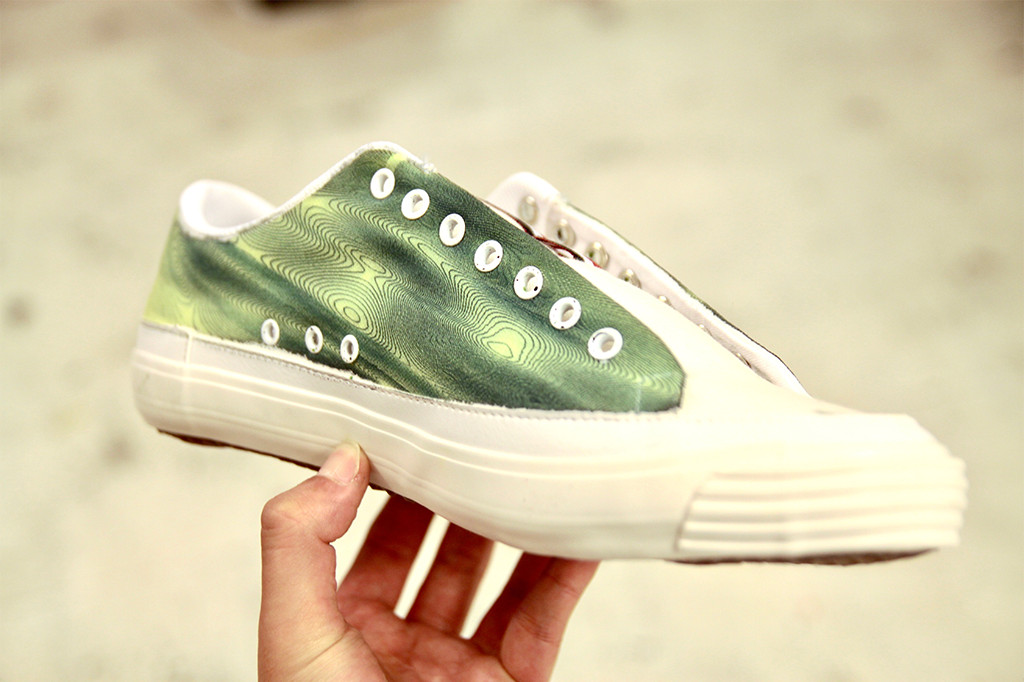
[Shih Wei Chieh] has built a laser cyanotype printer for fabrics. You know, for art!

How do you get an inkjet head on a shoe or a couch? Most printing processes require a flat surface to print. But hearkening back to the days when a blueprint was a blueprint, a mixture of an iron salt and an acid are mixed and applied to a surface an interesting reaction occurs when the surface is exposed to UV light. The chemicals react to form, of all things, prussian blue. After the reaction occurs simply washing away the remaining chemicals leaves a stable print behind.

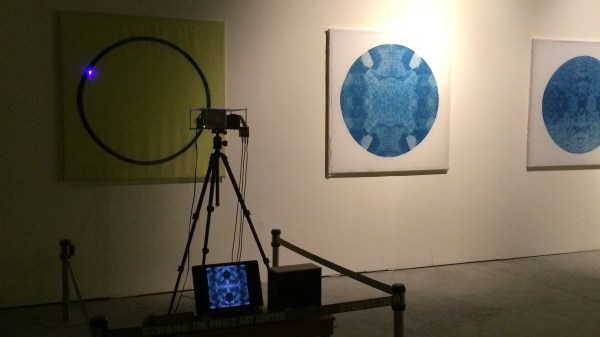
[Shih Wei Chieh] uses two galvanometers and a laser to cure the fabric. He uses a slightly newer process which reduces the exposure time required. This lets him print very large pictures, but also on uneven surfaces. As you can see in the video, viewable after the break, the effect is very pretty. There’s a new way to have the coolest pen plotter on the block.

Continue reading “Use Blueprint Process To Print On Fabric With Lasers”

1W Blue Laser – Remarkably Easy And Dangerous

[youtube=http://www.youtube.com/watch?v=lE3F7vjYx4U]

We’ve been covering Laser Hacks pretty much since the beginning but it’s surprising to see the niche market that has sprouted up around building powerful handheld modules. [Styropyro] filmed the video above as a tutorial on building a 1W blue laser. The “flashlight” that he starts with includes a heat sink intended for a laser diode. It seems there’s a lot of choices when choosing one of these build kits. A one Watt blue laser diode is press fit into the heat sink and wired in place. The body of the device receives a boost converter to get the batteries up to 1A, and once the assembly is complete the burning begins. It lights candles, matches, and pops balloons; the normal laser demo goodies.

So it’s a pretty easy build. But it’s also easy for someone being careless to damage their eyes. As [Styropyro] mentions in his comments, just looking at the dot created by the laser will damage your sight.

Seeing Sound With A Laser

You can hear sound, of course, but what if you could see it with a laser? That’s what [Goosetopherson] thought about, and thus a new project that you can see in the video below was born.

The heart of the project is an I2S chip and an ESP32. Sound energy deforms a plastic film that causes a mirror to move. The moving mirror alters the course of the laser’s beam. Continue reading “Seeing Sound With A Laser”

3D Print Smoothing, With Lasers

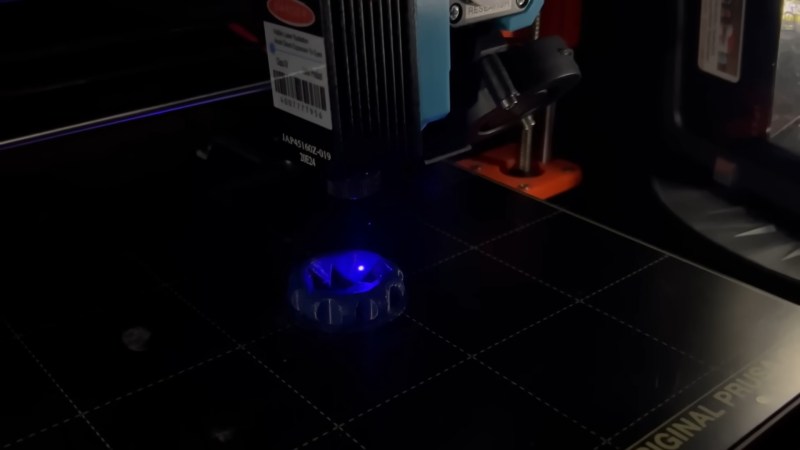
As anyone who has used an FDM printer can tell you, it’s certainly not the magical replicator it’s often made out to be. The limitations of the platform are numerous — ranging from anisotropic material characteristics to visual imperfections in the parts. In an attempt to reduce the visual artifacts in 3D prints, [TenTech] affixed a small diode laser on a 3D printer.

Getting the 1.5 watt diode laser onto the printer was a simple matter of a bracket and attaching it to the control board as a fan. Tuning the actual application of the laser proved a little more challenging. While the layer lines did get smoothed, it also discolored the pink filament making the results somewhat unusable. Darker colored filaments seem to not have this issue and a dark blue is used for the rest of the video.

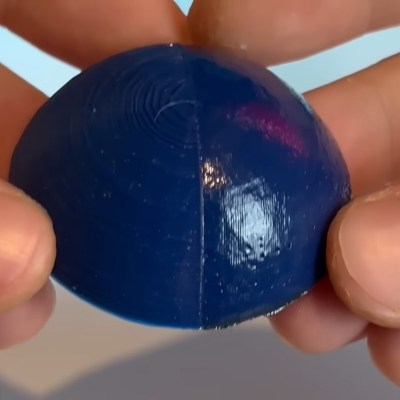
A half smoothed half unprocessed test printThe smoothing process begins at the end of a 3D print and uses non-planar printer movements to keep the laser at an ideal focusing distance. The results proved rather effective, giving a noticeably smoother and shiner quality than an unprocessed print. The smoothing works incredibly well on fine geometry which would be difficult or impossible to smooth out via traditional mechanical means. Some detail was lost with sharp corners getting rounded, but not nearly as much as [TenTech] feared.


For a final test, [TenTech] made two candle molds, one smoothed and one processed. The quality difference between the two resulting candles was minimal, with the smoothed one being perhaps even a little worse. However, a large amount of wax leaked into the 3D print infill in the unprocessed mold, with the processed mold showing no signs of leaking.

If you are looking for a bit safer of a 3D print post-processing technique, make sure to check out [Donal Papp]’s UV resin smoothing experiments!

Continue reading “3D Print Smoothing, With Lasers”

How Laser Headlights Died In The US

Automotive headlights started out burning acetylene, before regular electric lightbulbs made them obsolete. In due time, halogen bulbs took over, before the industry began to explore even newer technologies like HID lamps for greater brightness. Laser headlights stood as the next leap forward, promising greater visibility and better light distribution.

Only, the fairytale didn’t last. Just over a decade after laser headlights hit the market, they’re already being abandoned by the manufacturers that brought them to fruition. Laser headlights would end up fighting with one hand behind their back, and ultimately became irrelevant before they ever became the norm.

Continue reading “How Laser Headlights Died In The US”

Getting Started In Laser Cutting

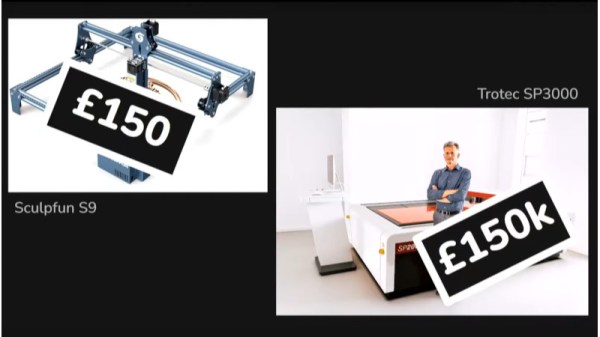
If you were to walk into most of the world’s hackerspaces, it’s likely that the most frequent big-ticket tool you’ll find after a 3D printer is a laser cutter. A few years ago that would inevitably been one of the ubiquitous blue Chinese-made K40 machines, but here in 2024 it’s become common to see something far more sophisticated. For all that, many of us are still laser cutter noobs, and for us [Dominic Morrow] gave a talk at last summer’s EMF Camp in the UK entitled “Getting Started In Laser Cutting“. [Dominic] is a long-term laser cutting specialist who now works for Lightburn, so he’s ideally placed to deliver this subject.

It’s fair to say that this is an overview in the time available for a hacker camp talk rather than an in-depth piece, so he takes the approach of addressing people’s misconceptions and concerns about cutters. Perhaps the most important one he addresses is the exhaust, something we’ve seen a few in our community neglect in favor of excessive attention to laser cooling or other factors. An interesting one for us though was his talking about the cheaper diode lasers, having some insight into this end of the market is valuable when you have no idea which way to go.

We’re sorry to have missed this one in the real world, perhaps because of the allure of junk.

Continue reading “Getting Started In Laser Cutting”