Isolated AC/DC Power Supply And Testing Station For 230 V Devices

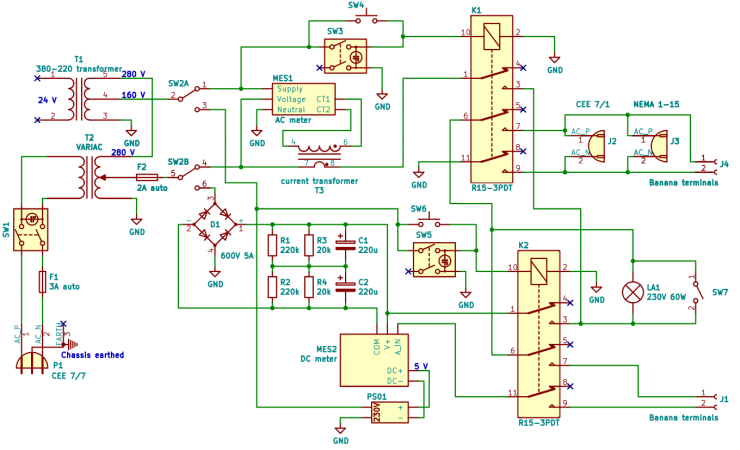
When you’re testing or debugging some mains-powered gear, plugging it directly into the outlet can often be an exciting proposition. If such excitement is not really your thing, you can opt for an isolation transformer and other types of safeties. In the case of [Michał Słomkowski], he opted to take a few steps further by modding a vintage East-German isolating variac with a broken amp meter into an isolated AC/DC power supply and testing station.
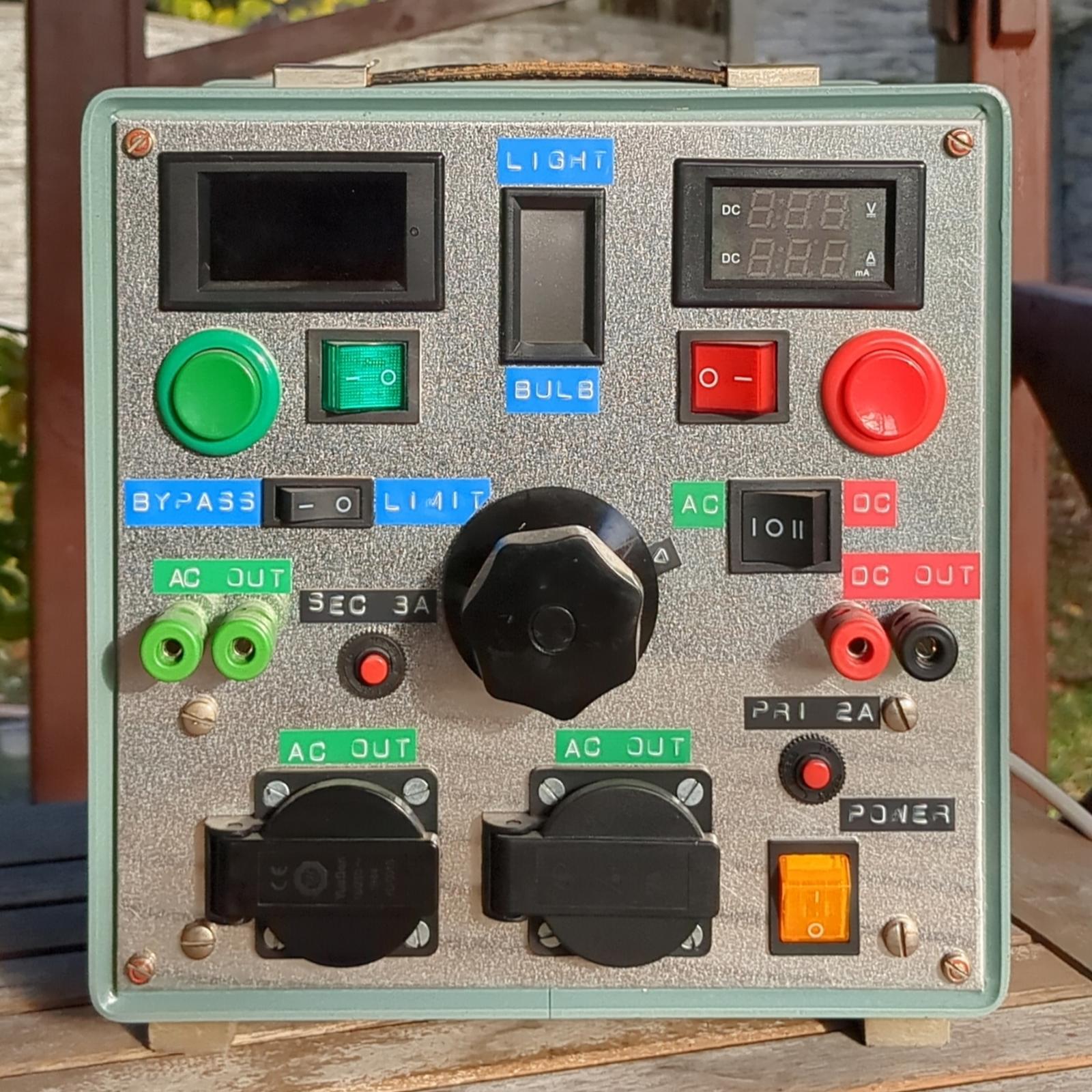
The core is formed by the isolated variable transformer, to which a configurable DC output section, a current limiter and digital voltage and current read-outs were added. This enables a variable AC output of 0 – 330 VAC and 0 – 450 VDC on their respective terminals, with the incandescent light bulb providing an optional current limiter.

In its final configuration [Michał] has been using the device for the past four years now for a range of tasks, including the simulating of various undesirable mains power conditions, varying the speed of an old Soviet-era drill, powering vacuum tube devices, capacitor reforming and of course running 100-120 VAC devices from e.g. the US.

As far as feature set goes, we have to admit that it is an impressive device, indeed. Although some parts of it are clearly playing it fast and loose with best practices, with [Michał] admitting to not being an electrician, it was clearly engineered well enough to survive a few years of use, something which cannot be said for even professional laboratory equipment these days.

[Dr Ali Shirsavar] drawing schematics and equations on the whiteboard

Calculating The Capacitance And ESR Specifications For The Output Capacitor In Your Switching-Mode Power Supply

[Dr Ali Shirsavar] from Biricha Digital runs us through How to Select the Perfect Output Capacitor for Your Power Supply. Your switching-mode power supply (SMPS) will require an output capacitor both to iron out voltage swings due to loading and to attenuate ripple caused by switching. In this video we learn how to calculate the required capacitance, and when necessary the ESR, for your output capacitor.

To begin [Dr Ali] shows us that in order to calculate the minimum capacitance to mitigate voltage swings we need values for Δi, Δv, and Ts. Using these we can calculate the minimum output capacitance. We then need to calculate another minimum capacitance for our circuit given that we need to attenuate ripple. To calculate this second minimum we need to change our approach depending on the type of capacitor we are using, such as ceramic, or electrolytic, or something else.

When our circuit calls for an electrolytic capacitor the equivalent series resistance (ESR) becomes relevant and we need to take it into account. The ESR is so predominant that in our calculations for the minimum capacitance to mitigate ripple we can ignore the capacitance and use the ESR only as it is the feature which dominates. [Dr Ali] goes into detail for both examples using ceramic capacitors and electrolytic capacitors. Armed with the minimum capacitance (in Farads) and maximum ESR (in Ohms) you can then go shopping to find a capacitor which meets the requirements.

If you’re interested in capacitors and capacitance you might enjoy reading about Measuring Capacitance Against Voltage and Getting A Handle On ESR With A Couple Of DIY Meters.

Fnirsi IPS3608: A Bench Power Supply With Serious Flaws

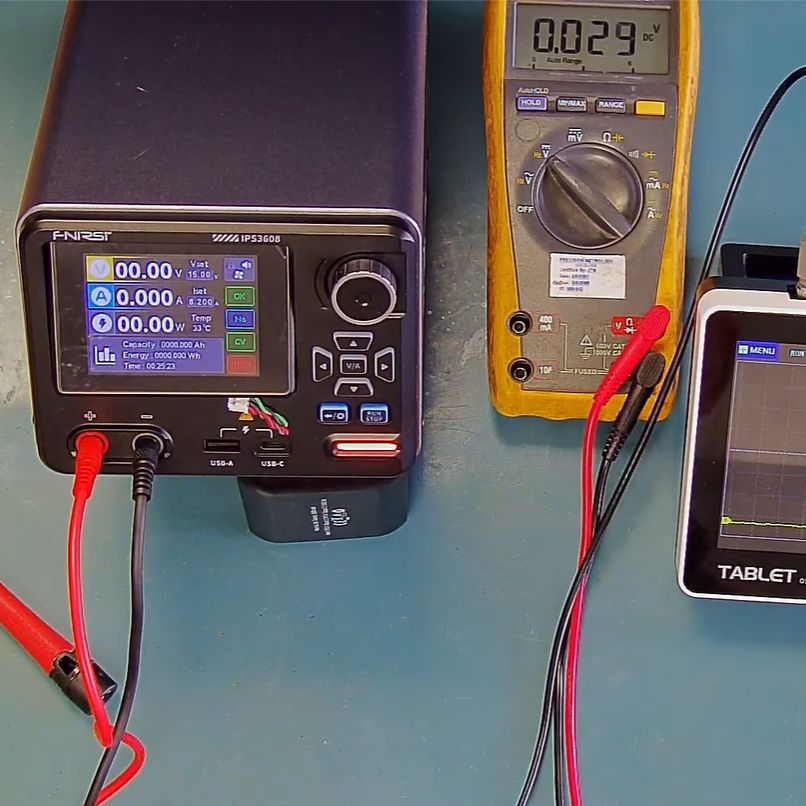
Fnirsi is one of those brands that seem to pop up more and more often, usually for portable oscilloscopes and kin. Their IPS3608 bench power supply is a bit of a departure from that, offering a mains-powered PSU that can deliver up to 36 VDC and 8 A in a fairly compact, metal enclosure. Recently [Joftec] purchased one of these units in order to review it and ended up finding a few worrying flaws in the process.

One of the claims made on the product page is that it is ‘much more intelligent than traditional power supplies’, which is quite something to start off with. The visual impression of this PSU is that it’s somewhat compromised already, with no earth point on the front next to the positive and negative banana plug points, along with a tilting screen that has trouble staying put. The USB-C and -A ports on the front support USB-PD 3.0 and a range of fast charge protocols

The ‘intelligence’ claim seems to come mostly from the rather extensive user interface, including a graphing function. Where things begin to fall apart is when the unit locks up during load testing presumably due to an overheating event. After hooking up an oscilloscope, the ripple at 1 VDC was determined to be about 200 mV peak-to-peak at 91 kHz. Ripple increased at higher voltages, belying the ’10 mV ultra-low ripple’ claim.

A quick teardown revealed the cause for the most egregious flaw of the unit struggling to maintain even 144 Watt output: a very undersized heatsink on the SMPS board. The retention issues with the tilting issue seemed to be due to a design choice that prevents the screen from rotating without breaking plastic. While this latter issue could be fixed, the buggy firmware and high ripple on the DC output make this €124 ‘285 Watt’ into a hard pass.

Continue reading “Fnirsi IPS3608: A Bench Power Supply With Serious Flaws”

Very Efficient APFC Circuit In Faulty Industrial 960 Watt Power Supply

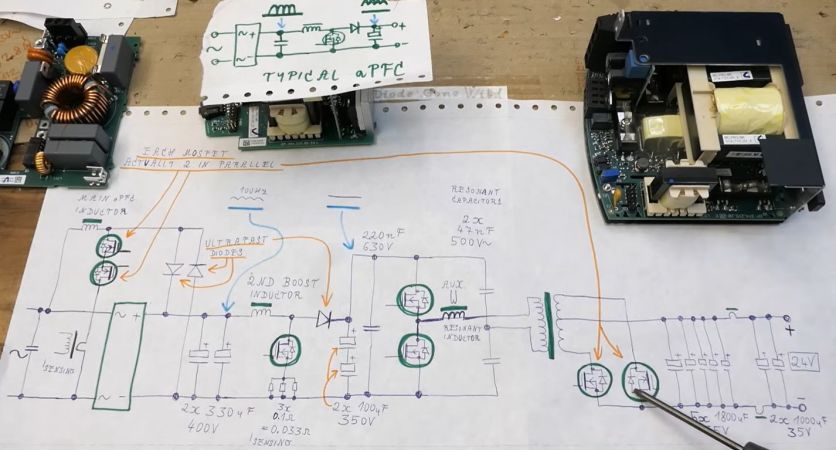
The best part about post-mortem teardowns of electronics is when you discover some unusual design features, whether or not these are related to the original fault. In the case of a recent [DiodeGoneWild] video involving the teardown of an industrial DIN-rail mounted 24 V, 960 Watt power supply, the source of the reported bang was easy enough to spot. During the subsequent teardown of this very nicely modular PSU the automatic power factor correction (APFC) board showed it to have an unusual design, which got captured in a schematic and is explained in the video.

Choosing such a APFC design seems to have been done in the name of efficiency, bypassing two of the internal diodes in the bridge rectifier with the external MOSFETs and ultrafast diodes. In short, it prevents some of the typical diode voltage drops by removing diodes in the path of the current.

Although not a new design, as succinctly pointed out in the comments by [marcogeri], it’s explained how even cutting out one diode worth of voltage drop in a PSU like this can save 10 Watt of losses. Since DIN rail PSUs rarely feature fans for active cooling, this kind of APFC design is highly relevant and helps to prevent passively cooled PSUs from spiraling into even more of a thermal nightmare.

As for the cause behind the sooty skid marks on one of the PCBs, that will be covered in the next video.

Continue reading “Very Efficient APFC Circuit In Faulty Industrial 960 Watt Power Supply”

Testing A Cheap Bench Power Supply Sold On Amazon

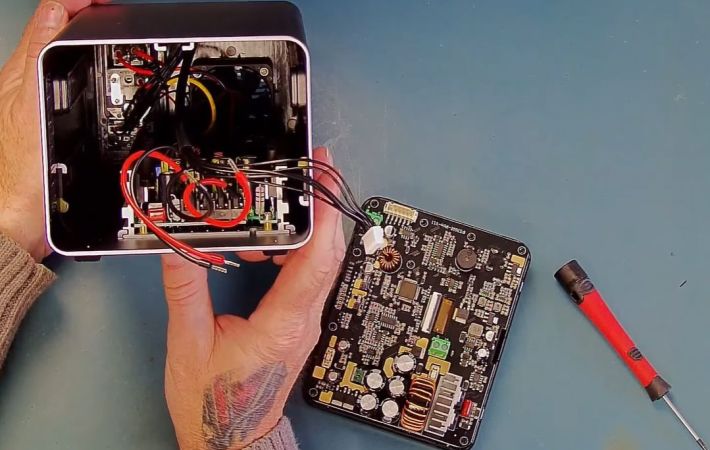
We’ve all seen those cheap bench power supply units (PSUs) for sale online, promising specifications that would cost at least a hundred dollars or more if it were a name brand model. Just how much of a compromise are these (usually rebranded) PSUs, and should you trust them with your electronics? Recently [Denki Otaku] purchased a cheap unit off Amazon Japan for a closer look, and found it to be rather lacking.

Internals of the cheap bench PSU reviewed by Denki Otaku on YouTube.

Major compromises include the lack of an output power switch, no way to check the set current limit without shorting the output, very slow drop in output voltage while adjusting due to the lack of a discharge circuit, and other usability concerns. That’s when the electrical performance of the PSU got tested.

Right off the bat a major issue in this cheap switching mode PSU is clear, as it has 200 mV peak-to-peak noise on its output, meaning very little output filtering. The maximum power output rating was also far too optimistic, with a large voltage drop observed. Despite this, it generally worked well, and the internals – with a big aluminium plate as heatsink – look pretty clean with an interesting architecture.

The general advice is to get a bench PSU that has features like an output power button and an easy way to set the voltage and current limits. Also do not connect it to anything that cares about noise and ripple unless you know that it produces clean, filtered output voltages.

Continue reading “Testing A Cheap Bench Power Supply Sold On Amazon”

Reviewing A Very Dodgy BSK-602 Adjustable Power Supply

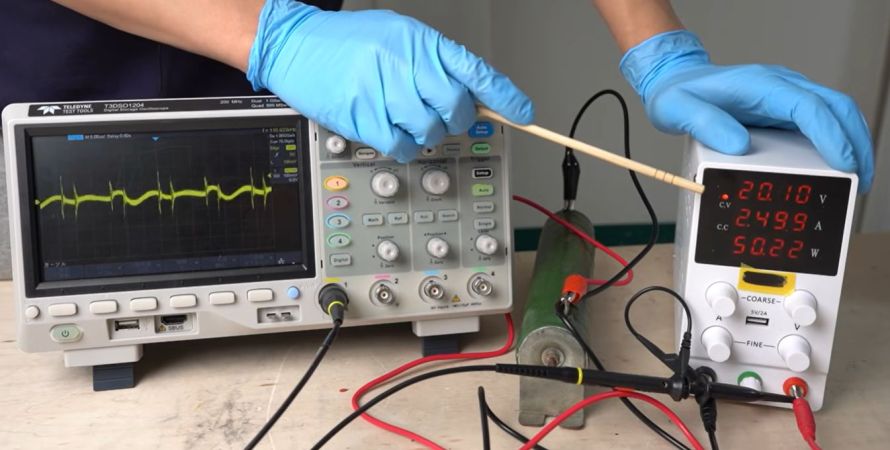
There’s no shortage of cheap & cheerful power supplies which you can obtain from a range of online retailers, but with no listed certification worth anything on them calling them ‘dodgy’ is more of a compliment. On the [DiodeGoneWild] YouTube channel an adjustable power supply by the model name BSK-602 is tested and torn down to see exactly what less than $5 off sites like Alibaba will get you.

Perhaps unsurprisingly, voltage regulation is very unstable with massive drifting when left to heat up for a few hours, even though it does hit the 3 V to 24 V DC and 3 A output that it’s optimistically rated for. After popping open the adapter, a very basic switching mode power supply is revealed with an abysmal component selection and zero regard for safety or primary and secondary side isolation. With the case open, the thermal camera reveals that the secondary side heats up to well over 150 °C, explaining why the case was deforming and the sticker peeling off after a few hours of testing.

The circuit itself is based around a (possibly legit) UC3843RN 500 kHz current mode PWM controller, with the full schematic explained in the video. Highlights include the lack of inrush protection, no EMI filtering, a terrible & temperature-dependent voltage reference, not to mention poor component selection and implementation. Basically it’s an excellent SMPS if you want to blast EMI, fry connected electronics and conceivably burn down your home.

Continue reading “Reviewing A Very Dodgy BSK-602 Adjustable Power Supply”

Giving A Proprietary Power Supply The Boot

You’ve probably noticed that everywhere you go — the doctor’s office, hotels, or retail shops, there are tiny PCs everywhere. These small PCs often show up on the surplus market for a very good price, but they aren’t quite full-blown PCs. They usually have little option for expansion and are made to be cheap and small. That means many of them have custom and anemic power supplies. We aren’t sure if [bm_00] needed a regular power supply to handle a graphics card or if the original power supply died, but either way, the HP small-form-factor box needed a new power supply. It took some clever work to be able to use a normal power supply in the little box.

At first, we thought this wouldn’t be much of a story. The motherboard surely took all the regular pins, so it would just be a matter of making an adapter, right? Apparently not. The computers run totally on 12V and the motherboard handles things like turning the computer on and off. The computer also was trying to run the power supply’s fan which needed some work arounds.

Continue reading “Giving A Proprietary Power Supply The Boot”