Announcing: The 2022 Hackaday.io Sci-Fi Contest

Ladies and Gentlemen, Sentient robots, Travellers from the distant future, or Aliens from the outer rim, it’s time to enter the 2022 Hackaday.io Sci-Fi Contest!

We last ran the Sci-Fi contest in the far, far past — before the Voigt-Kampff machine was detecting replicants on the gritty streets of 2019’s LA. Back then, we had some out-of-this-world entries. It’s time for the sequel.

Thanks to Digi-Key, the contest’s sponsor, your best blaster, your coolest costume, or your most righteous robot could win you one of three $150 shopping sprees in their parts warehouse. Create a Hackaday.io project, enter it in the contest, and you’re set. You might as well do that right now, but the contest closes on April 25th.
Sci-Fi is all about the looks, so if it’s purely decorative, be sure to blind us with science (fiction). If your project actually functions, so much the better! Of course we’d like to know how it works and how you made it, so documentation of the project is the other big scoring category. Whatever it is, it’s got to be sci-fi, and it’s got to have some electronics in it.

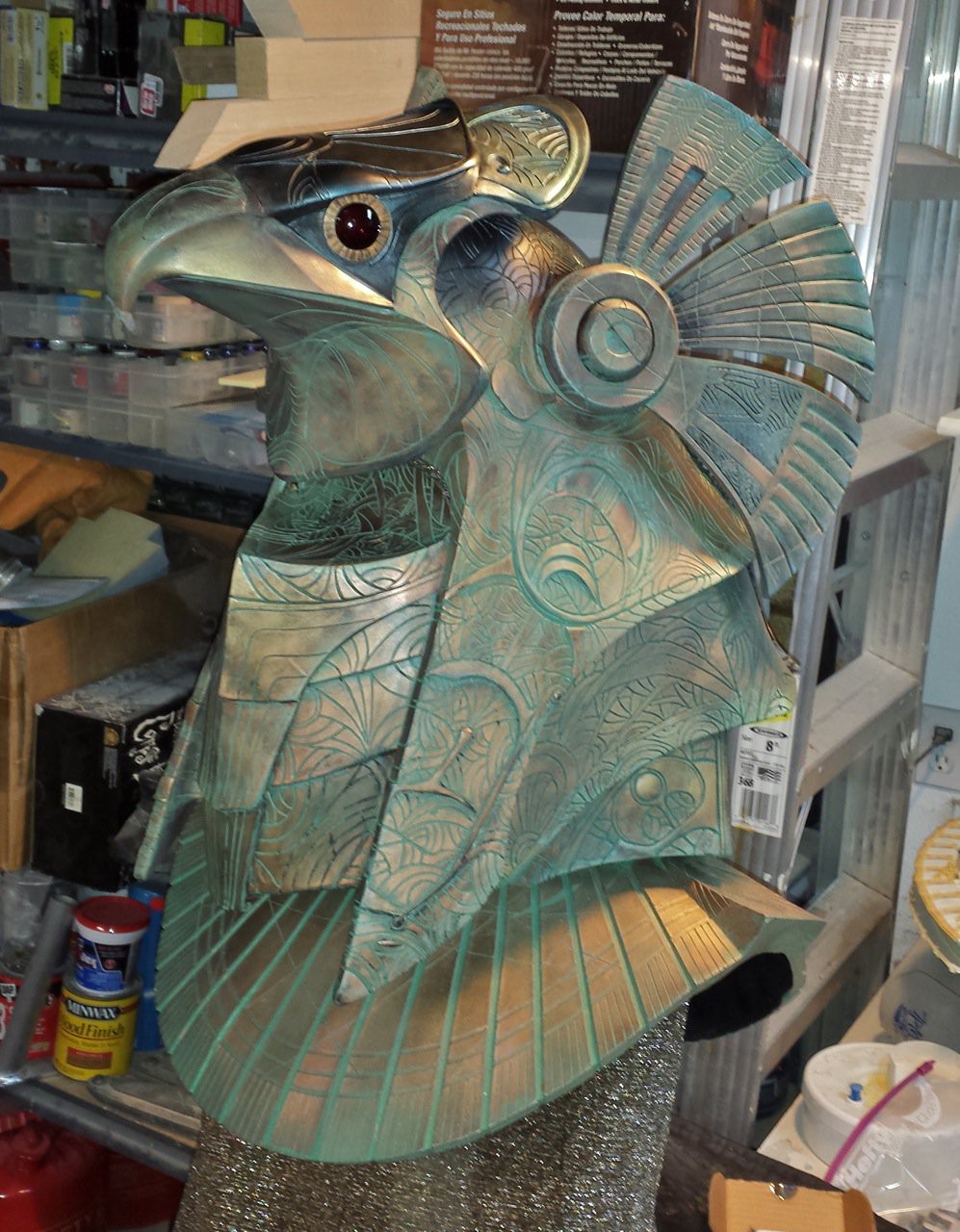
If you’re looking for inspiration, you could do a lot worse than to check out [Jerome Kelty]’s Animatronic Stargate Helmet, that not coincidentally took the grand prize last time around. It’s an artistic and engineering masterpiece all rolled into one, and the description of how it’s made is just as extensive. [Jochen Alt]’s “Paul” robot isn’t out of any particular sci-fi franchise that we know, but of rolling on one ball and reciting robot poetry, it absolutely should be.

Honorable Mentions

In addition to the overall prizes, we’ll be recognizing the best projects in the following honorable mention categories:

  • Star Star: Whether you’re “beam me up” or “use the force”, fans of either of the “Star” franchises are eligible for this honorable mention.
  • ExoSuit: This category recognizes sci-fi creations that you can wear. Costumes and armor fit in here.
  • Stolen off the Set: If your blaster looks exactly like Han Solo’s, you’re a winner here.  This is the category for your best prop replica.
  • Living in the Future: If your sci-fi device was purely fantasy when imagined, but now it’s realizable, you’re living in the future. A working tricorder or a functioning robot companion would fit in fine here.
  • The Most Important Device: Has no function, but it certainly looks like it does. Just blinking lights that blink back and forth, yet the government spent millions of dollars on it.

You don’t have to tell us where your project fits in. We’ve got you covered.

Engage!

Get started now by creating a project page on Hackaday.io. In the left sidebar of your project page, use the “Submit Project To” button to enter in the 2022 Sci-Fi Contest.

You have from now until April 25, 2022 to get it finished. Of course, if your time machine actually works, you can finish it whenever. Check out the Hackaday.io contest page for all the fine print.

Fumik: An Arduino Wall Drawing Robot Jellyfish

If you’ve ever wanted to build a large format plotter but didn’t have the floor space, maybe put it up against the wall and make it cute. That’s the idea behind Fumik, the wall-drawing robot. As you might expect, the little device is just a motion base with a pen. We hope there’s paper against the wall since not everyone wants computer-generated art on their drywall.

The maximum size is apparently 5 m wide by 3 m tall, plenty of room to express yourself. The controller is an Arduino Mega, and stepper motors with a CNC shield drive the whole assembly. Interestingly, the motor and electronics are all onboard the jellyfish itself, rather than the wall.

The device only holds one pen at a time, but you can draw with one color and then manually change the pen. The files on GitHub are good, but you’ll need to intuit some of the mechanics from the videos. However, since it uses off-the-shelf hardware, it should be pretty easy to figure it out. This looks like a cheap and cheerful wall plotter, and the results speak for themselves.

We have seen similar wall plotters. More than once, even.

Continue reading “Fumik: An Arduino Wall Drawing Robot Jellyfish”

How Did We Get To The Speed Of Light?

Every high school physics student knows c, or the speed of light, it’s 3 x 10^8 metres per second. More advanced or more curious students will know that this is an approximation, and the figure of 299,792,458 metres per second that forms the officially accepted figure comes from a resonance of the caesium atom from which is derived a value for the second.

Galileo
Galileo Galilei, whose presence in this story should come as no surprise. Justus Sustermans, Public domain.

But for those who are really curious about measuring the speed of light the question remains: Just how did we arrive at that figure and how long have we been measuring it? The answer contains some surprises, and some exceptionally clever scientific thought and experimentation over the centuries.

The nature of light and whether it had a speed at all had been puzzling philosophers and scientists since antiquity, but the first experiments performed in an attempt to measure it were you will not be surprised to hear, performed by Galileo sometime in the early 17th century. His experiment involved his observation of assistants uncovering lanterns at known distances away, and his observations  failed to arrive at a figure.

Later that century in 1676 the first numerical estimate of the speed of light was made by the Danish astronomer Ole Rømer, who observed an apparent variation in the period of one of Jupiter’s moons depending upon whether the Earth was approaching it or moving away from it. From this he was able to estimate the time taken for light to cross the Earth’s orbit, and from there the mathematician Christiaan Huygens was able to produce a figure of 220,000,000 metres per second.

Spinning Cogs And Mirrors: Time Of Flight

The mile-long evacuated tube used in Michelson's time-of-flight experiment. H.
The mile-long evacuated tube used in Michelson’s time-of-flight experiment. H. H. Dunn, Public domain.

The experiments with which we will perhaps be the most familiar are the so-called time of flight measurements, which take Galileo’s idea of observing the delay as light travels over a distance, and bring to it ever higher precision. This was first performed in the middle of the 19th century by the French physicist Hippolyte Fizeau, who reflected a beam of light from a mirror over several kilometres, and used a toothed wheel to chop it into pulses. The pulses could be increased in frequency by moving the wheel faster until the time taken for the light to travel the distance from wheel to mirror and back again matched the separation between teeth and the returning pulse could be observed. His calculation of 313,300,000 metres per second was successively improved upon through the work of succession of others including Léon Foucault, culminating in the series of experiments by the American physicist Albert A. Michelson in the 1920s. Michelson’s final figure stood at 299,774,000 metres per second, measured through a multi-path traversal of a mile-long evacuated tube in the California desert. In the second half of the century the techniques shifted to laser interferometry, and in the quest to define the SI units in terms of constants, eventually to the definition mentioned in the first paragraph.

The most fascinating part of the story probably encapsulates the essence of scientific discovery, namely that while to arrive at something takes the work of many scientists building on the work of each other, it can then often be rendered into a form that can be understood by a student who hasn’t had to pass through all that effort. We could replicate Fizeau and Michelson’s experiments with a pulse generator, laser diode, and oscilloscope, which while of little scientific value nearly a century after Michelson’s evacuated tube, is still immensely cool. Has anyone out there given it a try?

Header image: Tommology, CC BY-SA 4.0.

Galaxy Users Accuse Samsung Of Throttling Performance And Benchmark Rigging

A lot of Samsung Galaxy users think that Samsung has been throttling smartphone performance, so much so that they don’t live up to their published specifications. At issue is the game optimizing service (GOS) which is intended to throttle the CPU while playing games to prevent overheating. S22 owners have recently discovered that it’s not only games that are throttled, but there’s a list of over 10,000 apps which are subject to GOS control, and there is no way to disable it.

What they’re really upset over is the fact that popular benchmarking apps are not subject to GOS throttling — something that’s hard to see as anything but a blatant attempt to game the system. In fact, this past weekend the folks at Geekbench banned four generations of Samsung Galaxy phones (S10, S20, S21, S22) for benchmark manipulation.

Admittedly, thermal management is critical on today’s incredibly powerful handheld devices, and the concept of throttling is an accepted solution in the industry. But people are upset at the opaqueness and lack of control of GOS, not to mention cherry picking apps in order to excel at benchmarks. Furthermore Samsung has removed their vapor chamber cooling system from recent models. This makes GOS even more important and looks like a cost-savings measure that may have backfired. Currently there’s a petition with the government claiming false advertising, and users are actively pursuing a lawsuit against Samsung.

Reflow Hotplate Teardown Uncovers The Bare Minimum

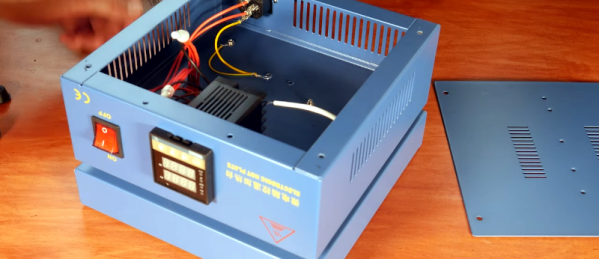
[EEforEveryone] is trying to find a good hot plate for reflow soldering. After trying one cheap unit, he got another one. He was a bit underwhelmed. The grounding was suspect and the bed wasn’t totally flat. He tore it apart and was surprised that there was very little inside. While the construction wasn’t perfect, it was better than the previous unit. You can see a video of the teardown and review below.

Before powering it up, the first order of business was to rewire the ground system. After that, it was time to try it. However, by confusing Fahrenheit and Centigrade, he set the temperature much higher than necessary which creating a little smoke. Fixing the temperature helped, but there was still a bit of a smoky smell that eventually subsided.

The verdict? The hot plate worked well enough, but you probably do want to check the ground wiring before using it. That’s often a good idea where cheap equipment is concerned, anyway. But the real takeaway is that it looks like you could homebrew something equivalent without much trouble. The controller is an off-the-shelf module. A switch and a plug aren’t hard to figure out. The heating element could be a silicone heater or PCB heater meant for a 3D printer.

Of course, there are other options. You could use a wok. Or why not a waffle iron? You can also make a custom PCB.

Continue reading “Reflow Hotplate Teardown Uncovers The Bare Minimum”

The Fliegerfaust Roars Back To Life After 77 Years

As their prospects for victory in the Second World War became increasingly grim, the Germans developed a wide array of outlandish “Wonder Weapons” that they hoped would help turn the tide of the war. While these Wunderwaffe obviously weren’t enough to secure victory against the Allies, many of them represented the absolute state-of-the-art in weapons development, and in several cases ended up being important technological milestones. Others faded away into obscurity, sometimes with little more then anecdotal evidence to prove they ever even existed.

One of these forgotten inventions is the Fliegerfaust, a portable multi-barrel rocket rocket launcher designed for use against low-flying attack planes. Although thousands were ordered to defend Berlin in 1945, fewer than 100 were ever produced, and there’s some debate about how many actually survived the war. But that didn’t stop [Jonathan Wild] of Wild Arms Research & Development from building a functional replica of the weapon based on contemporary documentation and blueprints.

Building the launcher was relatively straightforward, as it’s little more than nine tubes bundled together with a handle and a simplistic electric igniter. The trick is in the 20 mm (0.78 inch) rockets themselves, which are spin stabilized by the exhaust gasses exiting the four angled holes on the rear. With no fins or active guidance the path of each rocket is somewhat unpredictable, but this was known to be true of the original as well.

Continue reading “The Fliegerfaust Roars Back To Life After 77 Years”

WebGPU… Better Than WebGL?

As the browser becomes more like an operating system, we are seeing more deep features being built into them. For example, you can now do a form of assembly language for the browser. Sophisticated graphics have been around using WebGL since around 2011, but some people find it hard to use. [Surma] was one of those people and tried a new method that is just surfacing to do the same thing: WebGPU.

[Surma] liked it better and shares a lot of information in the post and — oddly — the post doesn’t use WebGPU for graphics very much. Instead, the post focuses on using GPU cores for fast computation, something else you can do with WebGPU. If your goal is to draw on the screen, though, you need to know the basics and the post links to a site with examples of doing this.

Continue reading “WebGPU… Better Than WebGL?”