The Nintendo Switch has been a hugely successful console for the century-old former playing card manufacturer. At least part of that success has come from its portability, of which [Michael Pick] has probably lost a bit with his 65-pound giant Nintendo Switch built for St. Jude’s Children’s Hospital. (Video, embedded below.) What he’s lost in portability has been more than made up in coolness-factor, though, and we’re sure the kids will appreciate that they can still play the monster gaming machine.
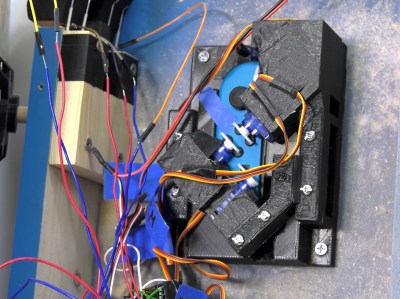
From its plywood body to the 3D-printed buttons, the supersized build looks solid. Docked inside the left Joy-Con is the actual console powering its big brother. Perhaps the biggest surprise, however, is that tiny (well, normal-sized) Joy-Cons are also hidden inside. These are manipulated via servos for the buttons and a direct pass-through setup for the joysticks to control games on the Switch.
While the Joy-Cons are unmodified and completely removable, [Michael] does recognize this isn’t necessarily the ideal solution. But he was certain it was a hack he could make work in the time he had, so he went for it. He’s looked into the controller emulation possible with Teensys and would probably use that solution for any giant Switch projects in the future. Of course, with this build, players can still pair regular Joy-Cons and pro controllers for more practical gaming.
Most Nintendo mods we see attempt to make the console smaller, not larger, so this is an eye-catching change of pace. Unfortunately, we don’t get to see the colossal console in action after it was installed, only some stills of hospital staff wheeling it in the front doors. But we can imagine that the children’s smiles are at least as big as ours were when we saw it.
High-level programming languages do a great job of making a programmer’s job easier, but these languages often leave a lot of efficiency on the table as a compromise. While a common thought is to move into a lower-level language like assembly to improve on a program’s speed or memory use, there’s often a lot that can be done at the high level before resorting to such extremes. This, of course, is true of the Arduino platform as well, as [NerdRalph] demonstrates by shrinking the size of the Arduino core itself.
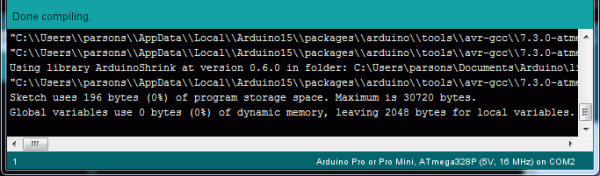
[NerdRalph] had noticed that the “blink” example program actually includes over 1 kB of extraneous code, and that more complicated programs include even more cruft. To combat this issue, he created ArduinoShrink, which seeks to make included libraries more modular and self-contained. It modifies some of the default registers and counters to use less memory and improve speed, and is also designed to improve interrupt latency as well by changing when the Arduino would otherwise disable interrupts.
While there are some limits to ArduinoShrink, such as needing to know specifics about the pins at compile time, for anyone writing programs for Arduinos that are memory-intensive or need improvements in timing, this could be a powerful new tool. If you’d prefer to go in the opposite direction to avoid ever having to learn C or assembly, though, you can always stick with running Python on your embedded devices.
The average punter shunts audio around with analog 3.5 mm cables, RCA jacks, or Bluetooth on a regular basis. A useful standard that hasn’t really bothered most of us is S/PDIF, standing for Sony/Phillips Digital Interface. It’s a useful way to pump digital audio around over copper cables or optic fiber. [Andrew Jeddeloh] got curious about the standard after contemplating some long cable runs in his home, and decided to try decoding it.
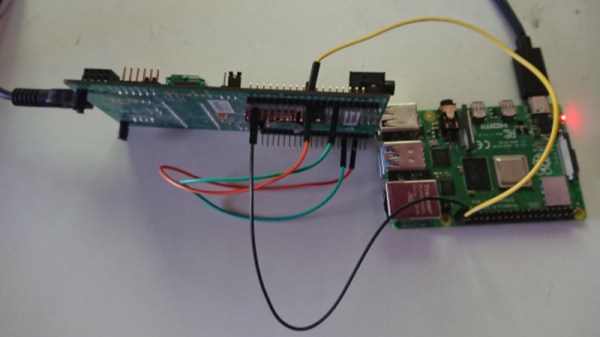
The target for [Andrew]’s development efforts was the STM32L476 Discovery, which had no SPDIF decoding hardware on board. Instead, [Andrew] tinkered with the peripherals he had to see what would work. In the end, a cavalcade of internal timers were daisy chained to allow the microcontroller to recover a clock from the self-clocked S/PDIF signal. This was then used to generate a clock to sync up the onboard SPI hardware to actually read in the 16-bit PCM data from the S/PDIF signal.
[Andrew]’s original broader plan was to pipe the S/PDIF data to the onboard I2S DAC, though he struggled manipulating the remaining resources on the STM chip to do so successfully. Anyone wishing to have a crack can take a look at [Andrew]’s code over on GitHub. If completed, the STM32L476 would become a useful analog endpoint for S/PDIF streams, allowing you to pump tunes digitally over long distances without signal degradation. If you know the key to getting it done, sound off in the comments! Alternatively, if you need to get up and running more quickly, the Teensy platform has you covered!
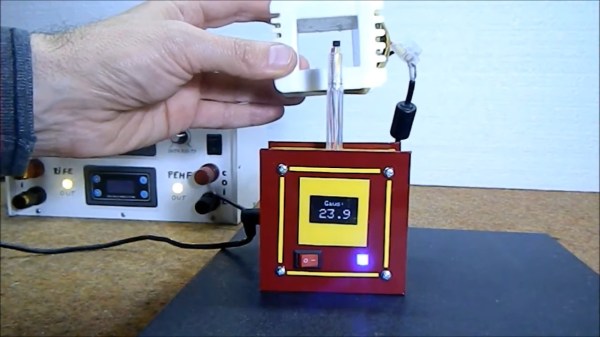
We’re used to Hall effect devices as proximity sensors in mechanical systems, used to provide detection of something that has a magnet attached to it. However it’s easy to forget that the devices that provide a magnet-or-not digital output are only part of the story, and linear Hall effect devices provide a handy way to measure a static magnetic field. It’s something [mircemk] demonstrates, with an Arduino-powered magnetic field strength meter that uses a UGN 3503U Hall effect device.
The circuit is extremely simple, comprising the sensor, an Arduino Nano, and an OLED display. This device is handy because its voltage output has a known relationship to the gauss level the sensor is experiencing, so while the accuracy of its calibration isn’t verified it can at least give a believable reading derived from the Arduino’s ADC.
The whole is wrapped up in an attractive case that looks as though it has been made from PCB material, with the sensor protruding on what seems to be the shell of a plastic ballpoint pen. It makes a handy instrument that provides a useful function for not a lot of money, so what’s not to like! Take a look at the video below the break for the full story.
Can I just say that doing a links roundup article in a week that includes April Fool’s Day isn’t a fun job? Because it’s not. I mean, how can you take something like reports of X-rays flowing from Uranus seriously when they release the report on such a day? It sure looks like a legitimate story, though, and a pretty interesting one. Planets emitting X-rays isn’t really a new thing; we’ve known that Jupiter and Saturn are both powerful X-ray sources for decades. Even though Uranus is the odd child of our solar system, finding evidence for X-ray emissions buried in data captured by the Chandra observatory in 2007 was unexpected. Astronomers think the X-rays might be coming from Uranus’ rings, or they might be reflections of X-rays streaming out from the sun. Or, it might be the weird alignment of the gas giant’s magnetic field causing powerful aurorae that glow in the X-ray part of the spectrum. Whatever it is, it’s weird and beautiful, which all things considered isn’t a bad way for things to be.
Another potential jest-based story popped up this week about the seemingly impossible “EmDrive”. It seems that when you appear to be breaking the laws of physics, you’re probably doing it wrong, and careful lab tests showed that fuel-free propulsion isn’t here yet. One would think it was self-obvious that filling a closed asymmetrical chamber with microwaves would produce absolutely no thrust, but EmDrive proponents have reported small but measurable amounts of thrust from the improbable engine for years. A team at TU Dresden found otherwise, though. Even though they were able to measure a displacement of the engine, it appears to be from the test stand heating up and warping as the RF energy flowed into the drive chamber. By changing the way the engine was supported, they were able to cancel out the dimensional changes that were making it look like the EmDrive was actually working.
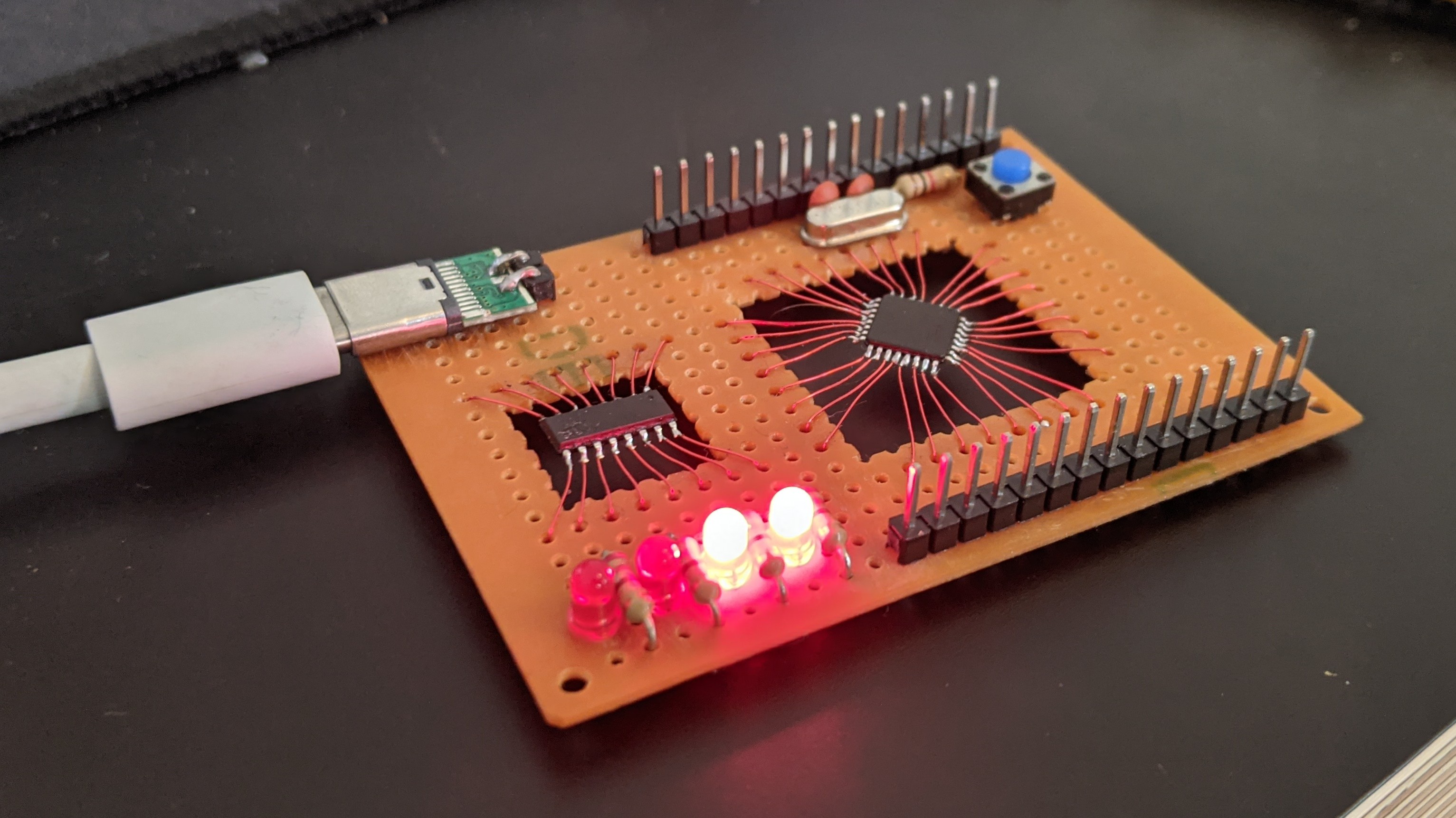
Want to use surface-mount parts, but don’t want to bother spinning up an SMD board? Not a problem, at least if you follow the lead of David Buchanan and perform no-surface surface-mount prototyping. We stumbled upon this on Twitter and thought it looked cool — it’s got a little bit of a circuit sculpture feeling, and we like the old-school look of plain 0.1″ perfboard. David reports that the flying leads are just enameled magnet wire; having done our share of scraping and cleaning magnet wire prior to soldering, we figured that part of the build must have been painful. We pinged David and asked if he had any shortcuts for prepping magnet wire, but alas, he says he just used a hot blob of solder and a little patience while the enamel cooked off. We still really like the style of this build, and we applaud the effort.
Speaking of stumbling across things, that’s one of the great joys of this job — falling down algorithmically generated rabbit holes as we troll about for the freshest hacks. One such serendipitous was this YouTube channel documenting a really nice jet engine build. We’ve seen plenty of jet engines before, but very few with afterburners like this one has. There’s also something deeply satisfying about the variable-throat nozzle that Praendy built for the engine — it’s a level of complexity that you don’t often see in hobbyist jet engines, and yet the mechanism is very simple and understandable.
The other rabbit hole we discovered was after reporting on this cool TIG tungsten grinding tool. That took us into The Metalist’s back catalog, where we found a lot of interesting stuff. But the real treat was this automatic tube polisher (video), which we have to say kept us guessing up to the very end. If you’ve got 12 minutes and you enjoy metalworking builds at all, watch it and see if you’re not surprised by the cleverness of this tool.
And finally, we had heard of the travails of Anatoli Bugorski before, but never in the detail presented in this disturbing video. (Embedded below.)
Who is Anatoli Bugorski, you ask? He is a Russian particle physicist who, while working in an accelerator lab in 1978, managed to get his head directly in the path of a 76 GeV proton beam. Despite getting a huge dose of radiation, Bugorski not only survived the accident but managed to finish his Ph.D. and went on to a long career in nuclear physics. He also got married and had a son. He was certainly injured — facial paralysis and partial deafness, mainly — but did not suffer anything like the gruesome fates of the Chernobyl firefighters or others receiving massive radiation doses. The video goes into some detail about how the accident happened — two light bulbs are better than one, it turns out. We enjoyed the video, but couldn’t stop thinking that Bugorski was the Russian atomic-age equivalent of Phineas Gage.
What started as business cards for [Nerdonic]’s engineering clients unexpectedly expanded into a project in its own right. A CheatKard set consists of seven electronics cheat sheets made in the style of PCB rulers. Sized at 80 mm x 50 mm, they should fit in your business card holder or wallet regardless of the standard in your country. Alternatively, the set can be held together with a small ring in the top corner. The cards are made from fiberglass PCB stock, 0.6 mm thick with gold plating and matte black solder mask. The stackup goes like so:
Cover
Measurements
Schematic Symbols
Component Values
Footprints, SMD 1
Footprints, SMD 2
PCB Design
Laws and Theory
Even before shipping this electronics set, [Nerdonic] has already been asked to make sets of CheatKards for other fields, such as photography, chemistry, antenna design, mathematics, etc. While these aren’t as comprehensive as the Pocket Ref book from years gone by, we like a good cheat sheet. If you want to get a set, check out [Nerdonic]’s Kickstarter project which was funded within hours of going live, and see the short video clip below the break. He also makes a pledge to plant one tree in the Amazon rainforest for each set he sells.
Do you have any favorite cheat sheets or cheat sheet making techniques? Do you prefer your cheat sheets to be physical or stored on your computer? Share your comments down below.
Last week we saw a hapless container ship vaulted to fame, where people converged on its combination of mind-boggling size suffering an easily relatable problem of getting stuck. Now that it is moving again, armchair engineers who crave more big ship problem-solving should check out [David Tracy]’s writeup on the salvage operation of an overturned car carrier ship, the MV Golden Ray published by Jalopnik. If the ship’s name doesn’t ring a bell, the writeup opens with a quick recap.
Written for an audience of gearheads, [Tracy]’s writeup walks through some technical aspects of the salvage plan and initial results of execution. Citing from the official entity in charge, the St. Simons Sound Incident Response Unified Command, and augmented with information from elsewhere. Even though the MV Golden Ray is “only’ half the length and a third of the gross tonnage of our meme darling MV Ever Given, it is still a huge ship. Every salvage operation this big is unique, requiring knowledge far beyond our everyday intuition. At this scale, most Internet “Why don’t they just…” comments range from impractical to absurd.
Fortunately, people who actually know how to perform salvage work designed plans, submitted by multiple bidders, each making a different tradeoff in cost and speed among other factors. The chosen plan was to cut the ship into sections small enough to be carried by barge for further processing elsewhere. This required a huge floating crane, a chain pressed into cutter duty, custom fabricated lugs for lifting, and similarly custom fabricated cradles for the barges.
But we all know that no plan survives contact with reality. While this plan was seemingly chosen for speed, it hasn’t gone nearly as fast as advertised. Certainly the pandemic was a huge hinderance, but cutting has also been slowed by pieces built far stronger than spec. Delays also meant more sediment buildup inside the wreck, compounding headaches. Other bidders have started saying that if their plan had been chosen the job would be done by now, but who’s to say their plan wouldn’t have encountered their own problems?
In time St. Simons Sound will be cleared as the Suez Canal has been. Results of their respective investigations should help make shipping safer, but salvage skills will still be needed in the future. At least this operation isn’t as controversial as trying to retrieve the radio room of RMS Titanic.