Micro Macro Keyboard Is ‘Mega-Based

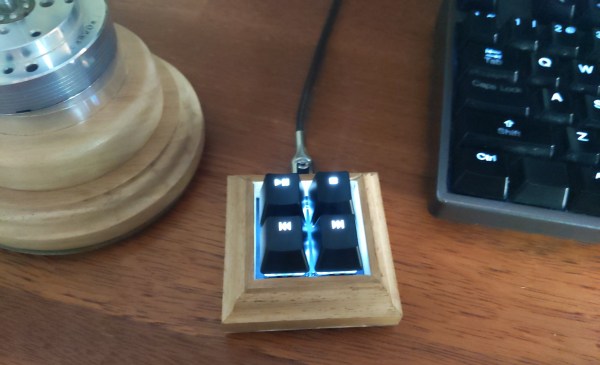
There’s a certain kind of joy that comes in throwing something together from spare parts, or from finding utility in a proof of concept for another project. [Clewsy] is cooking up something clacky and built this baby keeb to prove some stuff out, such as reading a key matrix. Now it’s become a music/media controller that looks great next to a giant matching volume knob.
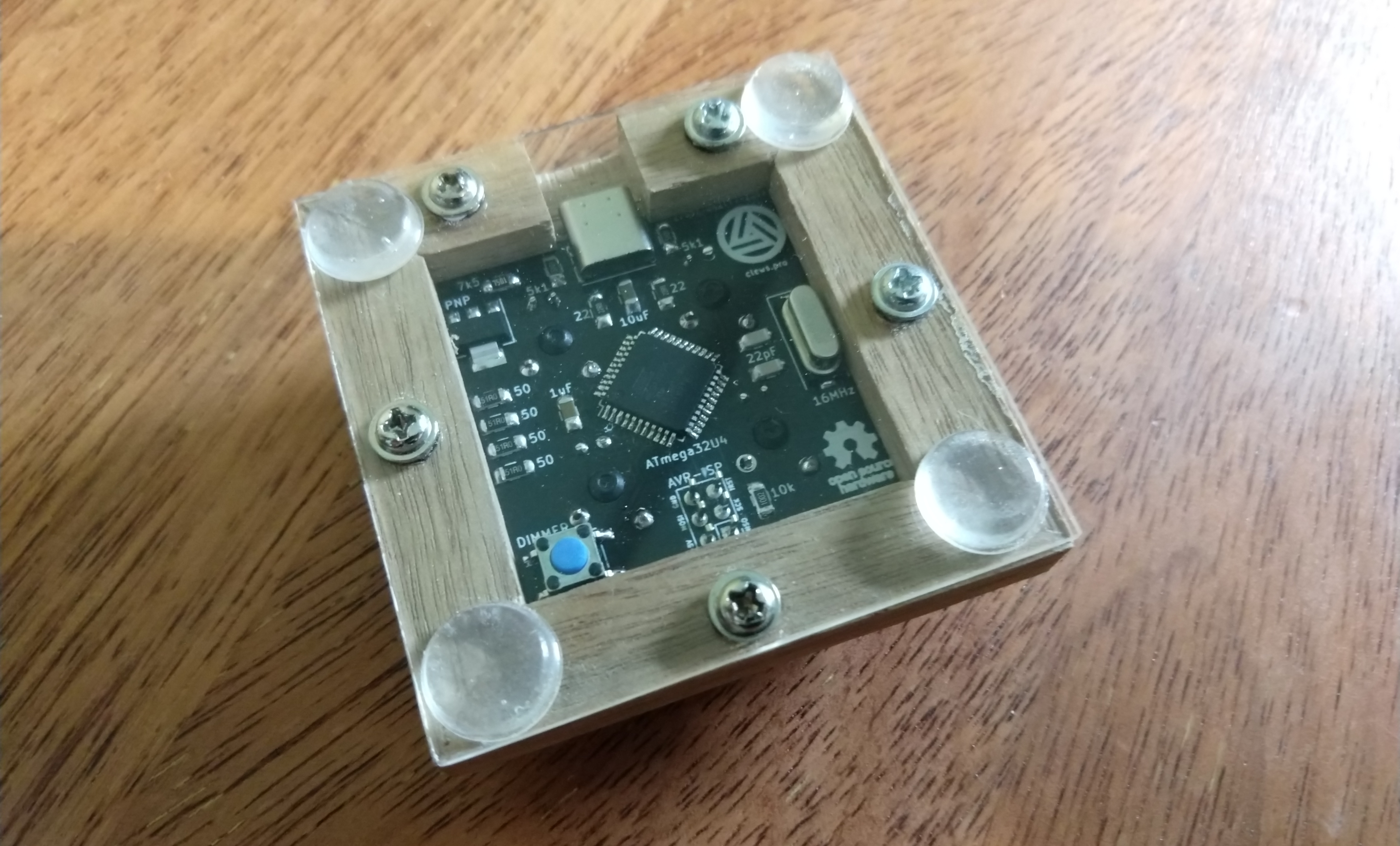
Beneath the gently backlit Gateron blues is a custom ATMega32u4-based board, which is viewable through the clear acrylic bottom plate. That’s a nice touch. We’re not sure if the wood came from a picture frame, but if not, they seem like a great candidates for enclosure material.

This keeb looks fantastic, and we are partial to both the clear and the chrome keycaps. We can only hope [Clewsy] sends the details of the next build our way.

If you want to get started building keyboards, you can’t go wrong with a macro keyboard like this one. If you have way more than four macros in mind, build something bigger, like a custom game pad with a joystick.

Remoticon Video: Firmware Reverse Engineering Workshop With Asmita Jha

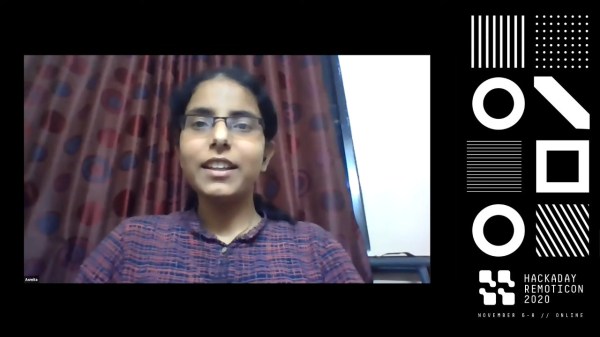
Taking things apart to see how they work is an important part of understanding a system, and that goes for software as much as for hardware. You can get a jump start on your firmware reverse engineering skills with Asmita Jha’s workshop which was presented live at the Hackaday Remoticon. The video has just been published, and is found below along with a bit more on what she covered in her hands-on labs.

Continue reading “Remoticon Video: Firmware Reverse Engineering Workshop With Asmita Jha”

Easy IoT Logging Options For The Beginner

If a temperature sensor takes a measurement in the woods but there’s nobody around to read it, is it hot out? 

If you’ve got a project that’s collecting data, you might have reasons to put it online. Being able to read your data from anywhere has its perks, after all, and it’s key to building smarter interconnected systems, too. Plus, you can tell strangers the humidity in your living room while you’re out at the pub, and they’ll be really impressed.

Taking the leap into the Internet of Things can be daunting however, with plenty of competing services and options from the basic to the industrial-strength available. Today, we’re taking a look at two options for logging data online that are accessible to the beginner. Continue reading “Easy IoT Logging Options For The Beginner”

Colorful Quinary Clock Makes The Most Out Of Five Neopixels

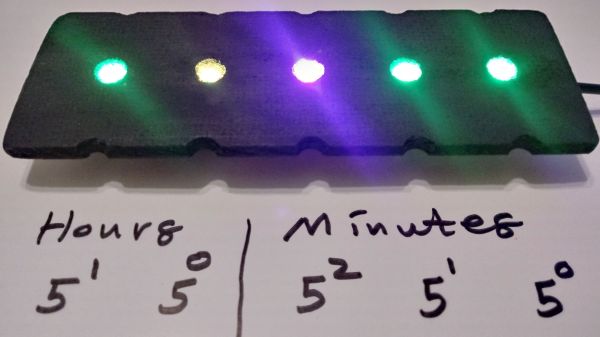
If binary digits are bits, are quinary digits “quits”? Perhaps, but whatever you call them, you’re going to have to wrap your head around some new concepts in order to make sense of this quinary display clock.

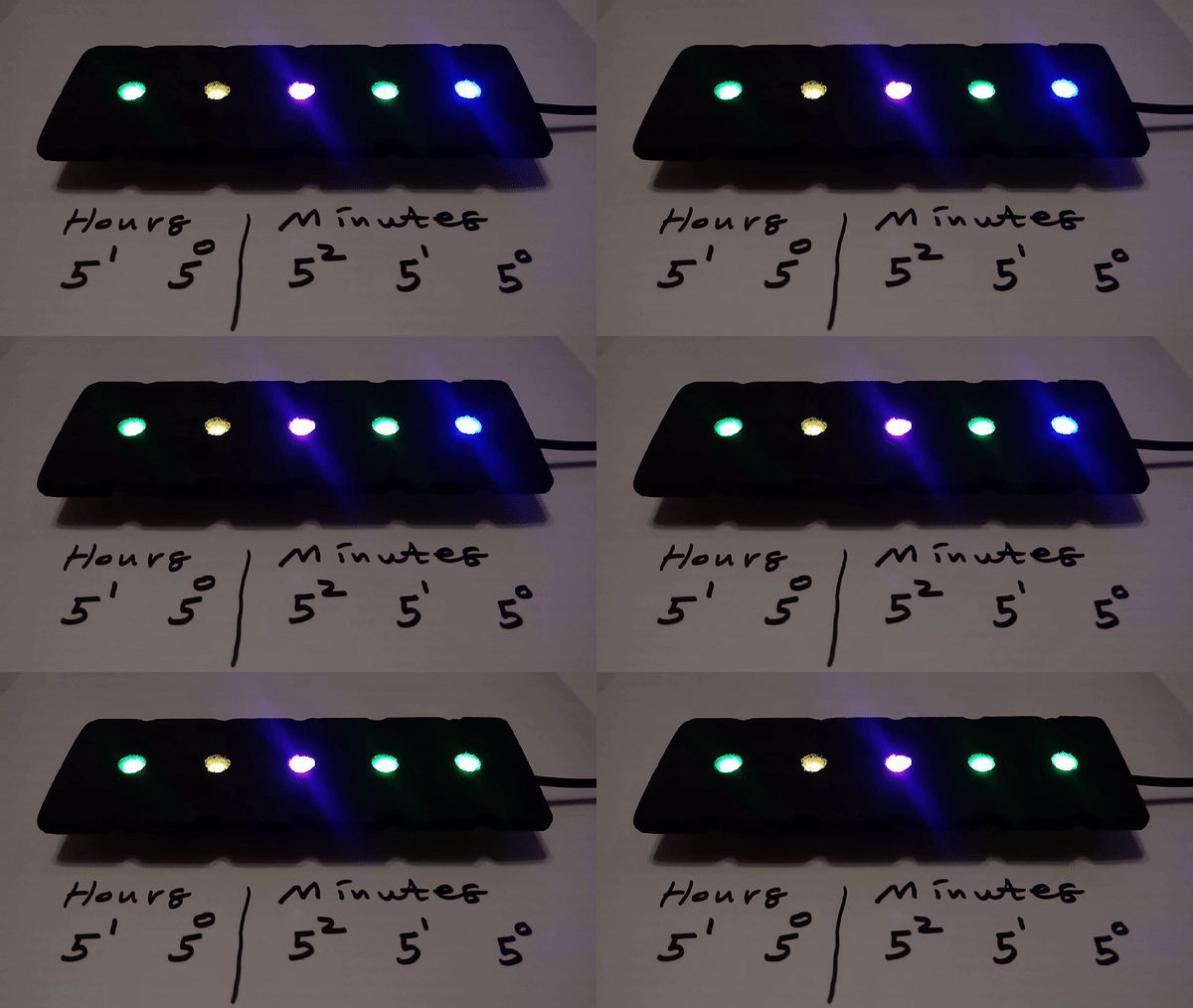
The transition between 15:42 and 15:43.

Why quinary? [Spike Snell] wanted to minimize the number of LEDs, and 52 is enough to cover all 24 hours. Binary clocks may have geek chic, but there are only so many ways to display ones and zeros.

[Spike]’s clock is unique because it shows each quit using a single WS2812 Neopixel. The values zero through four are each represented by a different color, meaning the user needs to memorize which color goes with which value, which we suspect is the hardest part of learning this clock. The clock’s software is fairly simple and runs on an ESP8266, and uses NTP to keep on track. The clock self-adjusts for Daylight Savings time, and it has a nice feature that dims the display in the evening to make living with it easier.

Even for those not up on their base-five arithmetic,  [Spike]’s clock is still a nice, slowly evolving abstract art piece. And for those who grok the quinary clock, perhaps a career awaits you in an alternate future where bi-quinary relay computers caught on.

The Shipping Industry’s Transition To Atomic Power And Faster Deliveries

The transport of goods with cargo ships and especially container ships is the backbone of today’s economies, with about 90% of non-bulk cargo transported with them. This is in addition to the large number of oil tankers and LNG carriers. Unfortunately, due to their use of diesel engines they are also responsible for about 3.5% of the world’s CO2 emissions, in addition to 18 – 30% of nitrogen oxide and 9% of sulfur oxides.

Although the switch to low-sulfur diesel (ULSD) and the use of speed limits has reduced some of these pollutants, the shipping industry sees itself faced with the necessity to decarbonize in order to meet the obligations of the Paris Agreement. This essentially means finding a way to switch from diesel engines to an alternative which has comparable or better fuel costs, produces no or almost no pollutants and will not negatively affect logistics.

As a highly competitive, cut-throat industry, this does seem to leave shipping companies backed up against  a wall. Yet an existing, proven technology just so happens to exist already which can be retrofitted into existing cargo ships. Continue reading “The Shipping Industry’s Transition To Atomic Power And Faster Deliveries”

3D Printer Lets You Play “Will It Shred?”

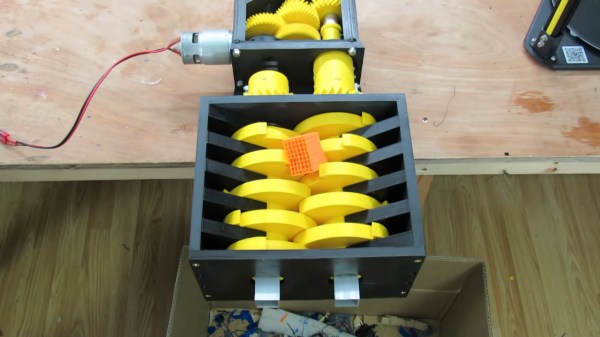
[Brian Brocken] is at it again, building mechanisms that are as striking in their aesthetic as they are in their function. This time around, he’s extended a project we recently featured by adding a menacing 3D-printed shredder attachment. When you hear “3D-printed shredder” you think that paper is all you’ll be able to feed it, but this beast can eat its own by shredding parts from failed prints.

His original goal in building the high-torque 3D-printed gear box we looked at back in August was to show that 3D printed parts can be functional and not merely decorative. Using it as a winch to pull a car did a good job of that, but this goes much further. The very nature of shredder blades is to tear apart objects, but the forces that destroy those things are also present on the shredder parts themselves. Still, as you can see in the video below, the counter-rotating twin-shaft shredder mechanism does its work without catastrophic damage to the blades which were printed with “least 25 percent infill for the structural parts”, and up to five outer perimeters.

The result is a shredder that can gobble up small pieces of failed prints, in addition to chewing on paper, cardboard, and polystyrene with ease. [Brian] does show a few failures along the way, all in the gearbox itself. The first was a defect in the housing that let an gear shaft pop loose and was fixed up with a reprint. The second is a catastrophic gear failure when trying to shred a soda bottle. This is not surprising as PET is quite tough and not brittle like the waste prints were. The shredder teeth got bogged down, and the power of the motor strips teeth from a few gears. But when working, it’s oddly satisfying to watch that powerful gear ratio chip away at sacrificial materials.

If you’re more on the prowl for a way to usefully recycle your plastics, set the 3D-printed stress test of this one aside and take a look at the plastic shredder Fablab RUC built out of metal and plywood a few years back.

Continue reading “3D Printer Lets You Play “Will It Shred?””

E-Ink Calendar Paves A Path For All

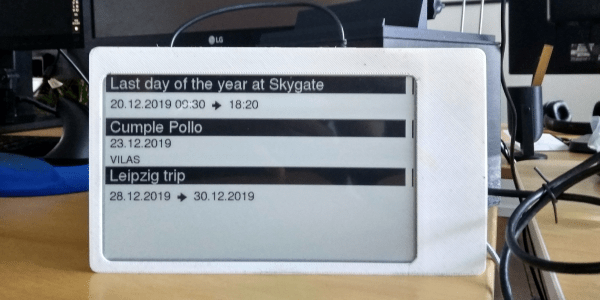
[Martin Fasani] has set out to build a beautiful low power E-Ink Calendar he can hang on his wall. But perhaps more importantly, the work he has done makes it easier for everyone in the future to have a e-ink display. Many battery-powered e-ink projects connect to some server, download a bitmap image, display the new image, and then go into a deep sleep power mode. [Martin’s] project is no different, but it uses a handy microservice that does the conversion and rendering for you.

The firmware for this ESP32/ESP32S2 based calendar is open sourced on GitHub, with a version based on the Arduino framework as well as the native ESP-IDF framework. One particularly fantastic part of the firmware is a C++ component called CalEPD that drives e-paper displays. CalEPD extends the Adafruit_GFX class and is broken out in a separate repo, making it easy to consume on other projects. Since this supports dozens of different e-paper displays, this simplifies the process of building a calendar with different screens. The firmware includes a Bluetooth setup flow from a smartphone or tablet. This means you can quickly configure how often it wakes up, what it queries, and other important features.

The hardware shown in the demo video has a 7.5″ Waveshare screen with 800 x 400 resolution nestled inside a 3D-printed shell. There is also a 5,000 mAh battery with an ESP32 TinyPICO powering the whole system. The TinyPICO was picked for its incredible deep sleep power consumption. All this fits into a frame just 11 mm thick, for which STL files are available. [Martin] continues to work on this calendar display and has recently added support for FocalTech touch panel controllers. We’re excited to see where he takes it next!

This isn’t the first e-ink display project we’ve seen but this is a great reference to build your own. If you need another good starting point, this weather display might give you that little bit of inspiration you need.

Continue reading “E-Ink Calendar Paves A Path For All”