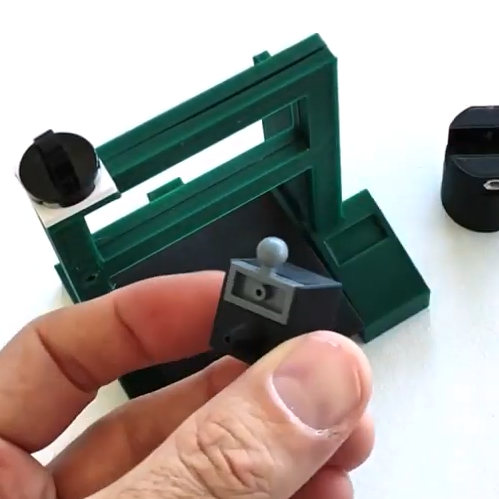
DIY Dongle Breathes Life Into Broken Ventilators

We have a new hero in the COVID-19 saga, and it’s some hacker in Poland. Whoever this person is, they are making bootleg dongles that let ventilator refurbishers circumvent lockdown software so they can repair broken ventilators bought from the secondhand market.

The dongle is a DIY copy of one that Medtronic makes, which of course they don’t sell to anyone. It makes a three-way connection between the patient’s monitor, a breath delivery system, and a computer, and lets technicians sync software between two broken machines so they can be Frankensteined into a single working ventilator. The company open-sourced an older model at the end of March, but this was widely viewed as a PR stunt.

This is not just the latest chapter in the right-to-repair saga. What began with locked-down tractors and phones has taken a serious turn as hospitals are filled to capacity with COVID-19 patients, many of whom will die without access to a ventilator. Not only is there a shortage of ventilators, but many of the companies that make them are refusing outside repair techs’ access to manuals and parts.

These companies insist that their own in-house technicians be the only ones who touch the machines, and many are not afraid to admit that they consider the ventilators to be their property long after the sale has been made. The ridiculousness of that aside, they don’t have the manpower to fix all the broken ventilators, and the people don’t have the time to wait on them.

We wish we could share the dongle schematic with our readers, but alas we do not have it. Hopefully it will show up on iFixit soon alongside all the ventilator manuals and schematics that have been compiled and centralized since the pandemic took off. In the meantime, you can take Ventilators 101 from our own [Bob Baddeley], and then find out what kind of engineering goes into them.

Soviet Core Memory Experiments

What do you do when you’ve bought some old Soviet core memory modules on eBay? If you are [CuriousMarc], you wire it up to some test connectors and use your test bench to see if the core memory still works. Spoiler alert: it does.

While it seems crude by today’s standard, there was a time when these memory modules would have been the amazing miniature tech of their day. Each little magnetic torus represents a bit and the modules have 1,024 and 4,096 tiny little donuts strung together in a grid.

Continue reading “Soviet Core Memory Experiments”

High-End Ham Radio Gives Up Its Firmware Secrets

Amateur radio operators have always been at the top of their game when they’ve been hacking radios. A ham license gives you permission to open up a radio and modify it, or even to build a radio from scratch. True, as technology has advanced the opportunities for old school radio hacking have diminished, but that doesn’t mean that the new computerized radios aren’t vulnerable to the diligent ham’s tender ministrations.

A case in point: the Kenwood TH-D74A’s firmware has been dumped and partially decoded. A somewhat informal collaboration between [Hash (AG5OW)] and [Travis Goodspeed (KK4VCZ)], the process that started with [Hash]’s teardown of his radio, seen in the video below. The radio, a tri-band handy talkie with capabilities miles beyond even the most complex of the cheap imports and with a price tag to match, had a serial port and JTAG connector. A JTAGulator allowed him to probe some of the secrets, but a full exploration required spending $140 on a spare PCB for the radio and some deft work removing the BGA-packaged Flash ROM and dumping its image to disk.

[Travis] picked up the analysis from there. He found three programs within the image, including the radio’s firmware and a bunch of strings used in the radio’s UI, in both English and Japanese. The work is far from complete, but the foundation is there for further exploration and potential future firmware patches to give the radio a different feature set.

This is a great case study in reverse engineering, and it’s really worth a trip down the rabbit hole to learn more. If you’re looking for a more formal exploration of reverse engineering, you could do a lot worse than HackadayU’s “Reverse Engineering with Ghidra” course, which just wrapping up. Watch for the class videos soon. Continue reading “High-End Ham Radio Gives Up Its Firmware Secrets”

Don’t Wait, You Need To See Comet NEOWISE Right Now

By now you’ve heard of NEOWISE, the most spectacular comet to visit our little corner of the galaxy since Hale-Bopp passed through over 20 years ago. But we’re willing to bet you haven’t actually seen it with your own eyes. That’s because up until now, the only way to view this interstellar traveler was to wake up in the pre-dawn hours; an especially difficult requirement considering a large chunk of the population has gotten used to sleeping-in over the last few months.

But things are about to change as NEOWISE begins a new phase of its trip through our celestial neck of the woods. Having come to within 44.5 million km (27.7 million miles) of the sun on July 3rd, the comet is now making its way back out of our solar system. Thanks to the complex dance of the heavens, that means that observers in the Northern Hemisphere will now be able to see NEOWISE in the evening sky just above the horizon.

NEOWISE is on a kind of “up and over” trajectory compared to the orbital paths of the planets. Get a better feel for it with JPL’s interactive solar dynamics tool.

While NEOWISE might be beating a hasty retreat from Sol right now, the comet it actually getting closer to us in the process. On July 22nd it will reach perigee, that is, the point in its orbit closest to Earth. On that evening the comet will be approximately 103 million km (64 million miles) away. Not exactly a stone’s throw, but pretty close in astronomical terms. The comet will appear to be getting higher in the sky as it approaches Earth, and should be visible with the naked eye between 10 and 20 degrees above the northern horizon.

Most estimates say that NEOWISE should remain visible until at least the middle of August, though it will be dimming rapidly. After that, you’re going to have to wait awhile for a repeat showing. Given the orbit of this particular comet, it won’t come around our way again for approximately 6,800 years, give or take a few lifetimes.

NASA will be hosting a NEOWISE live stream tomorrow afternoon where researchers will answer questions about this once in a lifetime celestial event, though we think you’ll get a lot more out of it if you just go outside and look up.

Take Pottery For A Spin With A Pocket-Sized Wheel

If 2020 can be remembered in any positive light, it would be that this has been the year of the hobby tryouts. Why not pottery? Sure, throwing pots won’t fill your belly like homemade bread. But we would bet you can see the value in having a bunch of expendable objects that are easily (and quite satisfyingly) smashed to smithereens. The best part is that between the workbench, junk box, and recycle bin, you can probably build [Jadem52]’s pottery wheel for ants with stuff you already have. Bonus!

Pottery wheels aren’t that complicated. They’re honestly kind of expensive for what they are — a motor and a belt driving a rotating platter. It’s like a record player, but less fussy. Where they really get you on expense is the kiln to heat-treat those pots into sturdy vessels. But you could always use air-dry clay, especially if you’re making these things just to smash them whenever you need to let off some steam.

So anyway, you don’t need much more than a motor, a jar lid for a wheel to throw on, and a bearing to make it spin smoothly. Store-bought pottery wheels have a foot feed to control the motor speed, but this pocket version is either spinning on nine volts or it isn’t. The great thing about a project like this is that once you have the general principle down and use the thing, you can iterate and upgrade to your heart’s content. Take it for a little spin after the break.

If you want to hack together a more conventionally-sized wheel, an old ceiling fan motor should be more than sufficient.

Continue reading “Take Pottery For A Spin With A Pocket-Sized Wheel”

A Robotic Stylist For Your Lockdown Lengthened Locks

It’s perhaps easy to think that despite the rapid acceleration of technology that there are certain jobs that will never be automated out of existence. Generally the job said to be robot-proof is the one held by the person making the proclamation, we notice. But certainly the job of cutting and styling people’s hair could never be done by a robot, right?

We wouldn’t bet the farm on it, although judging by [Shane Wighton]’s quarantine haircut robot, it’ll be a while before the stylists of the world will be on the dole. Said to have sprung from the need to trim his boyishly long hair, the contraption is an object lesson recreating the subtle manual skills a stylist brings to every head they work on — there’s a reason it takes 1,500 hours or more of training to get a license, after all. [Shane] discovered this early, and realized that exactly replicating the manual dexterity of human hands was a non-starter. His cutting head uses a vacuum to stand the hair upright, 3D-printed fingers to grip a small bundle of hair, and servo-driven scissors to cut it to length. The angle of attack of the scissors can be adjusted through multiple axes, and the entire thing rotates on a hell-no-I’m-not-putting-my-head-in-that-thing mechanism.

To his great credit, [Shane] braved the machine as customer zero, after only a few non-conclusive life-safety tests with a dummy head and wig. We won’t spoil the ending, but suffice it to say that the thing actually worked with no bloodshed and only minimal damage to [Shane]’s style. The long-suffering [Mrs. Wighton], however, was not convinced to take a test drive.

In all seriousness, kudos to [Shane] for attacking such a complex problem. We love what he’s doing with his builds, like his basketball catcher and his robo-golf club, and we’re looking forward to more.

Continue reading “A Robotic Stylist For Your Lockdown Lengthened Locks”

Jerry Lawson biography

Jerry Lawson And The Fairchild Channel F; Father Of The Video Game Cartridge

The video game console is now a home entertainment hub that pulls in all forms of entertainment via an internet connection, but probably for most readers it was first experienced as an offline device that hooked up to the TV and for which new game software had to be bought as cartridges or for later models, discs. Stepping back through the history of gaming is an unbroken line to the 1970s, but which manufacturer had the first machine whose games could be purchased separately from the console? The answer is not that which first comes to mind, and the story behind its creation doesn’t contain the names you are familiar with today.

The Fairchild Channel F never managed to beat its rival, the Atari 2600, in the hearts of American youngsters so its creator Jerry Lawson isn’t a well-known figure mentioned in the same breath as Atari’s Nolan Bushnell or Apple’s two Steves, but without this now-forgotten console the history of gaming would have been considerably different.

Continue reading “Jerry Lawson And The Fairchild Channel F; Father Of The Video Game Cartridge”