Kelly Heaton’s Artwork Blurs The Line Between Traditional And Electronic

Digital electronics are all well and good, but it’s hard to ignore the organic, living qualities of the analog realm. It’s these circuits that Kelly Heaton spends her time with, building artistic creations that meld the fine arts with classic analog hardware to speak to the relationship between electronics and nature. During her talk at the 2019 Hackaday Superconference, Kelly shared the story of her journey toward what she calls Electronic Naturalism, and what the future might bring.
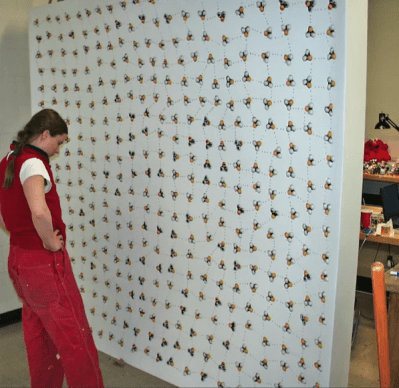
The Pool of Reflection Loop was one of Kelly’s early electronic installation pieces.

Kelly got her start like many in the maker scene. Hers was a journey that began by taking things apart, with the original Furby being a particular inspiration. After understanding the makeup of the device, she began to experiment, leading to the creation of the Reflection Loop sculpture in 2001, with the engineering assistance of Steven Grey. Featuring 400 reprogrammed Furbys, the device was just the beginning of Kelly’s artistic experimentation. With an interest in electronics that mimicked life, Kelly then moved on to the Tickle Me Elmo. Live Pelt (2003) put 64 of the shaking Muppets into a wearable coat, that no doubt became unnerving to wear for extended periods.

Analog electronics parallel living organisms while programmable logic merely simulates life.

Forrest Mims

Wanting to create art with a strong relationship to organic processes, Kelly focused on working with discrete components and analog circuitry. Basic building blocks such as the astable multivibrator became key tools that were used in different combinations to produce the desired effects. Through chaining several oscillators together, along with analog sequencers, circuits could be created that mimicked the sound of crickets in a backyard, or a Carolina wren singing in a tree.

Continue reading “Kelly Heaton’s Artwork Blurs The Line Between Traditional And Electronic”

Prusa Dares You To Break Their Latest Printer

Two months after its surprise reveal at the 2019 East Coast RepRap Festival, the Prusa Mini has started shipping out to the first wave of early adopters. True to form, with the hardware now officially released to the public, the company has begun the process of releasing the design as open source. In their GitHub repository, owners can already find the KiCad files for the new “Buddy” control board and STLs for the machine’s printable parts.

But even so, not everyone feels that Prusa Research has made the Mini as “open” as its predecessors. Some concerned owners have pointed out that according to the documentation for the Buddy board, they’ll need to physically snap off a section of the PCB so they can flash custom firmware images via Device Firmware Upgrade (DFU) mode. Once this piece of the board has been broken off, which the documentation refers to as the Appendix, Prusa Research will no longer honor any warranty claims for the electronic components of the printer.

For the hardcore tinkerers out there, this news may come as something of a shock. Previous Prusa printers have enjoyed a fairly active firmware development community, and indeed, features that started out as user-developed modifications eventually made their way into the official upstream firmware. What’s more, certain hardware modifications require firmware tweaks to complete.

Prusa Research explains their stance by saying that there’s no way the company can verify the safety of community developed firmware builds. If thermal runaway protections have been disabled or otherwise compromised, the results could be disastrous. We’ve already seen it happen with other printers, so it’s hard to fault them for being cautious here. The company is also quick to point out that the installation of an unofficial firmware has always invalidated the printer’s warranty; physically breaking the board on the Mini is simply meant as a way to ensure the user understands they’re about to leave the beaten path.

How much support is a manufacturer obligated to provide to a user who’s modified their hardware? It’s of course an issue we’ve covered many times before. But here the situation is rather unique, as the user is being told they have to literally break a piece off of their device to unlock certain advanced functionality. If Prusa wanted to prevent users from running alternate firmware entirely they could have done so (or at least tried to), but instead they’ve created a scenario that forces the prospective tinkerer to either back down or fully commit.

So how did Prusa integrate this unusual feature into their brand new 32-bit control board? Perhaps more importantly, how is this going to impact those who want to hack their printers? Let’s find out.

Continue reading “Prusa Dares You To Break Their Latest Printer”

Weird World Of Microwaves Hack Chat

Join us on Wednesday, December 18 at noon Pacific for the Weird World of Microwaves Hack Chat with Shahriar Shahramian! We’ve been following him on The Signal Path for years and are excited to pick his brain on what is often considered one of the dark arts of electronics.

No matter how much you learn about electronics, there always seems to be another door to open. You think you know a thing or two once you learn about basic circuits, and then you discover RF circuits. Things start to get a little strange there, and stranger still as the wavelengths decrease and you start getting into the microwave bands. That’s where you see feed lines become waveguides, PCB traces act as components, and antennas that look more like musical instruments.

Shahriar is no stranger to this land. He’s been studying millimeter-wave systems for decades, and his day job is researching millimeter-wave ASICs for Nokia Bell Labs in New Jersey, the birthplace of the transistor. In his spare time, Shahriar runs The Signal Path, a popular blog and YouTube channel where he dives tear-downs, explanations, and repairs of incredibly sophisticated and often outrageously expensive equipment.

We’ll be sitting down with Shahriar this week for the last Hack Chat of 2019 with a peek inside his weird, wonderful world of microwaves. Join us with your questions about RF systems, microwaves in the communication industry, and perhaps even how he manages to find the gear featured on his channel.

join-hack-chatOur Hack Chats are live community events in the Hackaday.io Hack Chat group messaging. This week we’ll be sitting down on Wednesday, December 18 at 12:00 PM Pacific time. If time zones have got you down, we have a handy time zone converter.

Click that speech bubble to the right, and you’ll be taken directly to the Hack Chat group on Hackaday.io. You don’t have to wait until Wednesday; join whenever you want and you can see what the community is talking about.

Sleek, Sophisticated Skittle Sorter

Sorting candy by color is a classic problem that has its roots in the contract riders of rock stars who were just trying to make sure that more important contractual obligations were not being overlooked by concert venues. Through the years, candy sorting has become a classic problem for hobbyists to solve in various ways. After a false start a few years back, [little french kev] was compelled to dust off those plans and make the most compact sorter possible.

This minimalist beauty uses an Arduino Nano and RGB sensor to assess the color. At the top, a small servo rotates an arm inside the hopper that both shakes the Skittles and sets them up single file before the sensor. Another small servo spins the tube rack around to catch the rainbow. There’s an RGB LED in the base that bathes the tube from below in light that matches the Skittles. Check out the series of gifs on [little french kev]’s personal project site that show how each part works, and then watch the build video after the break.

Did you know you can roll your own color sensor from an RGB LED and a photocell? If you don’t think candy is so dandy, you could always color-sort your LEGO.

Continue reading “Sleek, Sophisticated Skittle Sorter”

The Hornsdale Power Reserve And What It Means For Grid Battery Storage

Renewable energy has long been touted as a major requirement in the fight to stave off the world’s growing climate emergency. Governments have been slow to act, but prices continue to come down and the case for renewables grows stronger by the day.

However, renewables have always struggled around the issue of availability. Solar power only works when the sun is shining, and wind generators only when the wind is blowing. The obvious solution is to create some kind of large, grid-connected battery to store excess energy in off-peak periods, and use it to prop up the grid when renewable outputs are low. These days, that’s actually a viable idea, as South Australia proved in 2017.

Continue reading “The Hornsdale Power Reserve And What It Means For Grid Battery Storage”

Dashboard Dongle Teardown Reveals Hardware Needed To Bust Miles

Progress and the proliferation of computers in automotive applications have almost made the shade tree mechanic a relic of the past. Few people brave the engine compartment of any car made after 1999 or so, and fewer still dive into the space behind the dashboard. More’s the pity, because someone may be trying to turn back the odometer with one of these nefarious controller area network (CAN bus) dongles.

Sold through the usual outlets and marketed as “CAN bus filters,” [Big Clive] got a hold of one removed from a 2015 Mercedes E-Class sedan, where a mechanic had found it installed between the instrument cluster and the OEM wiring harness. When the dongle was removed, the odometer instantly added 40,000 kilometers to its total, betraying someone’s dishonesty.

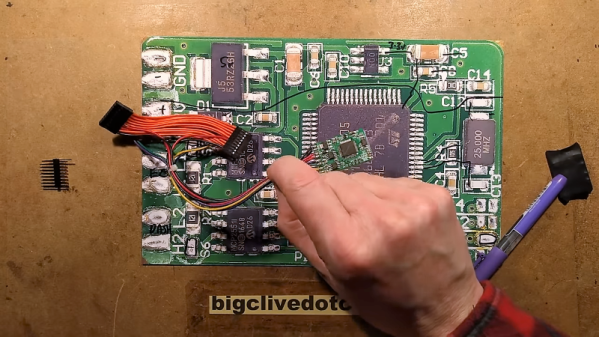
[Big Clive]’s subsequent teardown of the unit showed that remarkably little is needed to spoof a CAN bus odometer. The board has little more than an STM32F microcontroller, a pair of CAN bus transceiver chips, and some support circuitry like voltage regulators. Attached to a wiring harness that passes through most of the lines from the instrument cluster unmolested while picking off the CAN bus lines, the device can trick the dashboard display into showing whatever number it wants. The really interesting bit would be the code, into which [Clive] does not delve. That’s a pity, but as he points out, it’s likely the designers set the lock bit on the microcontroller to cover their tracks. There’s no honor among thieves.

We found this plunge into the dark recesses of the automotive world fascinating, and [Big Clive]’s tutelage top-notch as always. If you need to get up to speed on CAN bus basics, check out [Eric Evenchick]’s series on automotive network hacking.

Continue reading “Dashboard Dongle Teardown Reveals Hardware Needed To Bust Miles”

Nintendo Switch Doubles As Network Switch

Coming straight to you from the “Department of Redundant Redundancies” comes this clever hack that turns a Switch into a switch. More specifically, a network switch. Not even a half bad one either, judging by the speed tests [Cynthia Revström] performed after setting it all up. We wouldn’t advise you dump your existing network gear in favor of a repurposed game system, but perhaps in a pinch…

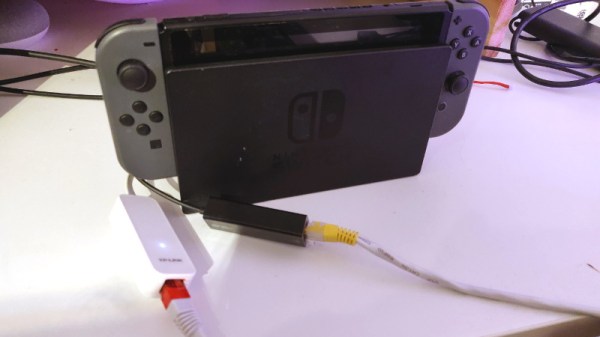
Despite what you might be thinking, there’s no hardware modifications at work here. This is a fully functional Nintendo Switch that’s just had two USB to Ethernet adapters plugged into it. The secret ingredient is the addition of some Penguin Power, up and running on Nintendo’s latest and greatest thanks to a project called switchroot.

With Linux running on the system, all [Cynthia] had to do was make sure that the USB to Ethernet adapters were supported, and fiddle around with the brctl and ip commands to configure a bridge between the interfaces to get the packets moving. Putting the Switch between the main network and a test computer showed it had a throughput of just over 90 Mbps, which is about all that could be expected from the USB-connected network interfaces.

From here it wouldn’t have taken much more effort to get the system working as a wireless router and providing services like DHCP and NAT to clients. But since Nintendo didn’t see fit to call it the Router, that would’ve offered minimal meme value. There’s always next generation.

Seeing the Nintendo Switch do a surprisingly good job running as an Ethernet switch is even more surprising given the fact that it struggles to function with accessories that are actually intended for it. Though to be fair, the migration to USB-C has been a little rockier than most of us would have hoped.