Friday Hack Chat: Everything Raspberry Pi

The Raspberry Pi is six years old now, and in that time it’s become the most popular single board computer. Over these last few years, the Pi has improved from a relatively anemic board based on a smartphone SoC to a surprisingly fast board that’s loaded up with some of the best software and the best community support we’ve ever seen. There’s an awful lot you can do with a Pi, and the continued support of the Raspberry Pi Foundation has enabled millions of people to get their hands on a cheap computer that runs Linux. It’s great.

Now it’s your turn to ask the engineers behind this tiny little computer what’s going on in the world of Pi. We’re having a Hack Chat this Friday, and you’re invited.
Our guest for this week’s Hack Chat will be [Roger Thornton], principal hardware engineer for the Raspberry Pi, where he oversees design, test, compliance, and production for Raspberry Pi products. Previously, [Roger]’s work for Broadcom included being part of the team that characterized and tested numerous SoCs including the BCM2835/6/7 found in various Pis. He also has experience in the smart home and IoT fields from working in a consultancy where be helped bring chips to market.

[Roger]’s most recent work was announced today; the Raspberry Pi 3 Model B+ is the latest in a long line of Pis, and while it’s not the octocore ARM monster with SATA and PCIe and Gigabit networking and 4G that the power-hungry have been clamoring for, it is more capable than its predecessor and still only costs less than forty bucks.

This is also the second time [Roger] has been a guest on our Hack Chats. You can check out the transcript of the 2017 chat here.

During this chat, we’re going to be discussing the future of Raspberry Pi products, Pi events around the world, and a question on the minds of many: where you can buy Pi Zeros in quantity. You are, of course, encouraged to add your own questions to the Hack Chat. You can do that by leaving the questions as a comment on this Hack Chat’s event page.

join-hack-chat

Our Hack Chats are live community events on the Hackaday.io Hack Chat group messaging. This week it’s going down at the usual time, on noon, Pacific, Friday, March 16th  Want to know what time this is happening in your neck of the woods? Have a countdown timer!

Click that speech bubble to the right, and you’ll be taken directly to the Hack Chat group on Hackaday.io.

You don’t have to wait until Friday; join whenever you want and you can see what the community is talking about.

Archimedes Would Have Known Better If He Could Count To A Million

Today is March 14th, or Pi Day because 3.14 is March 14th rendered in month.day date format. A very slightly better way to celebrate the ratio of a circle’s circumference to its diameter is July 22nd, or 22/7 written in day/month order, a fractional approximation of pi that’s been used for thousands of years and is a better fit than 3.14. Celebrating Pi Day on July 22nd also has the advantage of eschewing middle-endian date formatting.

But Pi Day is completely wrong. We should be celebrating Tau Day, to celebrate the ratio of the circumference to the radius instead of the diameter. That’s June 28th, or 6.283185…. Nonetheless, today is Pi Day and in the absence of something truly new and insightful — we’re still waiting for someone to implement a spigot algorithm in 6502 assembly, by the way — this is a fantastic opportunity to discuss something tangentially related to pi, the history of mathematics, and the idea that human knowledge builds upon itself in an immense genealogy stretching back to the beginning of history.

This is our Pi Day article, but instead of complaining about date formats, or Tau, we’re going to do something different. This is how you approximate pi with the Monte Carlo method, and how anyone who can count to a million can get a better approximation of one the fundamental constants of the Universe than Archimedes.

Continue reading “Archimedes Would Have Known Better If He Could Count To A Million”

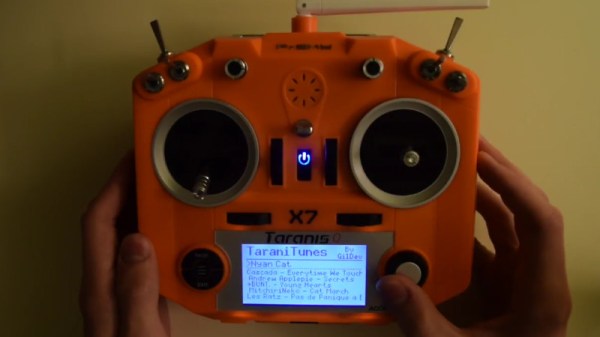
RC Transmitter Hacked Into Music Player

Packed with an incredible amount of hardware, and increasingly likely to be running an open source firmware, the modern RC transmitter is effectively a little multi-purpose computer in its own right. Accordingly there is a small, but growing, community of developers coming out with software applications targeting these switch-festooned wonders. It’s only a matter of time until they are running DOOM.

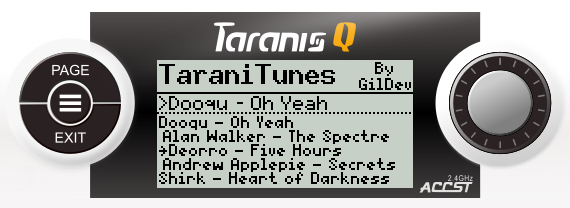
One such piece of software is TaraniTunes, developed by [GilDev]. This program allows you to load your OpenTX 2.2+ equipped Taranis Q X7 or Taranis X9D with music files which can be played on the transmitter’s built-in speaker. While it likely won’t win any awards for interface design, the large LCD display coupled with the radio’s numerous physical buttons and switches makes it relatively easy to navigate your music collection.

While the software [GilDev] has written for OpenTX looks straightforward enough, getting the songs on the radio is another story. For each track you need to merge the stereo channels into mono (as the transmitter only has a single speaker), and then convert it to a 32 kHz WAV. But don’t worry about the lack of ID3 tag information, TaraniTunes allows you to create a text file containing not only the filename of each track, but its name and artist.

We’ll admit this one should be filed away in the “Because I Can” category, but it’s still an impressive hack and a clever demonstration of the current state of RC transmitter technology.

Continue reading “RC Transmitter Hacked Into Music Player”

Raspberry Pi Gets Faster CPU And Better Networking In The New Model 3 B+

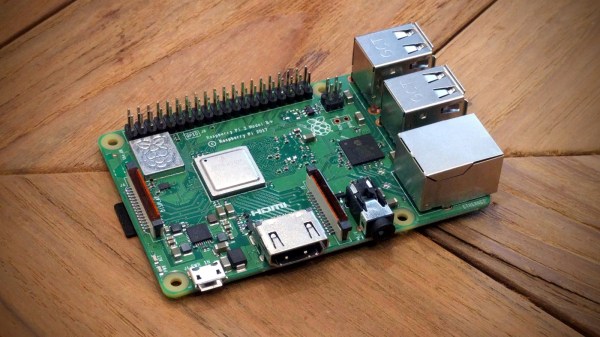
While the Raspberry Pi’s birthday (and the traditional release date for the newest and best Pi) was a few weeks ago, Pi Day is a fitting enough date for the introduction of the best Pi to date. The Raspberry Pi 3 Model B+ is the latest from the Raspberry Pi foundation. It’s faster, it has better networking, and most interestingly, the Pi 3 Model B+ comes with modular compliance certification, allowing anyone to put the Pi into a product with vastly reduced compliance testing.

Continue reading “Raspberry Pi Gets Faster CPU And Better Networking In The New Model 3 B+”

Pocket-Sized Multiduino Does It All

How many times have you wished for a pocket-sized multimeter? How about a mini microcontroller-based testing rig? Have you ever dared to dream of a device that does both?

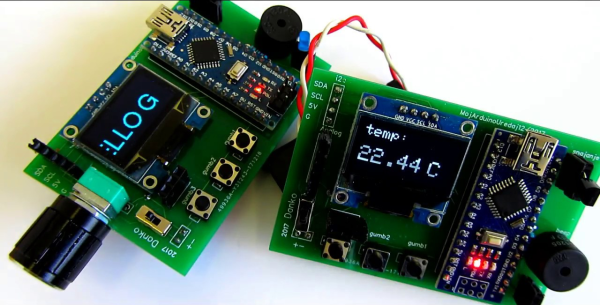
Multiduino turns an Arduino Nano into a Swiss Army knife of portable hacking. It can function as an analog multimeter to measure resistance, voltage drop, and continuity. It can also produce PWM signals, read from sensors, do basic calculator functions, and display the health of its rechargeable battery pack.

Stick a 10kΩ pot in the left-side header and you can play a space shooter game, or make line drawings by twisting the knob like an Etch-A-Sketch. Be sure to check out the detailed walk-through after the break, and a bonus video that shows off Multiduino’s newest functions including temperature sensing, a monophonic music player for sweet chiptunes, and a virtual keyboard for scrolling text on the OLED screen. [Danko] has a few of these for sale in his eBay store. They come assembled, and he ships worldwide. The code for every existing function is available on his site.

More of a maximalist? Then check out this Micro-ATX Arduino.

Continue reading “Pocket-Sized Multiduino Does It All”

Up AlphaGoer Five

AlphaGo is the deep learning program that can beat humans at the game Go. You can read Google’s highly technical paper on it, but you’ll have to wade through some very academic language. [Aman Agarwal] has done us a favor. He took the original paper and dissected the important parts of in in plain English. If the title doesn’t make sense to you, you need to read more XKCD.

[Aman] says his treatment will be useful for anyone who doesn’t want to become an expert on neural networks but still wants to understand this important breakthrough. He also thinks people who don’t have English as a first language may find his analysis useful. By the way, the actual Go matches where AlphaGo beat [Sedol] were streamed and you can watch all the replays on YouTube (the first match appears below).

Continue reading “Up AlphaGoer Five”

Building A Lightweight Softbox For Better Photography

If you want to take good photographs, you need good light. Luckily for us, you can get reels and reels of LEDs from China for pennies, power supplies are ubiquitous, and anyone can solder up a few LED strips. The missing piece of the puzzle is a good enclosure for all these LEDs, and a light diffuser.

[Eric Strebel] recently needed a softbox for some product shots, and came up with this very cheap, very good lighting solution. It’s made from aluminum so it should handle the rigors of photography, and it’s absolutely loaded with LEDs to get all that light on the subject.

The metal enclosure for this softbox is constructed from sheet aluminum that’s about 22 gauge, and folded on a brake press. This is just about the simplest project you can make with a brake and a sheet of metal, with the tabs of the enclosure held together with epoxy. The mounting for this box is simply magnets super glued to the back meant to attach to a track lighting fixture. The 5000 K LED strips are held onto the box with 3M Super 77 spray adhesive, and with that the only thing left to do is wire up all the LED strips in series.

But without some sort of diffuser, this is really only a metal box with some LEDs thrown into the mix. To get an even cast of light on his subject, [Eric] is using drawing vellum attached to the metal frame with white glue. The results are fairly striking, and this is an exceptionally light and sturdy softbox for photography.

Continue reading “Building A Lightweight Softbox For Better Photography”