Gesture Control For Lunch Money

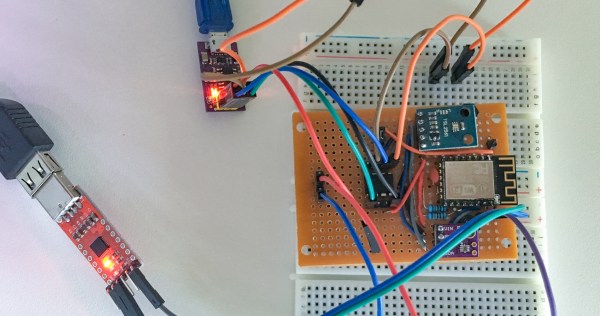
[Dimitris Platis] wanted to add gesture control to his PC. You’d think that would be expensive, but by combining a diminutive Arduino, a breakout board with a gesture controller, and an interconnect PCB, he managed to pull it off for about $7. That doesn’t include the optional 3D-printed case and we think you could omit the interconnect board if you don’t mind some wires and further cut costs. [Dimitris] calls it Nevma, and you can see how the device works in the video below.

The heart of the project is a sensor that measures light and motion. The chip and the breakout board are just a couple of bucks if you order them from China. You can find them in the US if you don’t mind spending a little bit more. The device has an I2C interface, and [Dimitris] uses a tiny Mini SS Micro for the USB interface and the CPU.

Continue reading “Gesture Control For Lunch Money”

Boxes, Form An Orderly Queue Behind The Armchair!

If you have ever been to a hacker camp, you’ll know the problem of transporting all your stuff to your hackerspace village, or to wherever you’ll be basing yourself for the duration. The car park is always too far away, whatever trolley you’ve brought along is never big enough, and the terrain you have to drag everything over feels more like the Chilkoot Trail than a city sidewalk.

[Jana Marie Hemsing] and [Lucy Fauth] have an effective solution to all your hacker camp transport woes, in the form of a motorized platform designed to carry a storage box. Underneath the platform are a pair of hoverboard motors and their controller board reflashed with a custom firmware.

You might be now looking at it and thinking “So what?”, for a single platform is handy but hardly a comprehensive transport solution. What makes this one impressive though is that it’s not a single board, instead there is a swarm of them for which they appear to have implemented some form of optical following system which is teased through the video we’ve placed below the break and with this Tweet, but not in detail yet in the wiki page. A neat train of platforms follows the lead one, transporting everything with minimum fuss. What can we say, except “We want one too!”. There is some code to be found in a GitHub repository, should you be interested in having a go for yourself.

Continue reading “Boxes, Form An Orderly Queue Behind The Armchair!”

Internet Of Things Opens Possibilities

While a lot of hardware gets put on the “Internet of Things” with only marginal or questionable benefits (or with hilariously poor security), every now and then a project makes use of this new platform in a way that illustrates the strengths of IoT. [ThingEngineer] turned to this platform as a cost-effective solution for an automatic gate, since new keyfobs were too expensive and a keypad was not an option.

Using an Electric IMP, [ThingEngineer] began by installing his IoT patch into the LiftMaster gate control box. This particular gate has easily accessible points that the controller can access to determine the gate’s status, so from there, an API was written to do the heavy lifting. A web server was deployed as well, so anyone with access can use a smartphone or other device to open the gate.

For anyone else looking to deploy a similar IoT solution, [ThingEngineer] has put all of the project code, schematics, and a thorough write-up about the project on his GitHub page. There are many useful ways to get on board the Internet of Things, though; so many that it’s been possible to win a substantial prize for using it in a creative way.

Jeep Wrangler Dome Light Mod

If you’re the owner of a Jeep Wrangler, you may have experienced some frustration with the interior dome light. For those not in the know, removing the doors on a warm day or for a bit of fun can lead to a dead battery. This happens because the Wrangler’s light stays on unless the fuse or light are removed, or a custom shutoff switch is added — at the expense of troublesome wiring. You could say it’s a Jeep Thing. [Tim Nummy] offers a solution with minimal modifications.

First off, pop the switch out of the door and set it aside. As a replacement, [Tim Nummy] has managed to salvage a door light switch from an old Mercedes. In addition to the same momentary-off function as the Wrangler’s stock switch, the button on the new one can be pulled out and locked for a secondary off position. Many machines and appliances use this same type of switch in their safety interlocks as a service position. [Tim] didn’t want to cut apart the wiring in the Wrangler in case something goes awry down the line, so for now he has filed down some spade terminals to slot into the Mercedes plug. He’s also 3D printed a nut to nicely secure the new switch in place. Check out his how-to video after the break!

Continue reading “Jeep Wrangler Dome Light Mod”

Flame Throwing Drone Is Actually Useful

A team in Xiangyang, China is using a flame-throwing drone to clear debris from high voltage power lines. These lines are made of metal of course, and are impervious to the high heat of the flames. Any type debris that gets on the lines will be charred to a cinder in just a few seconds. This is all is quite a bit safer than sending a human with some type stick up there near the high voltage lines.

Over the years here at Hackaday, we’ve seen people attach some strange things to drones. We can all recall the drone with a real firing pistol. And how about that drone with the huge flamethrower trying to cook a turkey. And let’s not forget the drone that fires bottle rockets.  [Caleb Kraft] did a write-up about hacking the AR drone years ago and mentioned that someone put an Estes-rocket on a drone.  While all of these are incredibly dangerous, ill-advised and for the most part useless, this new power line clearing drone may be the first exception we’ve seen.

What’s the strangest thing you’ve seen someone put on a drone?

Continue reading “Flame Throwing Drone Is Actually Useful”

Build Your Own Digital Panel Meter

A popular purchase from the usual stockists of imported electronic modules is a digital panel meter. A very small amount of money secures a module with a seven-segment display that you can stick on the front of your power supply or project for an easy readout. Even before the advent of these ultra-cheap Chinese products there have been readily available digital meters, in a line stretching back to the 1970s with chips such as the Intersil 7106.

[Marcus Taciuc] is eschewing the off-the-shelf parts, and creating his own digital panel meter. He’s using an MSP430 microprocessor as the brain of his device, and a Hitachi HD44780 compatible LCD display at the front end. The appropriate combinations of resistors and op-amps feeding the MSP’s ADC inputs allow his meter to be used to measure up to 40 VDV, and up to 10A.

He’s put up a video which we’ve included below the break, showing the use to which this meter has been put: replacing the moving-coil meter in what looks like a classic piece of Heathkit equipment. A 3D printed bracket allows the new meter to fit the circular hole of the original meter, with the LCD on the front. You might still order a prefab meter module, but you can’t deny this looks good.

Continue reading “Build Your Own Digital Panel Meter”

Solving A Rubik’s Cube With Just Two Motors

We’ve all seen videos of Rubik’s cube champions who can solve the puzzle in less than 5 seconds. And there are cube-twisting robots that can solve the cube even faster, often in under a second. This Rubik’s cube solver is not one of those robots, but it’s still pretty cool.

The reason we like Dexter Industries’ “BricKuber” is not for its lightning speed — it takes a minute or two to solve the puzzle. What we like is the simplicity of the approach to manipulating the cube. Built from LEGO parts, including Mindstorms motors and a BrickPi controller, the BricKuber uses only two motors to work the cube. One motor powers a square turntable upon which the cube sits, while the other powers an arm that does double duty — it either clamps the cube so the turntable can rotate a layer, or it rakes the cube to flip it 90° on the turntable. With a Pi Cam overhead, the rig images all six faces, calculates a solution to the cube, and then flips and twists the cube to solve it. It’s simultaneously mind-boggling and strangely relaxing to watch.

All the code is open source, and we strongly suspect a similar and possibly faster robot could be built without the LEGO parts. You might even be able to build one with popsicle sticks and an Arduino.

Continue reading “Solving A Rubik’s Cube With Just Two Motors”