Glitch Delays And Teensy Audio

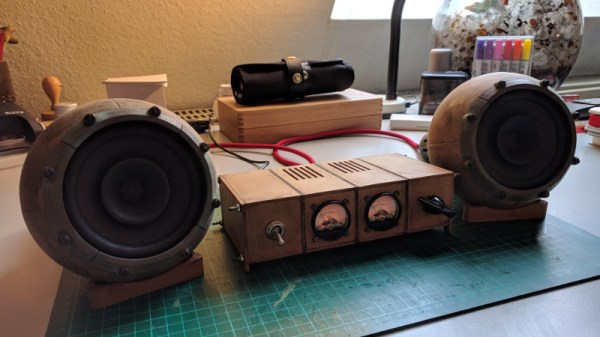
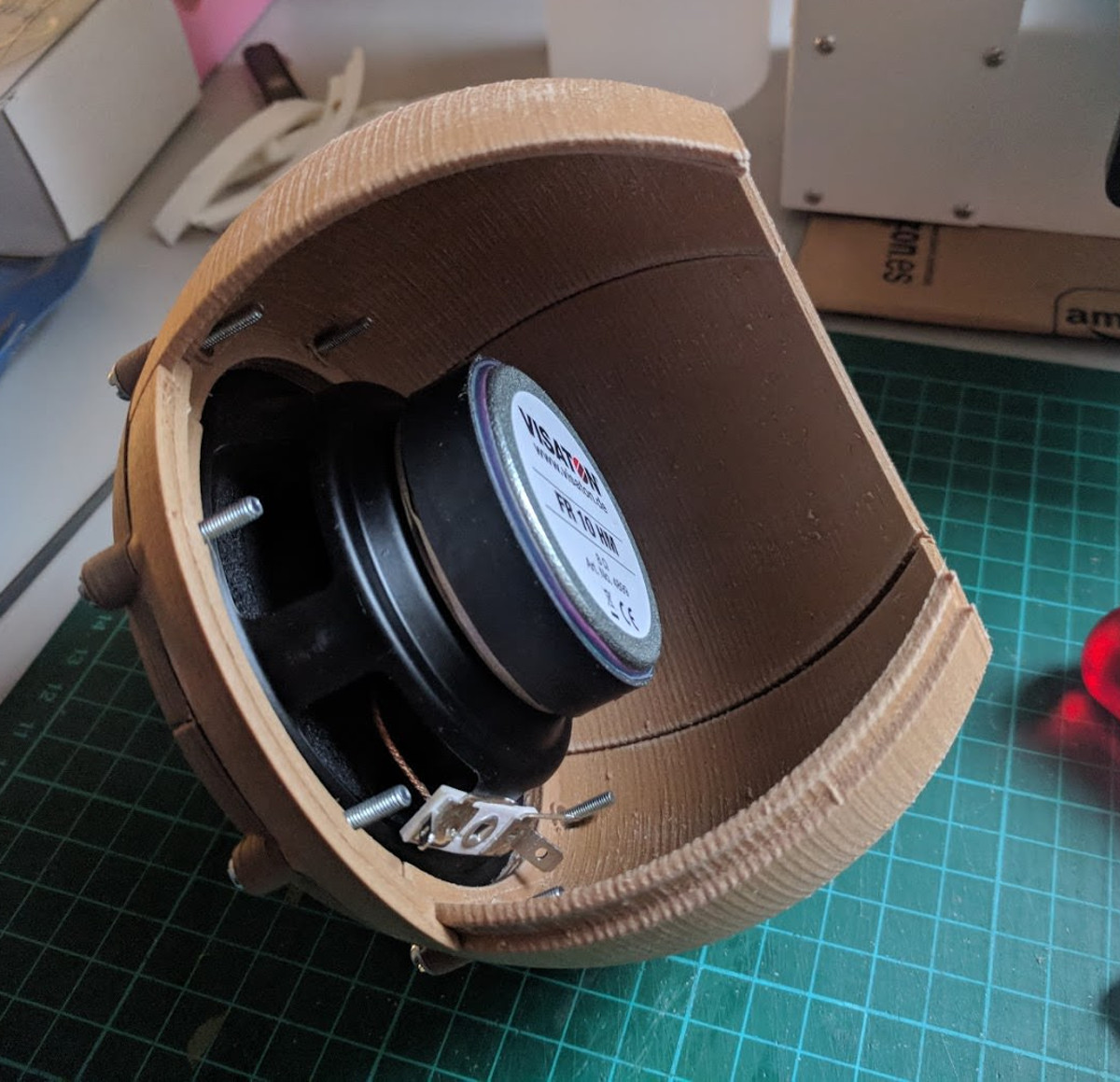
With the release of the Teensy 3.6 and the associated audio processing libraries, it’s never been a better time to get into DIY synth and effects projects. [Scott] is a musician and maker of electronic musical instruments, so he decided to leverage the power of the Teensy and make a delay module that really can’t be done any other way.

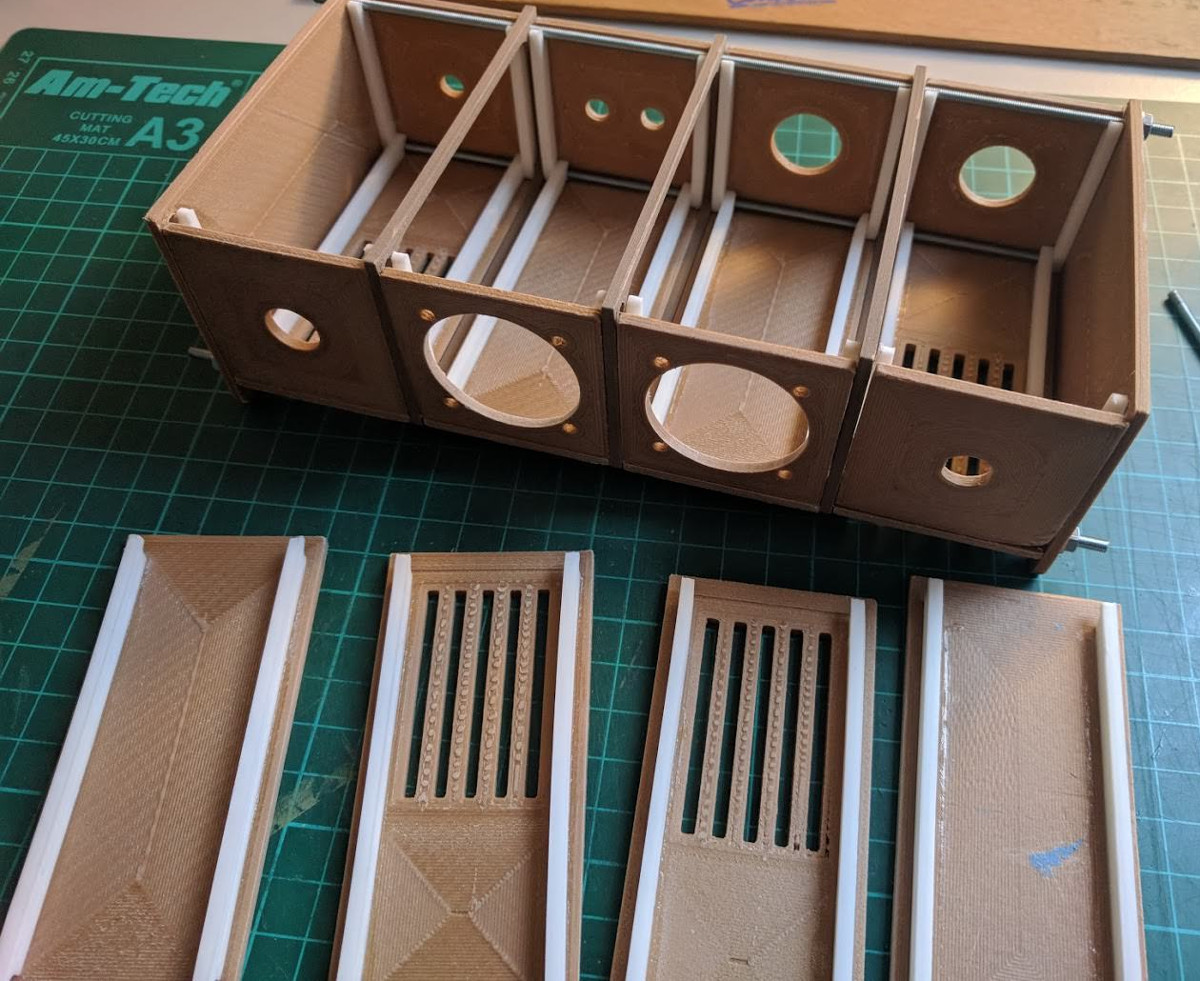
The function of this delay module is somewhat similar to a multi-head tape-based delay, only it’s completely impossible outside of the digital domain. There are four ‘read heads’ on a circular buffer. The first three heads play small loops within the buffer at different speeds, one at the original speed, one at half speed (and an octave below) and one at double speed (and an octave above). The fourth head doesn’t loop, instead, it plays the delay buffer in reverse. There are, of course, handy knobs for setting the level of each ‘read head’.

This project is built around [Scott]’s port of the JUCE framework, a very powerful audio API that’s now well suited for laptop and embedded development. The files for this project are all available on the GitHub, and [Scott] plans to build an expansion module for CV control of all the parameters.

So, how does this glitch delay sound? Pretty good. The video below is just a tele into a looper pedal, and into the glitch delay. There are surely some ambient post-rock stars wetting their skinny jeans over this one, and it’s a great application of the Teensy’s audio processing power, to boot.

Continue reading “Glitch Delays And Teensy Audio”

Local Infrastructure: The Devil Is In The Details

About two months ago I rode my bike to work like any other day, but on the way home a construction project seemed to have spontaneously started at one of the bridges that I pass over. Three lanes had merged into one which, for a federal highway, seemed like a poorly planned traffic pattern for a such a major construction project. As it happens, about an hour after I biked across this bridge that morning both outside sections of the bridge fell into the water. There was no other physical damage that seemed to explain why parts of a bridge on U.S. 1 would suddenly collapse.

The intriguing thing about this bridge collapse was that the outer retaining wall and about half of the sidewalk on both the northbound side and the southbound side had fallen into the water at the same time. This likely wasn’t caused by something like a boat impact, car accident, or an overweight truck. Indeed, Florida Department of Transportation (FDOT) investigated the incident and found that two post tension wires that held these sections of the bridge together had failed, making it unsafe for pedestrians and bicyclists but also for any boaters below. Continue reading “Local Infrastructure: The Devil Is In The Details”

Man-in-the-Middle Jog Pendant: Two Parts Make Easier Dev Work

In a project, repetitive tasks that break the flow of development work are incredibly tiresome and even simple automation can make a world of difference. [Simon Merrett] ran into exactly this while testing different stepper motors in a strain-wave gear project. The system that drives the motor accepts G-Code, but he got fed up with the overhead needed just to make a stepper rotate for a bit on demand. His solution? A grbl man-in-the-middle jog pendant that consists of not much more than a rotary encoder and an Arduino Nano. The unit dutifully passes through any commands received from a host controller, but if the encoder knob is turned it sends custom G-Code allowing [Simon] to dial in a bit acceleration-controlled motor rotation on demand. A brief demo video is below, which gives an idea of how much easier it is to focus on the nuts-and-bolts end of hardware when some simple motor movement is just a knob twist away.

Continue reading “Man-in-the-Middle Jog Pendant: Two Parts Make Easier Dev Work”

Meltdown Code Proves Concept

If you’ve read about Meltdown, you might have thought, “how likely is that to actually happen?” You can more easily judge for yourself by looking at the code available on GitHub. The Linux software is just proof of concept, but it both shows what could happen and — in a way — illustrates some of the difficulties in making this work. There are also two videos in the repository that show spying on password input and dumping physical memory.

The interesting thing is that there are a lot of things that will stop the demos from working. For example a slow CPU, a CPU without out-of-order execution, or an imprecise high-resolution timer. This is apparently especially problematic in virtual machines.

Continue reading “Meltdown Code Proves Concept”

Behind The Scenes At A Pair Of Cell Sites

Those who fancy themselves as infrastructure nerds find cell sites fascinating. They’re outposts of infrastructure wedged into almost any place that can provide enough elevation to cover whatever gap might exist in a carrier’s coverage map. But they’re usually locked behind imposing doors and fences with signs warning of serious penalty for unauthorized access, and so we usually have to settle for admiring them from afar.

Some folks, like [Mike Fisher] aka [MrMobile], have connections, though, and get to take an up close and personal tour of a couple of cell sites. And while the video below is far from detailed enough to truly satisfy most of the Hackaday crowd, it’s enough to whet the appetite and show off a little of what goes into building out a modern cell site. [Mike] somehow got AT&T to take him up to a cell site mounted in the belfry and steeple of the 178-year old Unitarian Church in Duxbury, Massachusetts. He got to poke around everything from the equipment shack with its fiber backhaul gear and backup power supplies to the fiberglass radome shaped to look like the original steeple that now houses the antennas.

Next he drove up to Mount Washington in New Hampshire, the highest point in the northeast US and home to a lot of wireless infrastructure. Known for having some of the worst weather in the world and with a recent low of -36°F (-38°C) to prove it, Mount Washington is brutal on infrastructure, to which the tattered condition of the microwave backhaul radomes attests.

We appreciate the effort that went into this video, but again, [Mike] leaves us wanting more details. Luckily, we’ve got an article that does just that.

Continue reading “Behind The Scenes At A Pair Of Cell Sites”

Mbed Labs Chock Full Of Arm Goodies

One of the things we like about ARM processors is that there are a variety of options for library support. You can write your own code at the bare metal, of course, but you can also use many different abstraction libraries to make things easier. At the other end of the spectrum, there is Mbed, similar to the sort of libraries that Arduino supplies. Easy to use, although not always the best possible performance. Mbed now has an Mbed Labs site with a lot of extra goodies that go with the Mbed ecosystem, and it has quite a few interesting things.

You’ve always been able to write Mbed code in your browser — some people love that and some hate it and use locally-hosted tools like Platform.io. However, with the Mbed Lab, you can build and most importantly simulate your code in the browser (something we covered last year). There’s also a Javascript interpreter that runs on your chip, a small implementation of TensorFlow for deep learning, and a few other projects on the page.

Continue reading “Mbed Labs Chock Full Of Arm Goodies”

LED Tree Brings Gravity To Christmas

Here’s a fun entry into our coin cell challenge. The power source is the actuating force in [Frank]’s blinky LED Christmas tree, which takes advantage of the physical structure of coin cells and our old pal gravity to roll out some holiday cheer. Talk about forward voltage!

We love the concept, and the circuit couldn’t be more simple. A coin cell is released at the top of the tree and rolls down a series of angled foam board railings covered with 1/4″ copper tape. As the coin cell travels, the negative terminal shimmies along the face of the tree, which has corresponding ground rail tapes. There’s no microcontroller here—all that’s needed for blinks are breaks in the negative rail tape.

The challenging part of a project like this is the execution. Getting a coin cell to ride the rails without falling off required angle experimentation prior to and during the build. Now that it’s done, keeping the tree tilted back against the wall is key. [Frank] explored several options for returning the coin cell to the top using a camera motor and the gear assembly from an old inkjet, but for now, his six-year-old does the job without complaint. Check out his work ethic after the break.

Continue reading “LED Tree Brings Gravity To Christmas”