Basic IKEA Wall Light Turned Smart And Colorful!

WallLight-DSO

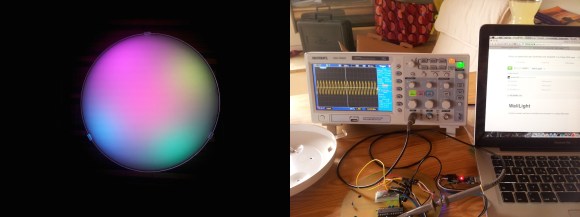
[Daniel Grießhaber] just finished his latest electronics project and we love it. He’s taken a cheap IKEA wall/ceiling light and completely revamped it with RGB LEDs and intelligent control!

The light he used is called the LOCK, and is a mere 1.79€ or about $4 USD. It has lots of room inside and a nice frosted glass dish which results in some excellent color diffusion. He’s designed a nice big circular PCB to mount inside off of the original mounting points. To do this, he used Eagle software to create the circuit and his trusty desktop CNC to mill out the pattern.

To control the lights he used an old ATMega8 board he had lying around, with the Arduino IDE and WS2812 Library. He’s outlined all the parts, diagrams and program sketches you’ll need to make your own over on GitHub.

Unfortunately the LEDs aren’t quite as bright as he hoped so it can’t be used to replace a regular room light — instead he plans on turning this project into sunrise timing light in one of the bedrooms — still pretty cool!

Android Doorbell Notifier

Breadboarded circuit to detect when doorbell rings

It’s always unfortunate to find a FedEx tag on your door saying you missed a delivery; especially when you were home the whole time. After having this problem a few times [Lee] decided to rig up a doorbell notifier for his Android phone.

[Lee]’s doorbell uses a 10 VAC supply to ring a chime. To reduce modifications to the doorbell, he added an integrated rectifier and a PNP transistor. The rectifier drives the transistor when the bell rings, and pulls a line to ground.

An old Netgear router running OpenWRT senses this on a GPIO pin. Hotplugd is used to run a script when the button push is detected.

The software is discussed in a separate post. The router runs a simple UDP server written in C. The phone polls this server periodically using SL4A: a Python scripting layer for the Android platform. To put it all together, hotplugd sends a UNIX signal to the UDP server when the doorbell is pushed. Once the phone polls the server a notification will appear, and [Lee] can pick up his package without delay.

VU Meter Record Player Lights It Up

vu_intro-image

[Michaël Duerinckx] was given a turntable for his last birthday from his fiancée — since then he’s started collecting records like nobodies business. But about a month ago he started itching to do an electronics project — he decided to upgrade his record player to include a VU Meter!

As he began designing he soon realized he didn’t have all the tools he needed to do this project right — a perfect excuse to go check out his local makerspace, SoMakeIt!

He started prototyping the VU Meter on a breadboard, and opened up the record player – it was like this thing was made to be hacked. Two free connections off the power supply to power his circuit, bingo! Continue reading “VU Meter Record Player Lights It Up”

Detroit Meetup This Friday

detroit-meetup-banner

The plans are made, the swag has shipped, are you going to show up or what? Friday night at 8pm we’re having a Hackaday Meetup at i3 Detroit. That link is how you get your free ticket.

You can come for the hacking, the leisure time, or just to score a free shirt and enough stickers to avoid actually repainting that 1991 POS you call a car.

i3 is offering up their facilities for those that want to work on projects or just hang out. They share a roof with B Nektar so there are an amazing array for tasty beverages available (part of the reason we’re calling this an 18+ event). There’s even talk of parking a food truck out front for the night but they’re still working on that.

Bring some hardware to show off and see if you can keep up with the yarns that [Brian Benchoff], [Chris Gammell], and [Mike Szczys] are known to spin.

DIY OLED Smart Watch

OLED DIY Smart Watch

What is better than making your own smart watch? Making one with an OLED display. This is exactly what [Jared] set out to do with his DIY OLED smart watch, which combines an impressive build with some pretty cool hardware.

When building a DIY smart watch, getting the hardware right is arguably the hardest part. After a few iterations, [Jared’s] OLED smart watch is all packaged up and looks great! The firmware for his watch can communicate with the PC via USB HID (requiring no drivers), contains a “watch face” for telling time, includes an integrated calendar, and support for an accelerometer. His post also includes all of the firmware and goes into some build details. With the recent popularity of smart watches and wearable electronics, we really love seeing functional DIY versions. This is just the beginning. In the future, [Jared] plans on adding Bluetooth Low Energy (BLE), a magnetometer, a smart sleep based alarm clock, and more! So be sure to look at his two older posts and keep an eye on this project as it unfolds. It is a very promising smart watch!

With Android L including support for smart watches (in the near future), it would be amazing to see DIY watches (such as this one) modified to run the new mobile OS. How great would it be to have an open hardware platform running such a powerful (open source-ish) OS? the possibilities are endless!

Connect 4 Robot Taunts You Before Kicking Your Butt

Connect 4 Robot

[Patrick McCabe] is a student at MIT and for his final project in his Microcomputer Project Laboratory course he decided to build a clever Connect 4 Robot.

The only criteria for the project was that you have to use the Cypress PSOC 5LP kit along with a 8051 micro-controller or equivalent (programmed in the same assembly language as the PSOC). All in all, [Patrick] had 5 weeks to work on the project.

He’s using a regular old Connect 4 game along with an assortment of custom parts. A stepper motor drives the token carriage back and forth across a 15″ aluminum channel using a timing belt. A servo releases the tokens, and all the other components, brackets, and other pieces were either made with his very own UP Mini 3D printer, or out of acrylic using the school’s laser cutter. It’s an extremely clean and well thought out build, and he’s actually uploaded all the custom part files (in SolidWorks format) online, for others to build their own.

Continue reading “Connect 4 Robot Taunts You Before Kicking Your Butt”

THP Entry: A Digital Large Format Camera

Click to embiggen. It's seriously worth it.
Click to embiggen. It’s seriously worth it.

After 20 or so years of development, digital cameras may soon be superior to film in almost every way, but there are a few niches where film cameras reign supreme. Large format cameras, for example, are able to produce amazing images, but short of renting one for thousands of dollars a day, you’ll probably never get your hands on one. For his entry to The Hackaday Prize, [Jimmy.c..alzen] decided to build digital large format camera, using an interesting device you don’t see used very often these days – a linear CCD.

[Jimmy]’s camera is built around a TAOS TS1412S, a linear CCD that is able to capture a line of light 1536 pixels across. The analog values are clocked out from this chip in sequence, going straight into an Arduino Due for processing, saving, and displaying on a small screen.

Inside the camera, the sensor is on a pair of rails and driven across the focal plane with the help of a stepper motor. The effect is something like the flatbed scanner to camera conversions we’ve seen in the past, but [Jimmy] is able to adjust the exposure of the camera simply by changing the integration time of the sensor. He can also change the delay between scanning each column of pixels, making for some really cool long-exposure photography techniques; one side of an image could be captured at noon, while the other side could be from a beautiful sunset. That’s something you just can’t do otherwise without significant digital manipulation outside the camera.


SpaceWrencherThe project featured in this post is an entry in The Hackaday Prize. Build something awesome and win a trip to space or hundreds of other prizes.