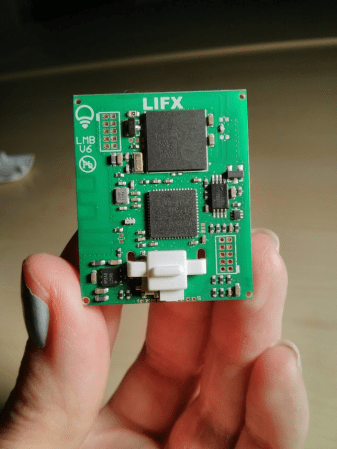
Back in 2012, the LIFX light bulb launched on Kickstarter, and was quite successful. This wireless LED lightbulb uses a combination of WiFi and 6LoWPAN to create a network of lightbulbs within your house. Context Information Security took a look into these devices, and found some security issues.
The LIFX system has a master bulb. This is the only bulb which connects to WiFi, and it sends all commands out to the remaining bulbs over 6LoWPAN. To keep the network up, any bulb can become a master if required. This means the WiFi credentials need to be shared between all the bulbs.
Looking into the protocol, an encrypted binary blob containing WiFi credentials was found. This binary could easily be recovered using an AVR Raven evaluation kit, but was not readable since it was encrypted.
After cracking a bulb apart, they found JTAG headers on the main board. A BusBlaster and OpenOCD were used to communicate with the chip. This allowed the firmware to be dumped.
Using IDA Pro, they determined that AES was being used to encrypt the WiFi credentials. With a bit more work, the key and initialization vector was extracted. With this information, WiFi credentials sent over the air could be decrypted.
The good news is that LIFX fixed this issue. Now they generate an encryption key based on WiFi credentials, preventing a globally unique key from being used.
[via reddit]

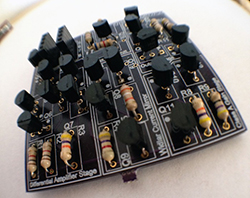 By now we’ve all seen the ‘Three Fives’ kit from Evil Mad Scientist, a very large clone of the 555 timer built from individual transistors and resistors. You can do a lot more in the analog world with discrete parts, and
  [David Schwarz] whipped up this
  David] built and tested his rig over a weekend. On Monday morning, he gave the rig its first run. The video came out pretty good, but he knew he could get a better shot. That’s when Murphy struck. The motor and controller on his rig decided to give up the ghost. With the contest deadline less than 24 hours away, [David] burned the midnight oil and replaced his motor and controller.