Light Bulb Efficiency Exhibit Updated With LED Bulb Option

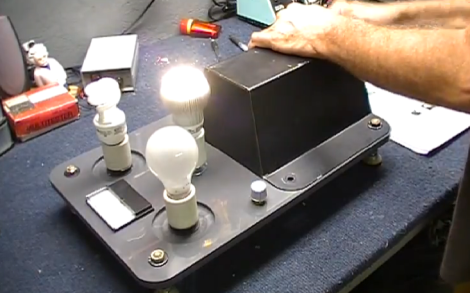
It seems like tinkerers are always being tapped to build or repair exhibit hardware. This time around it’s [Dino’s] turn. He’s been asked to alter a light bulb efficiency demo so that it includes an LED option.

The idea here is that you crank a generator to power different types of light bulbs. There’s an ammeter built in, but possibly the best feedback is knowing how hard you have to crank to illuminate the most inefficient choice. As it stands there is a toggle switch to choose between incandescent and CFL bulbs. [Dino’s] solution is to use a three-position rotary switch. He removes the toggle switch and replaces it with a socket for the LED bulb. A new location for the rotary switch is chosen and he does a bit of work to get it mounted securely. If you haven’t worked with this type of switch before he takes the time in the video after the break to explain how they work.

Continue reading “Light Bulb Efficiency Exhibit Updated With LED Bulb Option” →

200 Pound, WiFi Deploying Robot Ran Over My Foot

[Adam Bercu] and [Dan Landers] from Artisan’s Asylum in Somerville, MA brought a very, very cool toy to Maker Faire this year. It’s a two hundred pound WiFi repeater deploying robot able to amble across unforgiving terrain and my foot.

The robot is controlled through a web interface with the help of a front-mounted web cam with pan and tilt controls. All the signals are sent through a WiFi connection to a node.js web server; not the best way to communicate with a robot over long distances, but [Adam] and [Dan] have a few tricks up their sleeve.

On the back of the robot are two Pelican cases loaded up with a battery and a Linksys WRT54G wireless router. When the robot reaches the limits of its range, it activates a solenoid, dropping a WiFi repeater. This repeater has enough battery juice to stay powered for about a day and a half, meaning the robot can make multiple trips to deploy a wireless network through some very hostile terrain. Perfect for disaster and search and rescue operations.

There are two videos after the break: the first is [Dan] going over the capabilities of his tank bot and the second is a short demo of the bot tearing up the grass at Maker Faire.

Continue reading “200 Pound, WiFi Deploying Robot Ran Over My Foot” →

Laser-etched LED Zeotrope Looks Like A Circular Monochrome Screen

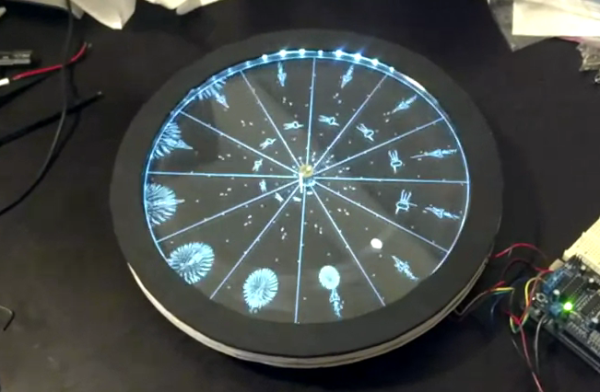
The still image of this animated display really doesn’t do it justice. But you can get an idea of how this really does look like an old monochrome display. It’s actually a zeotrope made from LEDs and etched acrylic. The LEDs blink at a rate that synchronizes with the spinning acrylic to produce an animated image.

You probably already know that a zeotrope uses moving physical models to trick the eye into seeing an animation. In this case the models are etched into a piece of acrylic so that their outline glows when the material is edge-lit. Twelve pie piece shaped panes were designed in Inkscape to look like a scene from the Linux game World War IV. A stepper motor spins the ring which allows for the perfect synchronization seen in the clip after the break.

Continue reading “Laser-etched LED Zeotrope Looks Like A Circular Monochrome Screen” →

LVDS On An FPGA Could Make It Possible To Reuse Laptops LCDs And The Like

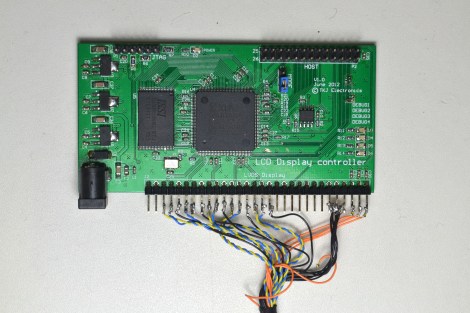
Search around the Internet and you’ll find a landfill of forum threads asking how to drive the LCD screen from a dead laptop. The answer is always that there is just no way to do it. That’s because most of them use a Low-Voltage Differential Signalling protocol that just isn’t available through the hardware used in hobby projects. But the appearance of this board could signal that things are about to change. We don’t want to get your hopes up too much. This isn’t an open source project, but it is a piece of hardware that can make LVDS available for the 8, 16, and 32-bit microcontrollers you’re used to working with.

It’s a derivative of a project [Thomas Jespersen] worked on for a customer. It uses an FPGA to implement the LVDS standard used by high-pixel-count LCD displays. It contains enough memory for a full frame-buffer, and includes a Motorola-8080 communication standard. [Thomas] gives a full description of how the setup works in the video after the break. Demonstrations start about 7:30 into the video with an STM32 F4 Discovery board driving the display.

Continue reading “LVDS On An FPGA Could Make It Possible To Reuse Laptops LCDs And The Like” →

Breadboarding With A 144-core Processor

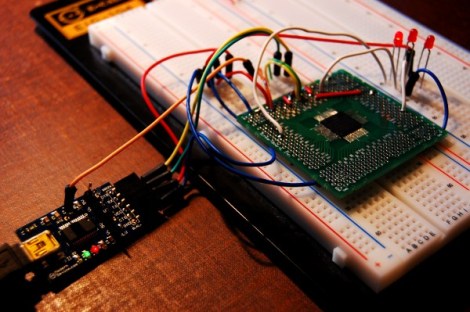
At the center of that green PCB is a tiny little processor with way too many cores. It’s the GA144 which was taken for a test-drive on a breadboard by [Andrew Back]. We saw a multi-core Kickstarter project last month. This will cost a lot less and get you more than twice the number of cores. But as was mentioned in the comments on that post, the drawback is the programming language. This chip’s IDE uses Forth.

There is a dev board available, but [Andrew] went instead with a QFN-to-Through-Hole adapter board which he hand soldered. Once he has access to the pins the chip can be programmed with an FTDI adapter which is compatible with the 1.8V logic levels. The provided Forth IDE (arrayForth) is a Windows only program but it does run under Wine. We followed the project through to see him twiddling I/O pins. But we still have trouble thinking of applications for it. In a world of complex and inexpensive FPGA chips, what would you use this type of processor for?

Hackaday Links: October 3, 2012

Cheap ergonomic mouse

If your had keeps cramping while using the computer mouse why not grab a hunk of wood and a couple of buttons to make your own ergonomic input device?

C# GUI for Arduino testing

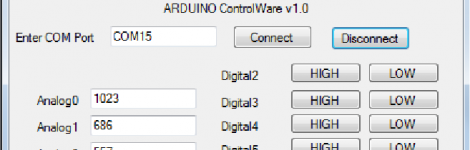
Here’s a Windows GUI for controlling Arduino. [Rohit] put it together using C#. It should make development very simple as you have control of almost everything before you need to worry about writing your own server-side software.

Networked strip lighting replaces the office overheads

[Jeremy] got tired of replacing the halogen bulbs in his office. He upgraded to ten meters of RGB LED strips. We can’t think they do as well at lighting up the room. But he did add network control so they can flash or change colors depending on what type of alert they’re signalling.

Woven QR codes

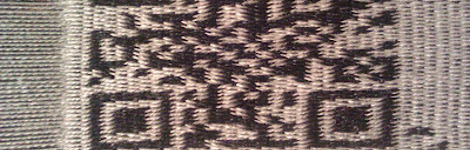
Now that [Andrew Kieran] proved you can weave a working QR code into textiles do you think we’ll see garments that have a QR code leading to care instructions? We could never figure out what all those strange icons stood for.

World’s largest QR code in a corn maze

The world’s largest QR code was cut out of this field of corn. It’s at the Kraay Family Farm in Alberta, Canada. Gizomodo called it “Stupidly Pointless”. But we figure if it got them a world record and put their website on the front page of Giz and Hackaday they’re doing okay. Plus, we whipped out our Android and it read the QR code quite easily.

How TO Dim EL Wire: Current Limiting The Oscillator!

[Ch00f] finally made a breakthrough with his efforts dimming EL wire.  He’s been at it for months and the last we heard his TRIAC idea had sputtered out. Not to be discouraged and with an determination we have to admire he has been hard at work reverse engineering others’ and developing his own methods. He put all of this knowledge to task helping a friend of his with a sleeping disorder, and made a dream-catcher that pulses at the approximate rate of an average person’s breathing (as determined by Apple for their pulsing power button lights).

Essentially the whole thing boils down to simply using a transistor to limit the current to the oscillator. A 555 timer is used to pass a triangle wave to the current limiting transistor at approximately the same rate as the Apple button (1/5 Hz). [Ch00f] notes that this isn’t the sinusoidal wave that apple uses, but it’s good enough. Finally a timeout power off is built in to the night light using a decade counter to monitor the number of triangles from the 555. This should keep the EL wire from wearing down faster, though we are hard pressed to  think of a project we used EL on that has lasted anywhere near the 7 year service life of the wire.

Check out [Ch00f]’s page as he walks us through the process, or just watch his circuit in action after the jump!

Continue reading “How TO Dim EL Wire: Current Limiting The Oscillator!” →