Thailand Residents Use Hacks To Make The Best Of A Horrible Situation

Thailand is dealing with horrible flooding right now. Despite the hardship, people still need to get around and go on with life so many have come up with clever hacks to make this disaster more manageable. [Jan] wrote in to let us know about this collection of flood-related hacks which he’s put together. They are wide-ranging, and many brought a smile to our faces, starting this the plastic-bag enclosed cars (not pictured).

We pulled out three of them to highlight above. On the top left is a canine life vest fashioned out of empty drinking bottles mounted on some type of harness. We hope the pets can stay out of the flood waters but this is a nice precaution. Speaking of precautions, the rubber-ducky to the right of that image is an electrical hazard detector. Float it in the water and an alarm and LED will go off if AC current is detected.  Finally, the image on the bottom shows a bridge constructed in front of a shopping center by turning carts on their backs and lining the pathway with wooden pallets.

There are several floating and amphibious vehicle hacks in the collection. So far we haven’t seen any drill-powered trolling motors though.

LED Strip And UC Add Some Flash To Your Tail Lights

[Dave] spiced up his new 2012 Nissan Juke with a little tail-light amendment. You can see that outlining the rim of the light enclosure is a series of dots. This is an LED strip that he added to augment the brake lights. It’s glued in place, and features side emitting LEDs so that the light will be focused behind the car.

To control the strip he’s using an ATtiny85 microcontroller. It’s the chip on the right, and an optoisolator next to it protects it from the 12V vehicle power which drives the strip (via a MOSFET), and acts as a trigger when the brake pedal is pressed. He wrote a few effects into the firmware. When the lights are turned on, the strip fades up to 75% over about eight seconds. When the brake pedal is pressed they go to 100%. Check out the video after the break (it seems a little weird to us, as the video runs 18 seconds but the audio keeps going… YMMV).

We’ve seen a couple of tail light concepts that flash the brake lights when you stomp on the pedal. Unfortunately the Juke (and all other cars as far as we know) don’t have functionality built-in to sense when you’ve really given the brake a sudden jolt. It makes us wonder if this info could be gleaned from the CANbus? Continue reading “LED Strip And UC Add Some Flash To Your Tail Lights”

$150 CNC Mill Is A Tad Slow But Very Solid

diy-150-cnc-mill

Like just about everyone else out there, [Adam] thinks that CNC machines are pretty cool – so cool that he decided to build one of his own from scratch.

The CNC machine was constructed mostly out of MDF and scrap wood, with drawer slides used for smooth gantry movement. An off-brand rotary tool was used to do the actual cutting, and [Adam] picked up a few Sparkfun stepper motors to drive the machine.

The assembly was completed without too much trouble, but [Adam] says that programming the mill was a long and frustrating process. Cutting was rough and not very accurate at first, but little by little he got things working pretty well. As you can see in the video below, while the cuts look great, improvement came at the expense of speed. He says that the machine could use a redesign to speed it up, which he’ll get around to if some free time comes his way.

It’s not the absolute cheapest CNC build we’ve seen, it’s pretty darn close. With a few tweaks, it could definitely be a solid budget-friendly contender.

Continue reading “$150 CNC Mill Is A Tad Slow But Very Solid”

RGB Upgrade For Ikea Single Color Fiber Optic Lamp

Five bucks will buy you a STRÅLA lamp from Ikea. It’s a battery operated hanging lamp that pipes the light out through multiple branches of fiber optic bundles. But you’ll only get white out of this, which is pretty boring. [Boris] decided to swap out the stock LED for an RGB unit and drive it with an Arduino.

The lamp nucleus is just a couple of pieces of plastic which can be popped apart to reveal the shard of PCB hosting one LED. The body of that diode is flat on the top, and [Boris] filed down his replacement to match the form factor. There are only two conductors in the wire that runs between that PCB and the battery pack, so he replaced them with four conductors (R,G,B, and GND). His prototype uses the Arduino’s PWM capabilities to control the colors, but [Boris] recommends transitioning to a simple chip like a PIC 12F675 or one of the smaller ATtiny microcontrollers after you’ve got the bugs worked out.

See how this turned out in the clip after the break.

Continue reading “RGB Upgrade For Ikea Single Color Fiber Optic Lamp”

20 Kilovolts Replaces Push Pins On This Bulletin Board

Electrical Engineers don’t need push pins. That’s because they know how to control electrons! [Sven] put his knowledge of these subatomic particles to use when building his high voltage bulletin board. It uses a set of vertically strung wires to keep paper pinned against the board. The wires have high voltage at low current travelling through them. They’re in front of the board, but not touching it, and the board is serving as a ground plane. In this way an electrostatic charge pushes (or should that be pulls?) against the paper to keep each sheet right where he places it.

In the video after the break [Sven] gives us a tour of the hardware at work here. It starts with a 12V psu which feeds a buck converter. The regulated feed is patched into a high voltage supply which was designed as a CCFL driver. Finally, a voltage doubler is used to reach the final voltage, measuring about 20 kV per wire.

Don’t worry, [Sven] says the bare wire is “almost completely safe” because of the low current being conducted.

Continue reading “20 Kilovolts Replaces Push Pins On This Bulletin Board”

Toilet Buddy Helps Cover Up Bathroom Noises

toilet-buddy

When it comes to bathroom etiquette, [Nick] and the crew at Gadget Gangster are nothing less than proper gentlemen. Inspired by a Japanese toilet that automatically plays a “courtesy flush” noise in an effort to conserve water while masking sounds, they created the Toilet Buddy.

While the Toilet Buddy does nothing to cover up any aromas, it does provide some sound cover for those louder times. Not only that, it also helps serve as a reminder for other bathroom courtesies as well. When mounted on the tank lid, the Toilet Buddy alerts the last occupant to put the seat down and shut off the lights before leaving the bathroom. Built with a Parallax Propeller board, it uses IR and ambient light sensors to determine the position of the toilet seat and the status of the bathroom lights, playing an audio notifier when necessary. Now if it only sprayed air freshener automatically!

[Nick] points out that the Toilet Buddy is not limited to bathroom duty, and can be used in a variety of projects where light/motion sensing is required. Be sure to check out his writeup for some usage suggestions if you’re thinking of building one.

In the meantime, continue reading to see a video of the Toilet Buddy in action.

Continue reading “Toilet Buddy Helps Cover Up Bathroom Noises”

Hackaday Links: November 10, 2011

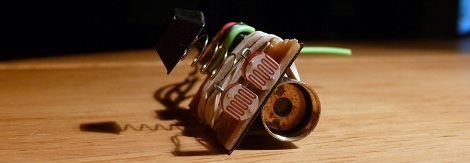
Experimentations with haptics

[Chris] sent in two videos (1, 2) documenting his experiments with haptic feedback. He’s recording the position of a DC motor and can either play it back or send it to another motor. It’s very similar to the kissing robot we saw earlier this year, but we’re not making any judgments.

Mobile Emergency Repeater go bag

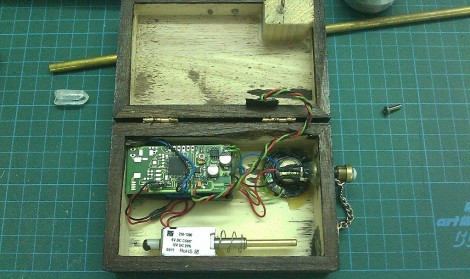
[Nick], a.k.a. [KF5JAK] sent in a few pics of his emergency/disaster relief amateur radio go bag. With a 3G connection via a cell phone, the MER can be used with EchoLink.

Launchpad MIDI booster pack

Earlier this month we lamented the dearth of add-ons for the TI Launchpad. The folks on the 43oh forums just came out with a MIDI booster pack. Time to dust off that old Radio Shack keyboard, we guess.

Macro photography with OH GOD WHARGARBL

You know camera lenses work both ways, right? [Karl] has been experimenting with this very idea by mounting a camera lens backwards and running a few wires so it’s electrically connected as well. Check out an example shot.

Keeping tabs on your kids’ homework

[Janis] doesn’t live with his kids but he wanted to keep track of their homework. He set up a document scanner that sends those worksheets straight to his email inbox. All he has to do is annotate them and send them back. This guy’s doing it right.