Programming An Arduino Using An Audio File

This proof-of-concept is just waiting for you to put it to good use. [Mike Tsao] wrote an Arduino sketch that lets him decode incoming audio data which could be used to program the device. He’s calling the project TribeDuino because it decodes an audio file which is actually the firmware update for a Korg Monotribe.

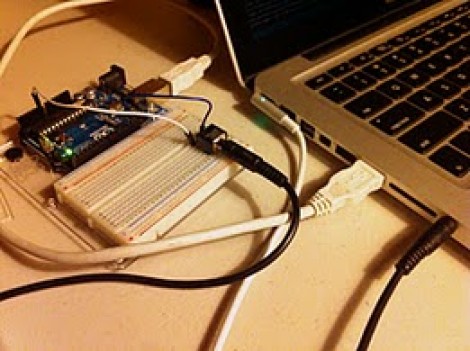
Earlier in the month [Mike] read our feature on a project that reverse engineered the audio-based firmware update for the Korg hardware. He wanted to see if he could write some code to read that file on his own hardware. All it took was an audio jack and two jumper wires to get the Arduino ready to receive the audio file. His firmware reads the Binary Frequency-Shift Keying encoded data as the audio is played, then echos a checksum to prove that it works.

This would be a fantastic addition to your own projects. Since the audio connection only needs to be mono, it only takes just one Arduino pin to add this jack (the other is a ground connection). Having just played around with alternative ways to push data to a microcontroller ourselves, we might give this a try when we have some free time.
Focus Fix For Non-reflex 35mm Camera

For camera fanatics the acquisition of an old camera is a thrilling event. But if you’re going to collect them, you’d better have some repair skills so that you can also use them. [Fernando’s] latest find was this Minox 35mm camera. The aperture needed cleaning, and after reassembling the unit he realized the he had not marked the focus ring when taking it apart. This is not a reflex camera, so you can’t look in the view finder to adjust focus. He came up with his own method to get the focus ring calibrated.

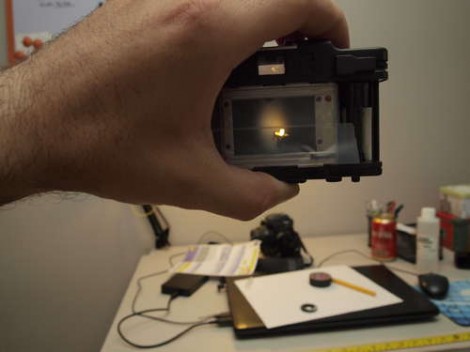
The focal point needs to focus on the film. He simulated this plane using some magic tape, which removes easily without leaving a residue. When the shutter is open, you can see the image projected on this translucent surface. He then set up the camera with the lens 90 cm from a bright light bulb. By adjusting the focus to create a sharp image on the temporary screen, he knows the focus is calibrated, and can reset the focus ring to the 0.9m mark.

Need some help developing that exposed film? You could always give the coffee and vitamin C hack a try.

Spring Clamp Tripod Mount Has Potential

Admittedly this post is flirting with flamebait, but we think the concept of using a spring clamp as an iPhone tripod mount has a lot of hacking potential. Hear us out, and if we havn’t made our case you can rant about it in the comments.

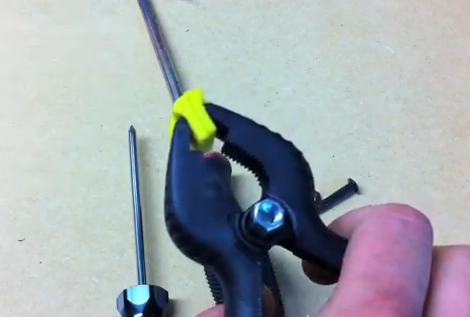
[Joe] wanted an easy way to mount his iPhone on a standard tripod. We’ve seen some creative solutions for this, like using Sugru to make a removable bracket. But he went a different route, using a cheap spring clamp to grip the phone body. These plastic clamps are like over-powered clothespins, and use a screw as the pivot point. [Joe] replaced the stock screw with a longer one, then used a coupling nut which will attach to the tripod. A bit of foam on the pads of the clamp protect your device from the plastic teeth.

It’s a fine solution (if you don’t mind putting that pressure on your smart phone). But we think this would be a great way to build your own heavy-duty third hand. It would be right at home with this modular solder platform. See [Joe’s] how-to video embedded after the break.

Continue reading “Spring Clamp Tripod Mount Has Potential”

dinos-new-years-ball-drop

Build Your Own Mini Ball Drop For New Year’s Eve

[Dino] wanted to make this New Year’s celebration a bit more interesting, but he can’t make it to New York for the ball drop. Instead, he decided to make his own mini display in his workshop. Obviously he’s working with a slightly smaller budget than the folks at Times Square, but we think his display is pretty neat. If anything, [Dino] can at least guarantee that his New Year’s is 100% Seacrest-free.

The ball drop is made up of five ping pong balls, each backlit by a 10mm LED. The LEDs and ping pong balls were mounted on the electron gun from a broken oscilloscope, giving it a cool look. The balls are lit one at a time by an Arduino, which illuminates each one for 15 seconds while the final minute of 2011 is counted down. Once midnight hits, a flashing “2012” sign illuminates while Auld Lang Syne plays from a tiny speaker.

The musical part of this build is something that [Dino] spent a lot of time on. He thoroughly explains how he translated the song from sheet music into its digital form, a process that would be helpful for beginners to watch.

Continue reading to see how the display was built, and if you’re just antsy to see the ball drop in action, a short demo can be found at 12:13.

Continue reading “Build Your Own Mini Ball Drop For New Year’s Eve”

A Floppy Drive Orchestra

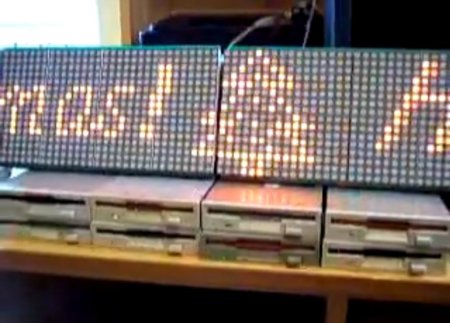
With 8 drives working in concert, this “floppy drive array orchestra” takes drive music to a whole new level!  As if that wasn’t enough, [SileNT] decided to use the16x64 LED array that he’s been working on in concert with the drives.

For those that remember, we’ve actually featured [SileNT], AKA [Pawel]’s, work before, where we were impressed that he was able to play the Imperial March from Star Wars on 2 floppy drives. He’s planning more information about his floppy drive music making in the future and maybe even instructions on building your own personal disk drive orchestra. Apparently [SileNT] has an abundant supply of 3 1/2 inch drives, so maybe even this feat can be topped…

Be sure to check out the video after the break of these 8 drives in action. In the video, more tunes are promised “soon”, so be sure to check back or subscribe to him on Youtube for more sweet melodies. Continue reading “A Floppy Drive Orchestra”

A Chink In The Armor Of WPA/WPA2 WiFi Security

Looks like your WiFi might not be quite as secure as you thought it was. A paper recently published by [Stefan Viehböck] details a security flaw in the supposedly robust WPA/WPA2 WiFi security protocol. It’s not actually that protocol which is the culprit, but an in-built feature called Wi-Fi Protected Setup. This is an additional security protocol that allows you to easily setup network devices like printers without the need to give them the WPA passphrase. [Stephan’s] proof-of-concept allows him to get the WPS pin in 4-10 hours using brute force. Once an attacker has that pin, they can immediately get the WPA passphrase with it. This works even if the passphrase is frequently changed.

Apparently, most WiFi access points not only offer WPS, but have it enabled by default. To further muck up the situation, some hardware settings dashboards offer a disable switch that doesn’t actually do anything!

It looks like [Stephan] wasn’t the only one working on this exploit. [Craig] wrote in to let us know he’s already released software to exploit the hole.

Knockoff Game Controller Makes A Fine Remote Shutter Release

remote-shutter-release

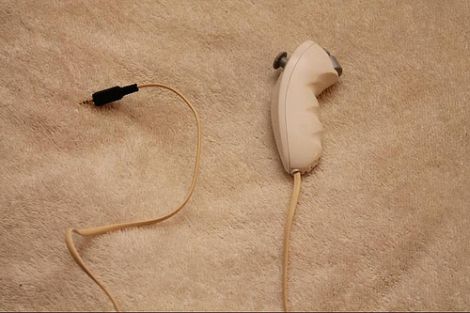
[Duncan Murdock] received a Canon DSLR camera for Christmas and wanted a remote shutter release to go along with it. Since nary a store was open on Christmas, he was pretty much out of luck. Scrounging around in his parts drawer, he found all sorts of goodies waiting to be reused, including a knockoff Wii nunchuck.

He pulled the original cable from the nunchuck and replaced it with an old telephone wire, attaching a 2.5mm plug to the end. The plug goes directly into his camera’s control port, allowing him to trigger the auto focus and shutter mechanisms with the push of a button.

We like the idea of a junk controller being recycled for use in a camera, though we think it has far more potential than being used as a simple wired trigger. If both the nunchuck and camera were fitted with some sort of wireless interface (Bluetooth, IR, etc), we think it would make a great addition to any hobby photographer’s kit.