A Light-Following Pong Game

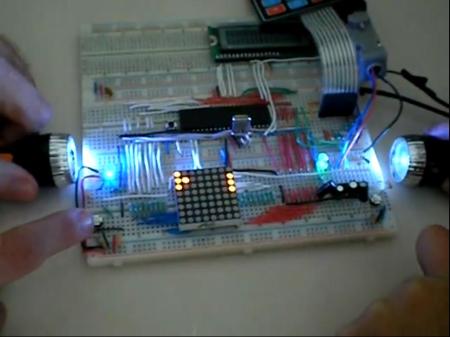
Although not everyone has the ability to make a hacked Pong game Like [Marcelo], even fewer have the ability or the creativity to come up with the elaborate hack that he did. The basic premise of his game is a version of pong played on a breadboard with a 8×8 matrix of LEDs. The controls are really what sets this hack apart. Instead of using a paddle controller or normal switches, small flashlights are used to control the on-screen (on-LED matrix) paddle. This is accomplished using a series of photoresistors and a PIC processor.

Innovative as this would be by itself, [Marcelo] decided to make a program in Flash to display the action on a computer.  Communication is done serially, and C# is used to translate everything as Flash doesn’t natively work with a serial connection.

Another innovation is that there are two LEDs connected on either side powered via pulse width modulation. The lights get dimmer as one player is about to lose. Check out [Marcelo’s] pong game after the break!


Continue reading “A Light-Following Pong Game”

ATTiny Hacks: Run Your Arduino Project On An ATTiny!

Yup. We have all been there. You throw together a really elaborate Arduino project that only really needs a couple pins, far fewer than the Arduino’s native microcontrollers have to offer. Well fear not, [Thatcher] has solved just this problem by adding some ATTtiny cores to the Arduino IDE. His blog details the process from grabbing the MIT developed core files and loading them up in your Arduino software directories. The modification looks simple and although [Thatcher] shows the whole process on a Mac it only involves unzipping and tossing files into a folder. With ATTiny chips only a few bucks each this is perfect for those simple software driven hacks that don’t require an entire Uno duct taped to the outside of an enclosure.  Nice work [Thatcher]!

Building An Optigan-like Instrument

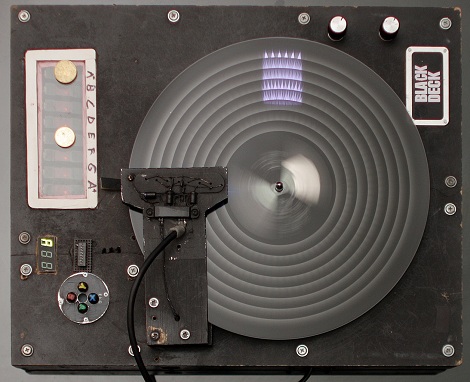
[Olli] sent in his writeup of a musical instrument he made called the Black Deck. [Olli]’s instrument was inspired [Jimi Tenor]’s photophone – a transparent disk attached to a fan and photocell.

A transparent disk is placed on the turntable [Olli] rescued during a dumpster diving expedition. A light shines though the optical disk and is picked up by phototransistors. After writing a program to generate an A minor scale onto a transparency, [Olli] connected his contraption to a stereo and heard his creation speak. To control the individual tracks (or notes) on the disk, [Olli] made a keyboard out of photoelectric switches that control which note is played.

Superficially, [Olli]’s instrument resembles an Optigan. While [Olli]’s instrument is capable of producing waveforms, the Optigan is able to reproduce sampled instruments. That being said, we think [Olli]’s Black Deck would feel comfortable next to the Optigans of Kraftwerk and Devo. Check out the YouTube demo of the Black Deck in action after the break:

Continue reading “Building An Optigan-like Instrument”

Digging Deep Into The Neato’s LIDAR Module

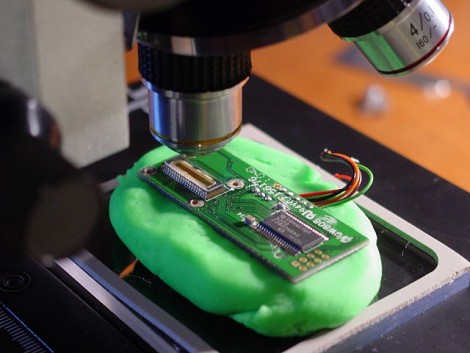
[Hash] is going to great lengths to learn about the parts used in his Neato XV-11 LIDAR (dead link; Internet Archive). We looked in on his work with the XV-11 platform recently, where he used the dust bin of the vacuum as a modular hardware housing. This hack is a hardware exploration aimed at figuring out how an equivalent open hardware version can be built.

The LIDAR module is made of two big chunks; the laser and optic assembly, and the sensor board seen above. [Hash] put it under the microscope for a better look at the line scan imager. The magnification helped him find the company name on the die, this particular part is manufactured by Panavision. He figured out the actual model by counting the bonding wires and pixels in between them to get a pretty good guess at the resolution. He’s pretty sure it’s a DLIS-2K and links to an app note and the datasheet in his post. The chip to the right of the sensor is a TI digital signal processor.

Putting it back together may prove difficult because it will be impossible to realign the optics exactly as they were–the module will need to be recalibrated. [Hash] plans to investigate how the calibration routines work and he’ll post anything that he finds. Check out his description of the tear down in the video after the break.

Continue reading “Digging Deep Into The Neato’s LIDAR Module”

Wall-climbing Bot Does It With Ease

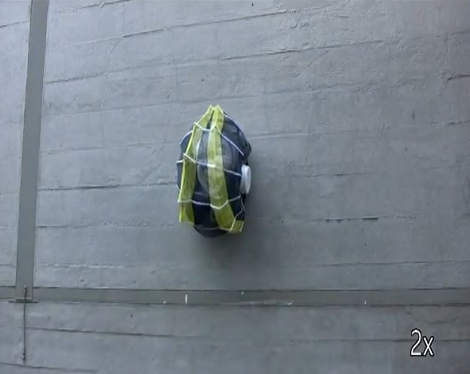
Paraswift is a robot that can climb vertical surfaces with ease. Here you can see the robot motoring up the side of a building with a parachute packed on it’s back for use on the way down. The team that built the robot is calling it a base jumper, but after seeing them catch the falling robot in a net we’d say it’s still a bit too fragile to make that claim.

The parachute isn’t the only way for this guy to get down after a long climb. As you can see in the video after the break, it has no trouble driving in any direction on a wall. Like other wall-climbers the Paraswift is using air to stick to the surface. A vortex of air, similar to a tornado, generates a large amount of negative pressure, sucking the body of the robot to the surface it is climbing. I you’re the one who traded a good portion of your life to spend building the Paraswift we’re guessing you added the parachute to hedge your bets against a power failure.

Continue reading “Wall-climbing Bot Does It With Ease”

Chumby’s New NeTV Makes Almost ‘any TV’ Into An Internet Connected Device

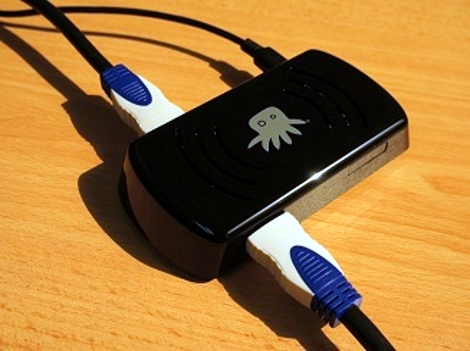
Check out the new set-top box on the block, the NeTV from Chumby Industries. That link will take you to their video demonstration of the device, which is a humble-looking black box with no apparent user interface. You’ll see a few cool tricks that may impress you, like pairing the device with an Android phone through the use of a QR code. Once the two have mated you can do things like share images on the TV and load webpages from addresses entered into the smart phone. There are options for scrolling alerts when you receive an IM or SMS, and a few other bells and whistles. All of this from a device which connects with two HDMI ports to sit between your TV and whatever feeds it a video signal. Read all about the features here.

But its the hacking potential that really gets our juices flowing. The developer page gives us a look inside at the Spartan-6 FPGA that lives in the little case. We don’t often quote [Dave Jones] but we’re certain he’d call this thing ‘sex on a stick’. They’ve made the schematic and FPGA information available and are just begging for you to do your worst. The power for the device is provided by a USB connection but curiously is just above spec when drawing a max of 700 mA. We have a USB port on the back of our TV and would love to velcro this thing in place and power it from that. What would you plan to do with it?

[via Reddit]

Super Pixel Bros Now With Manufactured PCB And Rewritten Software

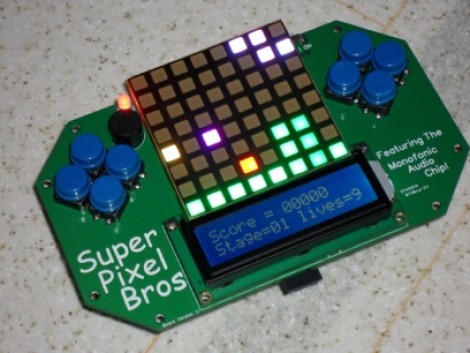
[Retro Brad] has come a long way with his 8×8 gaming device which he calls Super Pixel Bros. The newest rendition has a fab house PCB and freshly rewritten code. The game is still played on an 8×8 LED matrix, but it looks like he’s sourced a version with square pixels, which is a nice touch since he was inspired by the block-based Super Mario games. Also new in this version is the character LCD screen which displays score, level, and life information. But it’s not just the shiny new hardware that’s different, he’s rewritten the software in Swordfish Basic to run on the PIC 18F4550. The new code allowed him to tweak how levels are loaded and stored. He’s even written a level editor and has finished 20 levels thus far.

The demo after the break does a great job of showing off the hardware and the game play. He’s added a lot, including enemies, the ability to shoot fire, and of course the common moves of jumping and breaking blocks is all there. He mentioned that the fab house he used is selling boards for around $5 and he’s looking into the possibility of getting a kit service up and running.

His progress since we last checked in on the project is quite impressive.

Continue reading “Super Pixel Bros Now With Manufactured PCB And Rewritten Software”