Only Losers Text Message On Cellphones – This Guy Carries His Own Teletype For That

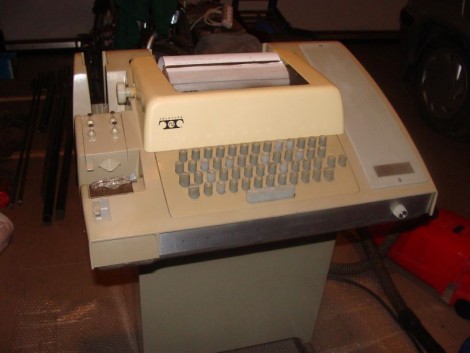
Yes, that’s an SMS text messaging device. [Mdziewie] decided that texting on a regular cellphone was too boring and decided to build himself an old-school SMS gateway. Here’s a translated link but the formatting of the forum post gets screwed up with the machine translation.

The device he’s using is an ASR-33 Teletype machine, which was introduced to the market in 1963. It is connected to a GSM modem via an ARM microcontroller, the STM32F103. This chip, along with a few electronic components, let [Mdziewie] design an interface that doesn’t require alteration to the ancient hardware. The forum post linked above includes video of this sending and receiving texts. It’s awesomely loud as it hammers away at the paper, and seems to work as expected.

If you hunger for one of your own but don’t have half-century old equipment there’s still hope. Find yourself a typewriter and turn it into a teletype machine.


Chainless Bicycle Will Turn A Few Heads

Someone let [Tane] play around with welding equipment and bicycle parts and look what happened! He built a diminutive velocipede. Now that’s just a term for a human-powered land vehicle, but the term fits a bit better as this is missing most of the stuff you’d expect to see on a bicycle.

He started with a mountain bike and a kick scooter, then went to work on both with a hack saw. A bit of welding and angle grinding left him with what you see above. It’s still steerable, but missing are the cranks, chain, and brakes. That’s okay though, the bike is low enough for your legs to reach the ground – you start it up and come to a stop Fred-Flintstone-Style.

[Tane] originally meant to add electric propulsion but didn’t quite get around to it. There’s always the option to add a hub motor to the rear wheel if he has the time and motivation.

Incredibly Fast 3D Printing With The Ultimaker

ultimaker_3d_printer

There’s a new 3d printer on the block, and hot damn is it fast!

Hailing from the Netherlands, the Ultimaker 3D Printer has finally hit US shores, and aims to give the MakerBot a run for its money. The Ultimaker was designed by Utrecht Fab Lab manager [Siert Wijnia] along with two frequent lab patrons, [Erik DeBruijn and Martijn Elserman]. The trio were big fans of the MakerBot, but they wanted to make a better 3D printer.

And make a better printer, they did.

The Ultimaker can print using Either ABS or PLA plastic just like the MakerBot, but it is several magnitudes faster than its predecessor. While the MakerBot utilizes a moving build platform, the Ultimaker has a print head that can move along three axes. The moving print head, along with offset motors which are mounted on the printer’s frame allow the Ultimaker to build taller object than the MakerBot, at higher speeds.

That’s not to say that the MakerBot is bad in any way – rather, the presence of a new kid on the block shows how the evolution and progression of open source design benefits us all.

Keep reading to see a video of the Ultimaker in action, you won’t regret it!

Continue reading “Incredibly Fast 3D Printing With The Ultimaker”

Virtual Segway Tours Using The Wii Balance Board

Take a tour of anywhere on earth without leaving your home. This virtual Segway tour uses the Wii Fit Balance Board and Google Earth to let the rider control a virtual tour by leaning in the direction they want to travel. It’s the product of a hackathon at SVI Hackspace, a new hackerspace in Stanford’s Huang Engineering Center.

The project was undertaken by four people who had just met for the first time that night. Seven hours later, they had a working system that combines a huge number of software packages; OS X, Osculator, Node.js, Socket.io, the Google Earth API, Monster Milk Truck, and Google 3D Warehouse. Most of those packages are used to get the board talking to the computer and then interpreting the data. Monster Milk Truck – which we had never heard of – is a plugin that lets you drive through Google Earth environments using button presses and arrows (which are simulated by the balance board data translations).

This is a nice complement to some of the other balance board hacks we’ve seen, like the one used to control World of Warcraft. Don’t forget to peek at the video after the break.

Continue reading “Virtual Segway Tours Using The Wii Balance Board”

Tiny External System Monitor Makes It Easy To Keep Tabs On Your PC

tiny_pc_resource_monitor

Instructables user [Jan] likes to keep close tabs on his computer’s memory usage, but wanted something more interesting to look at than the standard resource manager. He preferred to have an external display available that would show his computer’s status with a quick glance, and thus this system monitor was born.

His status panel contains a trio of constantly updated LED bars that show his computer’s CPU usage, available physical memory, and virtual memory consumption. With a small footprint being a priority, [Jan] kept the indicator’s size down by using SMD components and by including an on-board UART to USB converter to go along with his ATTiny microcontroller.

He uses a Python script to gather usage information from his computer, feeding it to his display over USB. The system works pretty well as you can see in the video below, though the virtual memory indicator doesn’t seem to get a ton of action – perhaps it could be used to indicate hard drive activity instead.

If you are looking to build something similar, [Jan] has made all of his code and schematics available for anyone’s use.

Continue reading “Tiny External System Monitor Makes It Easy To Keep Tabs On Your PC”

Bluetooth Morse Code Keyboard For The Disabled

The team a Zunkworks wanted to build a device for people who can’t normally use a keyboard and mouse. The Bluetooth Morse code keyboard is what they came up with. This build gives the user full control over the keyboard and mouse using a single button or a sip & puff interface.

Continue reading “Bluetooth Morse Code Keyboard For The Disabled”

Robots Listen Only To The Leader When Building A Roving Quadcopter Landing Pad

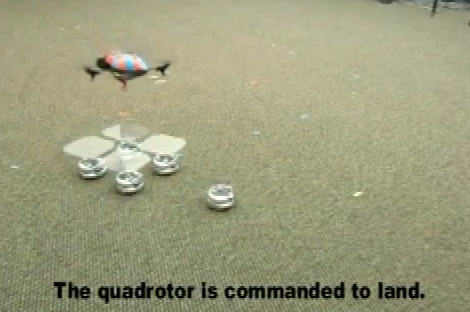
Swarm robotics is really starting to produce some interesting results. This image is from the video embedded after the break that show a group of five robots creating a landing platform for a quadrotor helicopter. The four that actually make up the platform are not in contact with each other, but instead following commands from the leader. We’re impressed by the helicopter’s ability to target and land on the moving platform. Takeoff appears to be another issue, as the platform bots stop moving until the quadcopter is airborne again.

These robots are part of a Graduate project at Georgia Tech. [Ted Macdonald] has been working along with others to implement an organizational algorithm that guides the swarm. The method requires that the robots have an overview of the location of all others in the swarm. This is done with high-speed cameras like we’ve seen in other robotic control projects. But that doesn’t discourage us. If you already have a flying robot as part of the swarm, you might as well add a few more to serve as the eyes in the sky.

Continue reading “Robots Listen Only To The Leader When Building A Roving Quadcopter Landing Pad”