Bluescripts Makes Bluetooth Control From Android A Bit Easier

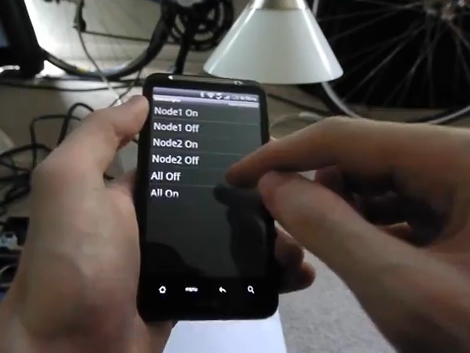
Here’s a way to gain control of your projects using an Android device. Bluescripts is a free app available in the Android market that makes it a bit easier to make interfaces to send customizable messages. If you have a Bluetooth receiver in your project, connecting to it is as easy as putting the MAC address into an XML file on the Android device. Each tag in that file has a name, as well as the address of the target and the message that should be sent. On the receiving end, you just need to make sure your project hardware is ready to receive an ASCII message and act based on what comes through.

Check out the demonstration video after the break. Perhaps it’s not as cool as you could do if you were writing your own Android program, but we can’t think of anything we’ve seen that makes an Android interface this quick and easy.

Continue reading “Bluescripts Makes Bluetooth Control From Android A Bit Easier” →

Mini IR Theremin

[Chris] at PyroElectro sent in a great 8-part write-up of a miniature infrared theremin.

The theremin is based on a PIC microcontroller and an infrared distance sensor.  The build log goes through the theory of operations for the IR sensor and tone generation. [Chris] definitely does a great job showing the math that went into the design.

Although this project isn’t a true theremin because it operates on light like a few other projects we’ve covered in the past, it’s easier to play because of the hard-coded notes. The build does show some promise though – he could likely expand it to use more accurate ultrasonic sensors or use, “two proximity sensors, one for treble and one for bass like an accordion.”

The theremin is usually played with both hands providing a continuous pitch and volume. This project features hard-coded, discrete notes, so we’re wondering about the possibility of implementing MIDI on this IR theremin. The original MIDIbox was based on the same microcontroller as this project, so it’s definitely a possibility.

Check out the video of the theremin in action below.

Continue reading “Mini IR Theremin” →

Reverse Engineering VxWorks (which Replaces Linux On Newer Routers)

The Linksys router seen about is a WRT54G version 1. It famously runs Linux and was the source of much hacking back in the heyday, leading to popular alternative firmware packages such as DD-WRT and Tomato. But the company went away from a Linux-based firmware starting with version 8 of the hardware. Now they are using a proprietary Real Time Operating System called VxWorks.

[Craig] recently put together a reverse engineering guide for WRT54Gv8 and newer routers. His approach is purely firmware based since he doesn’t actually own a router that runs VxWorks. A bit of poking around in the hex dump lets him identify different parts of the files, leading to an ELF header that really starts to unlock the secrets within. From there he carries out a rather lengthy process of accurately disassembling the code into something that makes sense. The tool of choice used for this is IDA Pro diassembler and debugger. We weren’t previously familiar with it, but having seen what it can do we’re quite impressed.

[Image via Wikimedia Commons]

VU Meter Scarf Lights Up The Night

vu_meter_scarf

[Eli Skipp] wrote in to share a project she has been working on bit by bit, for over a year – an LED VU meter scarf. The project was originally going to be built using a custom PCB, but no matter how long she spent troubleshooting the piece, it just wouldn’t work right. She eventually broke down and purchased a VU meter kit, which worked out quite a bit better than the homebrew version.

The VU meter circuitry is tucked away inside the scarf as she shows in the video below. The LEDs are connected using conductive thread sourced from Lamé Lifesaver, which she says is far more durable than other threads she has tried. After originally testing the VU meter, she was unimpressed by the output of the LEDs, so she swapped them out for brighter ones, which look much better. It looks like it works quite well – we definitely dig the idea of a scarf with a built-in VU meter, even if it was partially built from a kit.

Continue reading to see [Eli] give a quick demonstration and a rundown of the scarf’s construction.

Continue reading “VU Meter Scarf Lights Up The Night” →

Humanoid Robot Listens To Music, Plays Along On His Theremin

robot_playing_theremin

Researcher and YouTube user [mspetitegeek] along with her lab mate [Tatsuhiko Itohara] have been fortunate enough to spend some time working with the HRP-2 humanoid robot from Kawada Industries. Their research has seemingly been focused on using the robot to create real-time interactions with humans for entertainment purposes, at the very least.

The program they created allows the HRP-2 to listen and watch its human counterpart while he plays the guitar in order to recognize a beat pattern. Once the robot catches on, it plays along on his Theremin, matching both notes and rhythm perfectly. Since the human operator is clearly playing at a fairly relaxed pace, we are curious to see a demonstration where the robot required to match a snappier tune – it could be quite interesting.

In the meantime, we’re content to just sit back and enjoy the Mogwai-esque tones of the HRP-2 rocking the Theremin.

Keep reading to see a short video of the HRP-2 in action.

Continue reading “Humanoid Robot Listens To Music, Plays Along On His Theremin” →

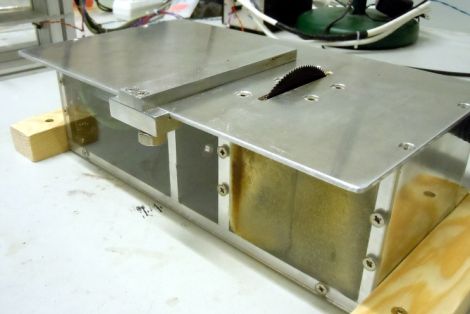
diy_table_saw

DIY Table Saw Cuts Through Anything, Leaves No Room For Mistakes

Students in the BASTLI lab at the Swiss Federal Institute of Technology Zurich had been stuck using underpowered and unreliable saws for quite some time. The saws often got stuck while cutting through PCBs and were generally a drag to use. When group member [Mario Mauerer] came across a big and powerful brushless motor in his basement, he decided it was time to upgrade the lab’s cutting tools.

Along with fellow student [Lukas Schrittwieser] he built a test rig to see how powerful the motor really was, and satisfied with the results, the pair set off to build their own table saw. The enclosure was wrapped up pretty quickly, leaving the pair to source a power supply. Rather than purchase one, they built a 700w monster switching PSU to power their saw.

As you can see in the video below the saw chews through most things with the greatest of ease, but the students added a “boost button” to the saw just in case they need to run it at full tilt.

While we can’t exactly overlook the lack of finger and eye protection in their demonstration, it does look like a great little tool to have around.

Continue reading “DIY Table Saw Cuts Through Anything, Leaves No Room For Mistakes” →

Minecraft Is Now A 3d Design Tool

[Cody Sumter] and [Jason Boggess] are students at the MIT Media Lab, and they just came up with Minecraft.Print(), an attempt to create a bridge between Minecraft and the real world via 3D Printers.

The print is first prepared by placing obsidian, diamond, gold, and iron blocks on opposite corners of the model in Minecraft. From there, a Python script takes over and parses the world map to generate an .STL file for a RepRap or MakerBot.

So far, [Cody] and [Jason] have printed a few Companion Cubes and the model of the Enterprise D. We’re pretty impressed with the resolution of the prints, especially considering the original model is voxelated. The prints look very nice, and right now we really want to print out all the cool stuff we’ve seen, like Isengard, gigantic CPU, or maybe a Minecraft 3D printer.

Minecraft.Print() sure is a nice program [Cody] and [Jason] have there. It would be a shame if anything happened to it. Check out a video demo after the break.

Continue reading “Minecraft Is Now A 3d Design Tool” →