We’ve Got A Real Bone To Pick With This Mouse

Finally, there’s a way you can feel like a real bad-ass while you’re formatting those TPS reports. It’s all thanks to this computer mouse built inside the skull of a dog. [Shannon Larratt] dug through his collection of skulls and came up with this one because it fits nicely in the palm of your hand.

Before you get too grossed out, this is not actually part of an animal’s body like another notable mouse hack that comes to mind. [Shannon] started with the skull of a small dog, making a mold for the pieces used in the finished version above. He was quite creative when fitting the electronic parts inside of his reproduction. He pulled the PCB from a $10 Logitech mouse and had no trouble getting it to fit into the base of the skull. But when it came to the buttons he ended up engineering a couple of rockers and used a belt to reposition the scroll-wheel. Not wanting to lose the middle-click feature there’s an additional lever for that functionality. We’d also like to compliment him on the quality of his write-up. Fantastic!


Libyan Rebels Turn Toys Into Weapons Of War

scrapyard_weaponry

They say all’s fair in love and war – trust us, you don’t have to tell these guys twice.

With the war in Libya raging on, the rebels have turned to anything and everything to help give them the upper hand. Engineers and engineering students have put aside their work and studies to become the architects of the Libyan revolution. In a school playground-cum-weapons facility people from all walks of life work together creating powerful weapons from scrap parts.

[Rajab], the group’s chief weapons engineer, used to drive trucks for a living. Now he is directing his fellow fighters on how best to re purpose scrap materials and recovered military weaponry into effective killing machines. As you can see in the video below, everything is fair game. Their creations range from pickup trucks fitted with recovered fighter jet machine guns, to a Power Wheels chassis that has been converted into a remote controlled machine gun turret.

It’s amazing the things that can be produced with some scrap materials and a bit of ingenuity.

Continue reading “Libyan Rebels Turn Toys Into Weapons Of War” →

Homebrew Heat Gun From Scrounged Parts

A Hack a Day reader needed a tool to solder a lot of SMD parts, so he built a DIY heat gun, and we’re impressed with the results.

After trawling the internet looking for ideas for his heat gun, [MRGATZ85] found that most builds used the ceramic element from cheap soldering irons. Experiments in this direction didn’t go very well because the ceramic element in these irons tends to fall apart very easily. In a moment of inspiration, [MRGATZ85] realized he had an old vaporizer lying around and decided to take it apart. To his surprise, the vaporizer element was a great size, self-contained, and most importantly free. After fabricating a case out of high-temperature foam, aerosol cans, and deadbolt parts, [MRGATS85] was left with a very nice build.

Aside from SMD work, a heatgun can be a very valuable tool for PCB stripping and being used for solder reflow. We’re a little surprised we haven’t seen a homebrew heat gun in quite a while. Even though the element is surrounded by high-temperature foam, the gun still gets a little hot to the touch. We’re hoping that will eventually be under control; it’s a very useful build otherwise.

Check out the image gallery, or the video demo after the break.

Continue reading “Homebrew Heat Gun From Scrounged Parts” →

An Instrument That Plays Along With You

muse

The crew over at Teague Labs was talking about musical instruments and how digital music creation seems to get bogged down under user interfaces littered with increasing numbers of buttons, knobs, and sliders. They decided to build a musical device that has its own musical inclinations and personality, while also allowing for two-way interaction with the user.

The resulting creation is Muze, a simple musical instrument with only a single user input. Muze has been programmed with a palette of notes that it can combine and remix into a nearly infinite number of musical combinations. Muze is perfectly happy composing on its own, and will create music that evolves over time, if left alone long enough.

As with all musicians, not every tune is a hit, so Muze can be gently nudged away from cacophonous melodies with a simple twist of a knob. Each of the device’s knobs represent a blend of functions, which are used to influence Muze when placed on the board. The interaction does not send Muze flying into a completely different direction, rather it tells Muze to shake things up a little bit, much like you would ask your guitarist to pick up the tempo during a jam session.

It’s a neat little instrument, and we can imagine it would be a big hit with kids and adults alike. Keep reading to see a video demonstration of Muze in action.

Continue reading “An Instrument That Plays Along With You” →

Modifying A Cheap Robot Arm For Arduino Control

Many a hacker has put together one of those cheap $30 robot arm kits you can get in just about any store with a section labeled, “science”.  In an ongoing search for a cheap robot arm, [Larry] decided to modify one of them to be controlled with a PC through an Arduino. The article doubles as a really basic tutorial on dc motor control. On the site he gives a brief explanation of how to use H-bridges and a good explanation of how he wired them up for this purpose. He eventually goes on to add a processing interface to the project. The next step would be figuring out how to add some kind of position feedback, such as encoders. Though, if modifying an arm is not your style, [Larry] has another cool article on rolling your own robot arm cheaply with some foam board and hobby servos.

An Even Simpler Smartphone Garage Door Opener

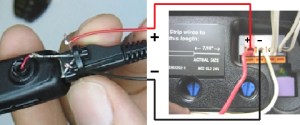
We have seen smartphone garage door openers in the past, but [Lou’s] Hack is beautiful in its simplicity. His door opener tackles the problem without using computers, Arduinos, wireless modules or even any smartphone based applications. For this project all that is needed is a Bluetooth headset and a single transistor. The door opener uses the Samsung HM1100 Bluetooth headset, which [Lou] has done significant testing on to show that his creation is quite secure and will not open the door unexpectedly.

When this headset connects to a phone it produces a beep from the earbud, so [Lou] removed the speaker and replaced it with a transistor. Now he can use the voltage spike produced by the amplifier before the beep as his switching signal. By wiring the transistor in parallel with the door button inside his garage he is able to open the door wirelessly by connecting then right away disconnecting from the headset. This setup is apparently perfectly secure as the only way to initially link your phone with the headset is to be inside the garage. Check out the video after the break for build instructions and a demonstration.

Continue reading “An Even Simpler Smartphone Garage Door Opener” →

MIT’s ESuperbike Takes On The Isle Of Man

mit_ebike

While the Isle of Man typically plays host to an array of gas-powered superbikes screaming through villages and mountain passes at unbelievable speeds, the island’s TT Race is a bit different. Introduced in 2009 to offer a greener alternative to the traditional motorcycle race, organizers opened up the course to electric bikes of all kinds. In order to entice participants, they even put a £10k prize on the line for the first bike that completes the race with an average speed of 100 miles per hour or faster. While no one has claimed the prize just yet, that didn’t stop the MIT Electric Vehicle team from tossing their hat into the ring this year.

Their entry into the race is the brainchild of PhD student [Lennon Rodgers] and his team of undergrads. They first designed a rough model of the motorcycle they wanted to build in CAD, and through a professor at MIT sourced some custom-made batteries for their bike. Through a series of fortunate events, the team found themselves in front of BMW management, who donated an S1000RR racing bike to the project. After a good number of alterations, including the addition of an Arduino to control the bike, they were ready for race day.

While the team didn’t take the checkered flag, they did finish the race in 4th place. Their bike managed to complete the course with an average speed of 79 mph, which isn’t bad according to [Rodgers]. He says that for their first time out, he’s happy that they finished at all, which is not something every team can claim.