Vintage Peripheral Hacks Roundup

A few days ago, we featured an Apple ][ USB keyboard mod, and several readers chimed in sharing their own retro conversions in the comments section. We had no idea that many of you had made similar modifications of your own, so here’s a quick roundup of what your fellow Hackaday readers have put together.


Optical Atari STM1 Mouse

atari_stm1_usb

[JJ] had a 25-year old Atari STM1 mouse sitting around and was wondering how to get it to work with his new computer. Instead of interfacing the old mouse with his computer via a custom circuit board, he gutted the STM1 and replaced the innards with those of a much newer optical mouse. He did a bit of trimming to get the new PCB to fit, aiming the optical sensor through the now-empty “ball hole”. According to [JJ] it works just as good as it looks.


ZX Spectrum USB keyboard conversion
sinclair_zx_spectrum_usb

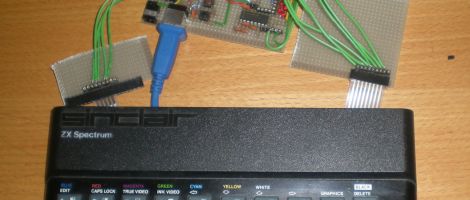
[Lee] is a sucker for vintage hardware, and with the help of his friend [LanceR], resurrected an old Sinclair ZX Spectrum computer into a working USB keyboard. After replacing the deteriorated membrane, the pair mapped out the keyboard to figure out how the matrix was wired. With that done, they built a prototype USB interface board, which they later replaced with a proper PCB.


BBC Master Compact USB keyboard conversion
bbc_master_compact_usb

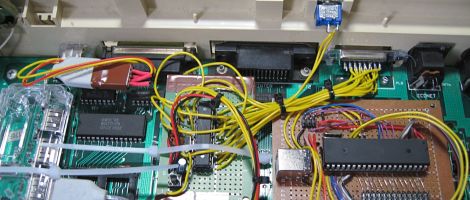
A friend of [MoJo’s] had a BBC Master Compact computer from back in the day and wanted to have the keyboard converted to USB in order to use it with certain emulators. [MoJo] gladly took on the project, stripping some of the old motherboard components out to make room for his new circuitry. He built a USB interface board around an ATMega162, and even got the old built-in speaker working properly. From the outside, the keyboard looks like it has never been touched – nice job!
Wifon Is Back And Better Than Ever

wifon_v2

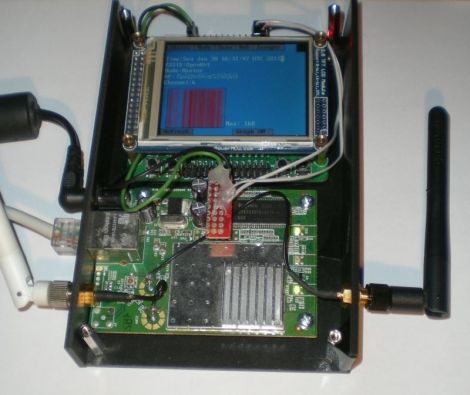
Hackaday forum member [Emeryth] recently posted his newest creation, the Wifon 2.0, which is an update to a project we featured last year. The second iteration of the device looks to make several improvements on the already solid concept.

Ditching the simple 16×4 LCD, version 2 sports a full color 320×240 touch panel LCD. A faster STM32 micro controller replaces the Atmega88 he used the first time around, allowing him to create a much more advanced user interface. The micro runs the ChibiOS/RT real time operating system, which enables multitasking, making the entire project a lot easier. Like the first version, an original Fonera performs all of the pen testing, though this time around he has ditched the vanilla DD-WRT distro for Jasager, which is purpose-built for running the Karma attack.

The project is coming along nicely, and [Emeryth] says he has a few simple apps running on the device already. He has found that running several applications on the device simultaneously is testing the practical limits of the Foneras capabilities, though he may add more memory to the router in order to squeeze a little more life out of it.

[via Hackaday forums]

Solar Powered Cellphone A True Hack

The polished quality of this hack isn’t quite there, but we love the ingenuity and exploration exhibited. [Paulie1982] shows us how to make an old cellphone work with the rays of the sun.

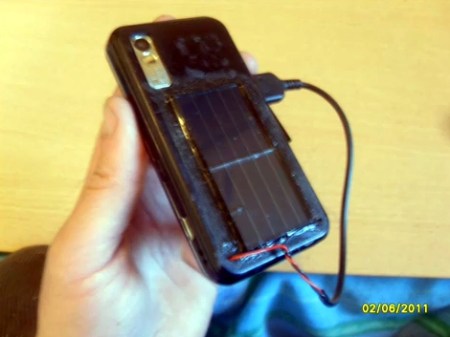
You can see above that he’s added photovoltaic solar cells to the back case of what looks like an old smart phone. He grabbed the cells from two inexpensive solar landscaping lights and inserted them by cutting holes in the case and using black silicone sealant to glue them in place. Each can pump out about 3V and together they get above the 5V threshold that he needs to do some charging. See the build process in the video after the break.

From what we’ve seen there’s zero consideration of current in this hack and that’s what makes us skeptical. Still, we love the idea of trickle charging and we’d love to see some speculation in the comments about how to improve upon this. Surely the additional hardware necessary for proper regulation, etc. could be fit in a custom case cover like the one used for this inductive charger hack.

Continue reading “Solar Powered Cellphone A True Hack” →

Trobot: Kickstarting The 6-axis Minature Robot Arm

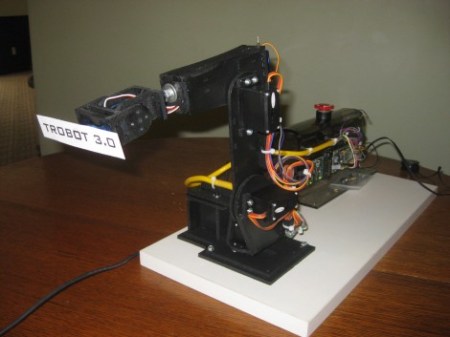
Having already made it to three hardware development versions, [Toby Baumgartner] is looking for some financial backing to make version four of this robot arm possible.

He’s modelling the arm after much larger ABB industrial robots. Like those, it mounts on a stationary base, and features movement along six axes.  The first couple of iterations even used ABB Software’s RobotStudio for control. This is the same software used by the full-sized robots, and features a special design language to integrate the robots into just about any production facility.

We don’t think the need for high-end software used with these small manipulator arms is very great, but we could see the finished product used for small-scale assembly line work some day. In the mean time these might be useful in your own projects. [Toby] has been using an mBed microcontroller board as the hardware driver. It communicates with the computer via an Ethernet connection and he’s even working on an Android interface right now.

Check out a video demonstration of version 2 and 3 embedded after the break.

Continue reading “Trobot: Kickstarting The 6-axis Minature Robot Arm” →

Stripping DRM From OverDrive Media Console EBooks

stripping_drm_from_overdrive_media_center_ebooks

[Armin Tamzarian’s] local library recently started lending eBooks via the OverDrive Media Console system. He checked out a couple of books, which got him thinking about how the copy protection scheme was implemented. He wondered what recourse users had if they wanted to view a book they have already checked out on a different, or unsupported piece of hardware.

His research centers around Adobe’s ADEPT digital rights management scheme, which is used to protect the books offered on loan by OverDrive. The topic is broken down into three parts, starting with an introduction to the EPUB file structure, the OverDrive Media Console, as well as the aforementioned ADEPT DRM scheme.

The second part takes a close look at the OverDrive Media Console itself, where he uses the ineptkey and ineptepub utilities written by [I♥CABBAGES] to pull the RSA cipher keys from the EPUB data he uncovered. When he then tries to strip the ADEPT DRM layer from his books however, he discovers that OverDrive is using a non-compliant version of the ADEPT standard, which renders existing tools useless.

The final part of [Armin’s] discussion digs even deeper into the OverDrive Console’s inner workings, where he finds that the OverDrive Media Console stores quite a bit of information in an SQLite database. After a bit of digging, he finds all the data he needs to strip the DRM from his books. [Armin] also took the time to wrap all of his findings up into a neat little tool called OMCStrip, which as you may have guessed, strips the DRM from ADEPT-protected eBooks with ease.

Automatic Espresso Loader For Those Late Night Hack Sessions

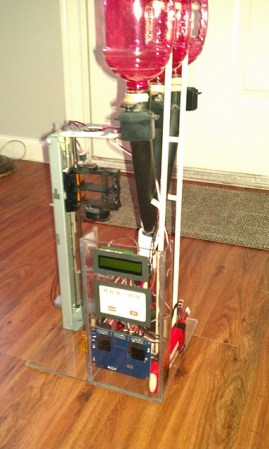
For [Roy’s] graduate electronics class, he decided to make something that many in and out of the hacking world would certainly love, an automatic espresso loader.  One can choose from three flavors available. In order to accomplish this, a Parralax Propeller board is used to control three servos that regulate the amount of coffee dispensed, chosen by a handy LCD HMI (human machine interface).

After the coffee is dispensed, the chute swings out of the way. A modified inkjet cartridge carrier (from a dead printer) is then used to compact the beans. Check out the video of this machine in action after the break. Continue reading “Automatic Espresso Loader For Those Late Night Hack Sessions” →

The Kinect Controlled Zombie Skeleton

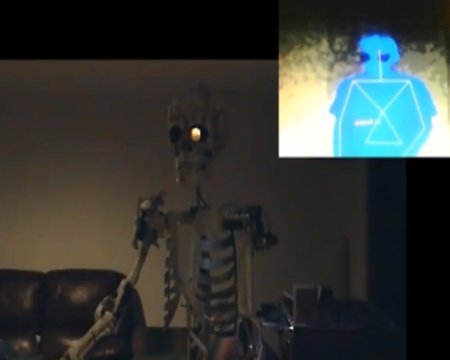
Although there is no shortage of Kinect hacks out there, this one from Dashhacks seems especially cool.  According to them, the software part of this design uses a “modified OpenNI programming along with GlovePIE to send WiiMote commands to the cyborg such as jaw and torso movement along with MorphVOX to create the voice for the cybernetic monstrosity.” As pointed out in the video, this robotic zombie also has a “pause” feature, and a feature to loop movements like what would be done at an amusement park.

The other great thing about this hack is how well the skeleton is actuated via servo motors. Although it’s difficult to tell how many servos were used for this robot, it certainly has 10 or more degrees of freedom between the head, both arms, and the torso. To control all of this a hacked Wiimote and Nunchuck is used in conjunction with the Kinect. Check out the video after the break.

Continue reading “The Kinect Controlled Zombie Skeleton” →