Class Up Your Next Party With The Drink Making Unit 2.0

drink_making_unit_20

The crew over at [Evil Mad Scientist Laboratories] has been hard at work preparing for the Barbot 2011 cocktail robotic exhibition. This year, they are packing some serious drinking fun with the Drink Making Unit 2.0. The predictably named follow-up to last year’s wildly popular Drink Making Unit doubles the mixing capability with six, rather than three fluids, and provides a visually stimulating drink mixing experience.

While they are similarly named, the new unit has been completely redesigned since last year. No longer are they relying on breast pumps to move the alcohol along. Instead, they are using compressed air to dispense fluids from wash bottles which were constructed from laboratory beakers. The fluids are measured in specially altered graduated cylinders that are designed to tip over and release their contents when the appropriate amount of alcohol has been poured. These cylinders are designed to mimic the movement of Japanese garden fixtures called “deer chasers”, tipping back and forth solely powered by the ingress and egress of liquid.

The dispenser’s control panel houses an ATmega164, which orchestrates the entire operation. It interfaces with the LED driver boards that make up the display via SPI. The micro controller is also tasked with monitoring when the graduated cylinders tip their libations into the dispensing funnel, which is done using IR LEDs and photogates.

It’s a great looking machine, and while there isn’t any drink mixing video as of yet, we can’t wait to see it in action.


Kinect Hack Makes April Fools’ Prank A Reality

gmail_motion

Unless you have been hiding out in a cave for the last week or so, you have heard about this year’s April Fools’ joke from Google. Gmail Motion was purported to be an action-driven interface for Gmail, complete with goofy poses and gestures for completing everyday email tasks. Unfortunately it was all an elaborate joke and no gesture-based Gmail interface is forthcoming…at least not from Google.

The team over at the USC Institute for Creative Technologies have stepped up and made Google’s hoax a reality.  You might remember these guys from their Kinect-based World of Warcraft interface which used body motions to emulate in-game keyboard actions. Using their Flexible Action and Articulated Skeleton Toolkit (FAAST), they developed a Kinect interface for Gmail which they have dubbed the Software Library Optimizing Obligatory Waving (SLOOW).

Their skeleton tracking software allows them to use all of the faux gestures Google dreamed up for controlling your inbox, however impractical they might be. We love a good April Fools’ joke, but we really enjoy when they become reality via some clever thinking.

Stick around for a video demo of the SLOOW interface in action.

[via Adafruit]

Continue reading “Kinect Hack Makes April Fools’ Prank A Reality” →

RFID Drink System Eliminates The Need For Change

popcard_vending_machine

[Avatar-X] snagged a drink vending machine online a few years back, and has been selling drinks to his neighbors ever since. People are always asking him for change, and just the other day he was thirsty and out of change himself.  He considered adding an override key so that he could snag free drinks whenever he pleased, but decided to go all out and built a cash card system instead.

He didn’t know how to interface with the machine’s logic board, so after poring over the service manual he consulted with a support rep from the company that manufactured it. Luckily, he was able to get enough information from them to start making some headway. With his friend’s assistance, he was able to figure out which pins on the Bill Validator Interface needed to be shorted in order to simulate the addition of funds.

Using an Arduino with an Ethernet shield, LCD display, and an RFID reader, he had his PopCARD system up and running in no time. Now all his neighbors have to do when they want a drink is swipe their card in front of the machine and hit a button to add funds from their account.

As you can see in the video below it works great, and we’re sure his neighbors are pleased with the improvements he has made.

Continue reading “RFID Drink System Eliminates The Need For Change” →

Power-sipping MSP430 Mini Alarm Clock

msp430_alarmclock

[Markus] had a TI MSP430 sitting around from the LaunchPad kit he bought a while back. He didn’t know what to do with it, but eventually decided that it would make a great miniature alarm clock.

He added a shift register to the mix in order to drive his 7-segment LCD display, using two of the MSP430’s output pins in the process. Four more pins were tied to the display’s cathodes, while the remaining two pins are connected to push buttons which register user input.

He crammed the clock’s logic as well as an alarm tune into the chip’s scant 2KB of memory space, literally occupying everything up to the last available byte. The clock is quite a power-miser, using just 2 µA in standby mode. According to [Markus’] calculations, that should enable the clock to use one set of batteries for 10+ years.

While this isn’t the first MSP430 clock we have seen, it certainly is the smallest and most simple.  Stick around to see a quick video of his clock in action.

Continue reading “Power-sipping MSP430 Mini Alarm Clock” →

Thinkpad Dock-Picking

Hackers at the “RaumZeitLabor” hackerspace in Mannheim Germany have noticed that the locking mechanism on the thinkpad mini dock is extremely easy to circumvent. Sold as an additional layer of security, the mechanism itself is not really secured in any way. The button that actuates it is locked by a key, but the latch isn’t secured and can be accessed via a vent on the side. They are using a lockpicking tool in the video, but they say that even a long paperclip would suffice.

We know that no security device is perfect, and if someone really really wants it, they’ll take it, but this seems a bit too easy. Maybe the next version will have a little plastic wall protecting the latch from being actuated manually.  Hopefully if security is your main concern you are using something a little more robust that a dock-lock.

[via the RaumZeitLabor hackerspace (google translated)]

Continue reading “Thinkpad Dock-Picking” →

Solar-powered GameBoy Color Never Runs Out Of Juice

solar_gbc

Instructables user [Andrew] was given a free, but damaged GameBoy color by a friend. The friend’s dog had done quite a number on the outside of the handheld, but it was definitely usable.  After replacing some of the outer shell, [Andrew] decided that he would try tweaking the GameBoy to utilize a solar cell in order to keep the batteries topped off.

He bought a solar garden light for $5 and disassembled it, being careful not to damage the heavily-glued solar panel in the process. The GameBoy was pulled apart next, and the solar panel was soldered to the handheld’s battery leads. Once the wires were properly routed through the case, he reassembled the handheld and picked up a pair of rechargeable AA batteries to test things out.

[Andrew] tells us that the solar panel works nicely, and that simply setting it out face-down keeps his batteries charged and ready to go.

Stick around for a quick video demo of his solar-powered GameBoy.

Continue reading “Solar-powered GameBoy Color Never Runs Out Of Juice” →

Gun Turret Built Into A Cake Box

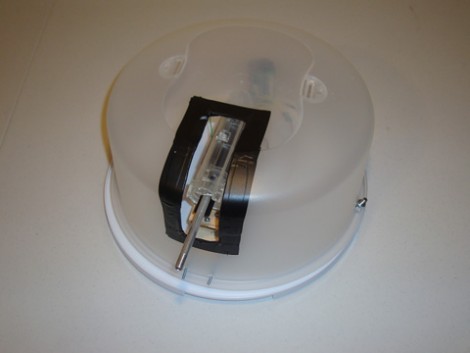
Couch potatoes have a new line of defense thanks to this remote-controlled turret. The gun itself is a hacked down airsoft model. The mount started with a servo motor in the center of a plastic cake box. A thin strip of plywood was added, along with a couple of sliding furniture feet to stabilize the platform as it rotates. A second servo mounts to that platform, which allows the trajectory of the projectile to be adjusted up or down. A PIC 18F4520 controls both of the motors, as well as the firing of the airsoft module, all while listening for commands from an IR receiver. Just adjust the firmware to match an unused device on your universal remote and the power to annoy your roommates will be at the tips of your fingers.

You can see an overview of the build process, as well as a demonstration of the final project in the video after the break. The page linked at the top has a very detailed build log but some of the ‘next’ buttons on that page don’t work for us. Luckily you’ll see a table of contents in the right column which lets you navigate around these bad links.

Continue reading “Gun Turret Built Into A Cake Box” →