Halloween Props: This Drill Makes Your Head Spin

[Nollie551] sent us a demonstration of his head spinning yard prop. Adding a possessed child as part of your Halloween display is a nice touch. But when her head starts to spin (think: The Exorcist) as trick-or-treaters saunter by it should scare the life out of them. You can see that all it took is a jig to hold an inexpensive power drill in place. He didn’t include details of how this is hooked up but we think it would be a great way to use that drill switch hack that [Ben Krasnow] did a while back.

Join us after the break for some video.

Continue reading “Halloween Props: This Drill Makes Your Head Spin” →

AVR Programming 02: The Hardware

You may be able to write the most eloquent code in the history of embedded systems but without a way to run it on the hardware it will be worthless. In this installment of the tutorial series we will:

  • Look at some of the available AVR programmer options
  • Place the microcontroller on a breadboard and connect it to a power supply and a programmer.
  • Use programming software to send some example code to the microcontroller

If you missed Part 1 take a few minutes to review that portion of the tutorial and then join us after the break.

Series roadmap:

Continue reading “AVR Programming 02: The Hardware” →

Hackaday Links: October 24, 2010

Square Gears

This video demonstrates square gears and other oddly shaped cogs. We can’t think of a use but it’s interesting none-the-less. [via Tinkernology]

Cooking with Lasers

It’s late and you’ve been at the workbench for quite some time. But why go to the kitchen for a snack? Grab a couple of 1 watt lasers, hot glue a kernel of corn to a DC motor, and you’ll have popcorn in no time.

Calling this a simulator just doesn’t do it justice

Okay, so this link is a Lexus commercial. But it’s worth watching to see the footage of this driving simulator. Inside that pod is an actual automobile surrounded by a 360 degree screen. The room has a full x and y axis to move the pod (and the car) as you drive through the simulated world. It’s like someone gave a bunch of geeks an unlimited budget and say “go nuts”. [Thanks Luke]

What takes the most time in your hacking adventures?

Everyone whose spent some time in web design has run across the peculiar rendering bugs and workarounds associated with Internet Explorer. Internet Explorer Stole My Life aims to tabulate the collective time wasted from the lives of developers. We think it’s hilarious because spending the same amount of time meeting W3C standards and this problem would go away. But [Caleb] mentioned something interesting when he saw this site: What part of your hacking adventures wastes the most time? We’d love to hear about it in the comments.


Hackvision Is Build-your-own Retro Game

If you wanted to try your hand at programming some retro games Hackvision can jump-start the process. It is an Arduino-based game console in a controller format. You get four directional buttons and one function button. It has two RCA jacks for mono audio, and black and white video.

We’re happy to find that there’s information about game development that will help you follow along with the Space Invaders and Pong examples. The system uses the Arduino TVout library for video, which is robust and fairly easy to interact with. But once you see the game play in the video after the break it’ll be hard to resist building one of these. Don’t forget, this is Arduino based. If you already have an Arduino that uses an ATmega328 you just need to build the audio, video, and button circuits. Continue reading “Hackvision Is Build-your-own Retro Game” →

Lightsaber Color Selector

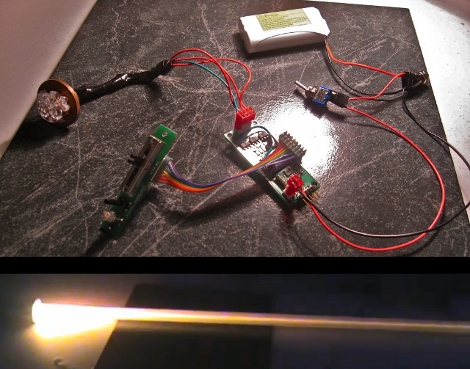
[George Hadley] developed a nice setup to control the color of a replica Lightsaber. A small PCB houses a PIC 18F2221 and three switching transistors for the colors. A powerful LED resides in the tip of the handle, lighting up the diffuser that makes up the blade. But our favorite part is the control scheme. He’s embedded a small RGB LED in the handle, giving feedback as to which color of light can currently be adjusted (red, green, or blue). One button scrolls through the colors and a slide potentiometer adjusts that them.

We wouldn’t go as far as calling this a Halloween prop, we think it’s better suited for serious replica builds. But it would make an amazing addition to the little one’s costume. See it in action after the break.

Continue reading “Lightsaber Color Selector” →

Marx Generator, Knocks Our Rocks Off

What weighs more than 500 pounds, produces 500 kilovolts, and we don’t recommend you try at home in any way shape or form? If you guessed a rock disaggregation device, you’re correct! We also accepted lightning generators as correct answers. Using high voltage electricity, a rock can be split apart down to its grains without destroying the precious minerals inside; unlike traditional grinding and mechanical techniques that often ruin the sample. All it takes is a massive hydro pole transformer, five 1uf 100 kilovolt capacitors, eight hand wound inductors, and two massive cojones to stand within 20 feet of the thing while it’s going off. Video after the divide.

Continue reading “Marx Generator, Knocks Our Rocks Off” →

IM-ME USB Dongle Hacking

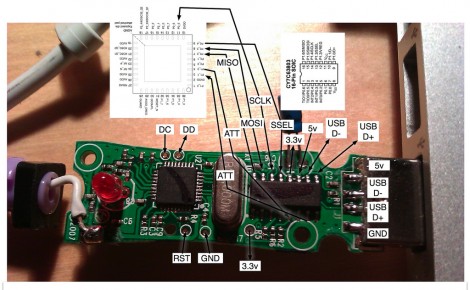
This circuit board is from the USB dongle of a Girl Tech IM-ME. [Joby Taffey] took it apart and poked around to learn its secrets. These dongles come along with the pink pager that has become a popular low-cost hacking platform. But we haven’t seen much done with the dongle itself up until now.

[Joby] used the OpenBench Logic Sniffer to gain some insight on what’s going on here. The board has two chips on it, a Cypress CY7C63803 USB microcontroller which talks to the computer over USB and also communicates over SPI with a Chipcon CC1110 SoC radio. It looks like reprogramming the Cypress chip is a no-go, so he went to work on the CC1110. The inter-chip communications data that he acquired by sniffing the SPI lines gave him all he needed to reimplement the protocol using his own firmware. As a proof of concept he to reflashed the CC1110 and can now send and receive arbitrary commands from the dongle. There’s a tiny video after the break showing a script on the computer turning the dongle’s LED on and off.

Continue reading “IM-ME USB Dongle Hacking” →