Tax-exempt Geek Group Hit With Huge Tax Bill

Non-profit hackerspace The Geek Group has been hit with a hefty tax bill despite their tax-exempt status. We featured a boom camera built by the organization back in November. It is the goal of The Geek Group to fulfill the thirst to explore and create by providing facilities, peer group, and camaraderie that make knowledge and learning not only acceptable, but desirable. In the video after the break you can hear a bit about the organization’s role in servicing donated computers and putting them out into the community, as well as its role in education through groups like the Boy Scouts of America.

This is all done without the goal for profit and accordingly they have attained 501(c)(3) status with the federal government (we’ve seen their 990 forms stating this). To the best of our knowledge this doesn’t mean that they don’t need to pay property taxes, but it does make property taxes ridiculously low (we’ve heard of one cent per acre for non-profit land holdings before). That’s why it comes as quite a surprise when the township slaps a sticker on the doors giving notice of seizure and demanding payment for $47,652.78 in back taxes or the assets will be auctioned off. The entire story, from The Geek Group’s point of view, unfolds in a video of the quarterly Board of Directors meeting from last Saturday.

We’re hoping this is just a mistake and can be remedied. That being said, it’s not easy to run this type of operation. It’s unfortunate that the Board of Directors needs to deal with a tax battle in addition to fulfilling the mission of the organization. Good luck to them in navigating the road ahead.

Continue reading “Tax-exempt Geek Group Hit With Huge Tax Bill”

Follow-up: Hacking OnStar

Reader [regulatre] has provided us with his furthering of hacking the OnStar system in GM cars. Previously, we wrote about some initial attempts to gain access to the system that OnStar uses to monitor and control cars called GMLAN. [regulatre] has managed to create an adapter between the GMLAN connector and a standard OBD2 plug, which should allow a number of standard readers to be able to retrieve data.

This method details using a bluetooth OBD2 reader, and passing the data onto a linux machine. It looks as though the writer of this method is looking to integrate OnStar reading and writing into an Android App which currently is an OBD monitor.

We love seeing follow-ups like this, because it puts everyone one step closer to full control of closed devices. As always, let us know if you take any of this in a new direction.

Keep Tabs On Your Car Without OBD-II

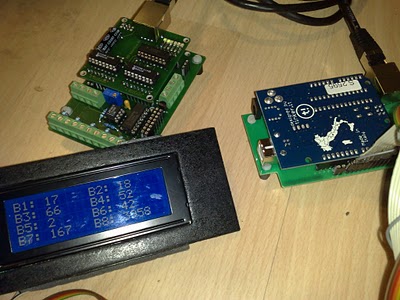
[Steve] let us know about his MultiDisplay car monitoring system. Unlike traditional systems that rely on interfacing with the OBD-II protocol and existing car computer, the MultiDisplay uses an Arduino and custom shield with a combination of sensors; including temperatures, pressures, throttle, Boost, and etc. The data collected can then be displayed on a 20×4 LCD or streamed to a PC with visualization and event recording.

It’s nice to see half a years worth of work finally be complete and presented in such a clean and professional manner, keep up the good work [Steve]

Mondo Spider

This vehicle is aptly named the Mondo Spider. It’s not from some apocalyptic movie, but seen here at Burning Man. Like a lot of Burning Man exhibitions, it was built for the joy of the build and with a rather extreme budget: $15,000. We’ve embedded one of the many videos after the break, as well as a few of the hardware details.

Continue reading “Mondo Spider”

Thermos Temperature Meter

[youtube=http://www.youtube.com/watch?v=UXsxtEmKgbw]

We’re always a little surprised by how well a vacuum thermos works, but eventually the contents will cool down (or warm up depending on what’s in there). [Gamesh_] added a temperature meter to his thermos using an Arduino and a temperature sensor. The original post is in Portuguese but [Bruno] republished it in English.

The temperature sensor has been repurposed from a digital thermometer meant for taking your temperature. Holes for the LEDs making up the indicator bar were melted in the side of the plastic housing. When the hot liquid is poured out at about 0:45 into the video you can glimpse the Arduino hanging our on the other side of the pot and a power cord running off behind the laptop. It would be nice to see this migrated over to a less powerful chip and run from a small coin cell, but we like the concept.

3D Printing On A Much Larger Scale

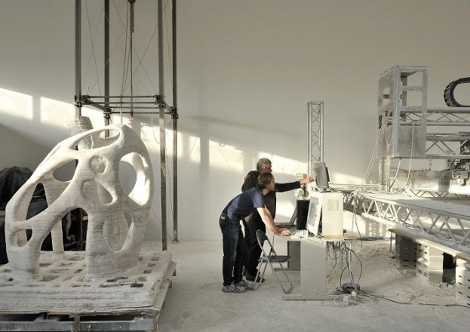
The end goal of this giant rapid prototyping machine is to print buildings. We’re not holding our breath for a brand new Flintstones-esque abode, but their whimsical suggesting of printed buildings on the moon seems like science fiction with potential. The machine operates similar to a RepRap but instead of plastic parts, it prints stone by binding sand with epoxy. This method is not revolutionary, but hasn’t really been seen in applications larger than a square meter or so. It’s fun to see the things we dabble in heading for industrial production applications.

[Thanks Juan]

Eat Your Heart Out IPad

We don’t remember where we read it, but our favorite criticism of the iPad is that is does the same things a lot of other Apple devices do. So why wait until April to get your hands on that functionality? [Alexbates] built his own iPad clone using existing hardware and software. This started with an MSI wind that he used as a hackintosh. A touchscreen was added to the display, the keyboard removed, and the LCD flipped around. Boom, a tablet running OS X was born. This is different from others because [Alexbates] took the time to alter the UI to look like the iPad. Sure, it doesn’t automatically flip the display when rotated and there’s no pinch-zooming. But it does have more processing power and storage space.

We’re more likely to hack our own like this rather than purchase a device we’re not all that enthusiastic about.

[Thanks Jadon via Engadget]