Hackaday Links: July 25, 2010

Radio Receiver

If you never got the chance to build one as a kid [JoOngle] takes you through the steps to build your own radio receiver. Details are a bit scarce but it’s nothing your friend Google can’t help you out with.

Fixing a Blackberry trackball

If your Blackberry trackball stops working well you can try this non-technical fix. Remember when mice used to have a ball in them and you would need to clean out the gunk from time to time? Forcefully skidding your Blackberry across a piece of paper does a similar service.

Linux time lapse

Open source can be a great help to small businesses. Here’s a way to use a Linux machine to make time-lapse movies from surveillance camera feeds. We especially enjoy the use of a desktop wallpaper that has the terminal commands necessary to start recording.

Host a webpage with Dropbox

Here’s a way to host a simple webpage using Dropbox. It’s one of those easy ideas that you wouldn’t come up with yourself. When you place an HTML file in your Dropbox you can get a public URL which will be built as a webpage when visited with a browser.

Inline splicing
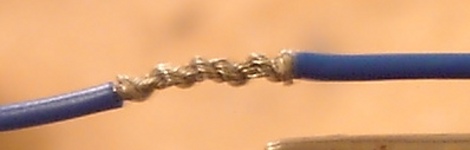
To round out the weekend here’s [Osgeld’s] tips on inline wire splicing. We laughed as he recounted spearing himself with stray strands. This is pretty simple stuff but he’s explained it well and who’s to pass up a good tip?
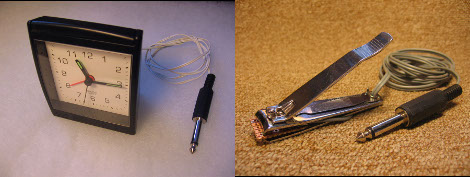
Alternative Morse Code Keys

Add a bit of interest to your radio equipment with one of these unorthodox CW keys. [OH6DC] has been hard at work posting almost sixty of these hacks. Above you can see an alarm clock whose snooze button acts as the key, and a nail clipper used as a key. There’s a banana , a cross-country ski shoe , and a toaster key. The rest you’ll have to see for yourself. Any of these would work perfectly with that Morse code keyboard you’ve been wanting to build.

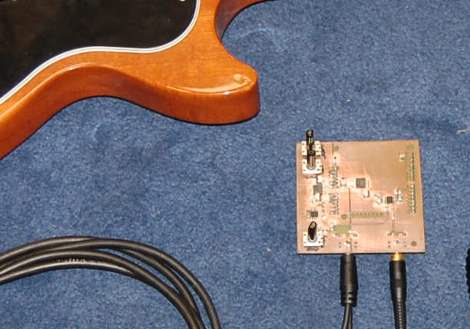
Guitar Effect Shield For Maple

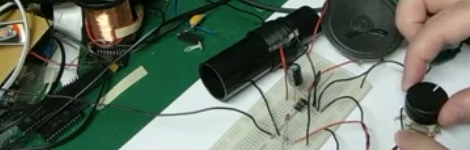
[Okie] designed this audio effect shield for Maple. You’ll remember that Maple is a prototyping system built around an ARM processor, so there’s plenty of power and speed under the hood. First and foremost, the shield provides input and output filters to keep noise out of the system. From there a set of potentiometers let you change the effect, with the manipulation like echo, distortion, and ring modulation happening in the firmware.

Extremely Organized Prototyping

We’ve got a couple of very high-tech shoe boxes in which we store our prototyping accessories. You’ll find a collection of LCD modules, chips on breakout boards, switches soldered to homemade boards for easy breadboarding, and much more. That is assuming you can find anything in that mess of components.

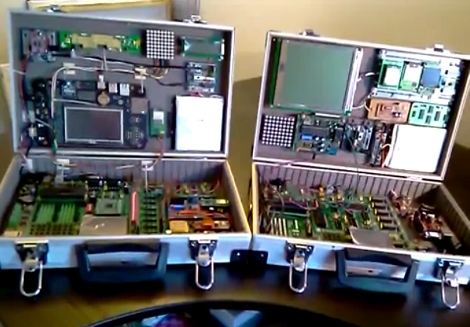
[Shahriar] took a different approach. He’s mounted all of his prototyping gear inside of a briefcase. This large collection of high-end boards include PIC prototyping, various LCD screens, and a large portion of SparkFun’s stocked boards. It’s much more advanced than the Arduino to-go platform, and you can see a full walk through of the system after the break.

Continue reading “Extremely Organized Prototyping” →

Daft Punk Helmet Replica Finally Completed

[Harrison Krix] finished his Daft Punk Helmet replica and posted about it this week. We took a look at his work back in October but he’s come a long way to pull off a legendary build. Take three minutes after the break and see 17 months worth of work. So many skills were pulled together to make this happen; sculpting, mold making, painting, electronic design, mechanical design, and bad-ass-ery. Crammed in along with your noggin are a bag-full of LED boards but the Arduino that controls it all resides outside, in a project box tethered to the helmet. This is a masterpiece of socially-unwearable geek fashion.

Continue reading “Daft Punk Helmet Replica Finally Completed” →

Adding Mute To A Bluetooth Headset

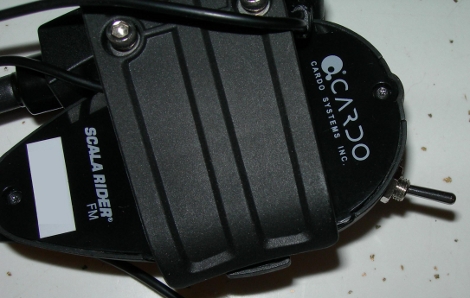
[Jared] often needs to be on conference calls for work during his motorcycle commute. He’s got a bluetooth headset that cancels noise but it didn’t have a mute feature. He cracked open the speaker and microphone portion of the apparatus but there wasn’t enough room for a switch. The base unit which houses the noise cancelling hardware had plenty of room. He added a single pole double throw (SPDT) switch to the positive wire from the microphone, allowing him to disconnect it as a mute function would. He mentions the need to seal the unit with silicone after the hack in order to keep out the elements. We might have opted for a weather-proof switch as well.

This simple hack makes a nice addition to any Bluetooth projects you’re working on.

Teensy Credit Card Reader

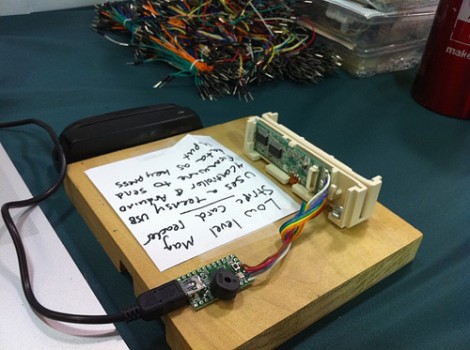
Here’s a hack that makes business sense. [PT] recalls last year’s HOPE conference when their booth was using a virtual credit card terminal for purchases that required manual entry of card information. This year they’ll have the same virtual terminal but this magnetic stripe reader will fill it out automatically.

A magstripe reader (reading only, no funny business here) from Mouser grabs data from the card. A Teensy microcontroller board, which identifies itself as a USB keyboard, automatically fills out the virtual terminal from the parsed data. The real question, are his customers comfortable sliding their plastic through a hacked reader?