Rotating Radar Visualization

[flickr video=http://www.flickr.com/photos/peplop/4106571163/]

We ask, who wouldn’t want a rotating motion and distance tracking radar? Sure in today’s day and age anyone could purchase a wide-angle sonar or IR solution that achieves the same goal, but [LuckyLarry] took it old school and made his own rotating radar. He used an Arduino, servo, and ultrasonic sensor as a base to gather data, and the open source programming language Processing to draw the data on the screen. He says it’s a little inaccurate currently, but will try out some other sensors in the future.

USB To Serial Adapter

[Spikenzie] is at it again. This time he’s posted a nice USB to serial converter. He points out that you can buy a USB to serial adapter pretty cheaply, but sometimes you want this functionality built into your project enough to justify the greater cost. In those cases where you want to integrate it, this is an elegant solution. This design was made to be fairly compact and still usable on a breadboard. As usual, you can download the files from his website.  If his work looks familiar, it’s because we’ve covered his work several times before.

[via Flickr]

LED Ring Light

diy-ring-light

[Jani] built his own photography ring light based on automotive LED rings. The rings he used are meant to encircle headlights on a car and are available at a low cost. The assembly is built around a filter that attaches to his camera lens. Two rings of LEDs are then glued to a case made from the plastic of a CD-R container. To diffuse the light, he sanded both sides of the clear plastic housing to make it translucent.

LED rings operate on DC power and unlike a ring flash, they provide constant light to help set up your shot. His finished project is well-built and should come in between $10-20.

Radio Assisted Drawing Device

radio-assisted-drawing-device

An exhibition just wrapping up at the Russian Frost Farmers Gallery in New Zealand presented an interactive artwork hack. Called the Radio Assisted Drawing Device (R.A.D.D), it is a plotter that mounts on the wall. It isn’t computer controlled, but rather relies on a remote control with two sticks to move the plotter Etch-a-Sketch style.

A clear gantry mounts vertically and travels along the top edge of the wooden backing. A slot cut in the acrylic steadies the plotter and allows for smooth vertical movement. Obviously built by hand, the mechanics seem to have tight tolerances for precise movements of the stylus. See the exhibit in the video after the break.

Wouldn’t you love to have one of these on the wall at your next party? It adds a whole new spin on a guest book.

Continue reading “Radio Assisted Drawing Device” →

Tauntaun Costume

[youtube=http://www.youtube.com/watch?v=upl7F5p0DHY]

[Scott Holden] went all out this year and built an amazing Tauntaun costume. The Tauntaun from Star Wars was massive,  standing 8 feet tall, and usually carrying a rider. [Scott] wanted to make it the correct size, and ultimately pulled it off. He had to build custom stilts to get the leg angle correct as drywall stilts were too straight. The rest is mainly pvc and fur.  We think he did a fantastic job on this. The effect is quite nice, and we can imagine that in person it is even better.

Take note at the bottom of page 3. Apparently, he got pinned in the costume in his workshop and almost had to spend the night on the floor in the costume. That’s pretty wild, at least he was warm.

[via makezine]

Radar Detector Tester

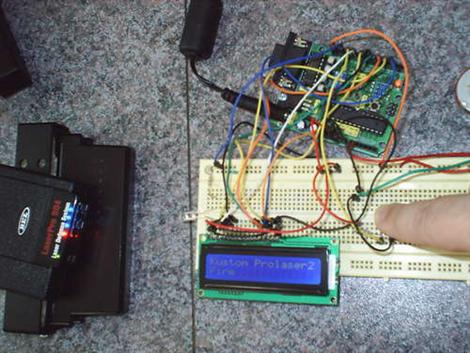
[Blacklight99] made this cool tool. It is a tester for those radar detectors that people keep in their cars. Though this seems like it would rarely be a tool we would need, it’s an interesting project. Some speed guns that the police use have a “stealth” mode that makes them invisible to some detectors. This tool can tell you if your detector is vulnerable to this. While this really is just a complicated flashing LED, he notes that it could be taken further to be made into a detector that is programmable and not vulnerable to any of the stealth modes.

Bulbdial Redux

pic2

[Taufeeq] sent in his “Circle of Light” bulbdial clock. You may remember when we showed you Evil Mad Scientist’s version a while back, and [Taufeeq] did use it as a base but he’s added some of his own little touches. Some of the changes include using a PIC with an RTC chip instead of AVR, which allowed him to shrink the board down small enough to fit behind the clock face, rather than on front. He’s even zipped everything up conveniently to help you build your own.