Create A Temporary Phone Number With Inumbr

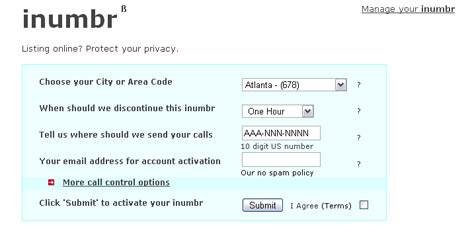
Maybe you don’t want that one person that has barged into your life to know your private phone number? Could be a salesperson or a co-worker who you aren’t that impressed with, but have to get in contact with. Check out inumbr.

inumbr is a free online service that gives US users the ability to set up a unique phone number, have it forwarded to any number within the US and then have it set to expire without a trace when finished with it. The unique inumbr’s are never reused, and can be extended if longer terms are required. Users choose from a list of 22 area codes from major US cities like Chicago, Los Angeles and New York, select an expiry date and set a number that it should be forwarded to. When the term is up, the number is expired from the system, and never used again for any other user. If you wish to use the number at a later date, you can log into the inumbr system and reactivate it.

As we are becoming more and more mobile and security conscious, the desire for these types of services grows. A phone number can now be given out at will, with security and privacy remaining intact. Google Voice is a major player in this arena. A somewhat similar service, they allow for a unique number with voice mail to forward to other numbers at will, creating a masked or unidentified private number that can be used to give out to 3rd parties. inumbr makes this process simpler with the ability to cut off and reactivate numbers as desired.

Life Size Animatronic Wolf Tail

tail076

We’re not 100% sure the usefulness of this hack, but it is extremely interesting regardless and will probably make a lot of furries happy. WolfTronix presents their method for creating a realistic animatronic wolf tail. It uses an Atmel MCU controlling two servos alongside a mess of Klixx toys and paper clips to produce a nice wag motion. The guide is extremely detailed and looks to be fun, so long as you don’t mind the monotonous task of shaving off potentially hundreds of ‘nubs’ as they call them. Either way, you’ll definitely have the best (and only…) tail on the block.

Thanks [J. Peterson]

Windows 7 And Vista Crash Via SMB Exploit

vista_dx10_bsod

[Laurent Gaffié] has discovered an exploit that affects Windows Vista, Windows 7, and possibly Windows Server 2008 (unconfirmed). This method attacks via the NEGOTIATE PROTOCOL REQUEST which is the first SMB query sent. The vulnerability is present only on Windows versions that include Server Message Block 2.0 and have the protocol enabled. A successful attack requires no local access to the machine and results in a Blue Screen of Death.

[Laurent] has a proof of concept available with his writeup in the form of a python script (please, white hat use only). There is no patch for this vulnerability but disabling the SMB protocol will protect your system until one is available.

Update: According to the Microsoft advisory this vulnerability could lead to code execution, making it a bit worse than we thought. On the bright side, they claim that the final version of Windows 7 is not open to this attack, only Windows Vista and Windows Server 2008.

[via Full Disclosure]

[picture: Inquirer]

Hand Of Man Mechanical Claw

[Christian Ristow], a former Muppet creator, has created a much larger puppet that has caught the attention of Popular Mechanics. His Hand of Man is a 27 foot long remote control mechanical claw. Powered by a 90 hp diesel engine, the hydraulic system can be controlled by a glove worn by the operator. This started as a demonstration for a robotics fair, but has recently made appearances at Burning Man, Maker Faire, and had the Grand Champions seat of Popular Mechanic’s Backyard Geniuses Award. While not as practical as some robotic human augmentations, it can crush a car. [Christian] is even allowing anyone who is interested at these events to pick things up and crush them at their own whim.

Various promo videos after the jump.

Continue reading “Hand Of Man Mechanical Claw” →

DIY Solar Panels

solar

Reader [unangst] pointed out to us an article in the U.K.’s Daily Mail, where a teenager from Nepal had managed to create a 9v, 18W solar panel using human hair rather than the usual semiconductors (usually crystalline-silicon). The complex silicon in solar panels are what keep the prices out of reach of developing nations, and while there are a number of new technologies that are helping  bring down the cost, [Karki] managed to make his solar panel for only £23 (roughly $38). He also claims that when mass produced the price could drop substantially down to under $10 a panel, which would shatter the $1/watt sweet spot.

The melanin in hair acts as an organic-semiconductor, and while the hair does not have the longevity that silicon panels have (months rather than years), these panels can be made cheaply and serviced with little to no complex knowledge. Using melanin as an organic semiconductor seems to be a newer idea, because information seems hard to come by, but we managed to find a research paper from 2007 that explored the energy absorption attributes of melanin, as well as some good background info for the science types.

Research Paper (Warning: PDF)

So, Hack a Day readers, which one of you is going to make your home-brew solar panels first? Let us know when you do.

Thanks [unangst].

[digg=http://digg.com/environment/Teenager_Makes_DIY_Solar_Panels_from_Hair_Hack_a_Day]

Build Your Own Browser Extensions For Google Chrome

google-chrome-logo

[Ryan] posted a writeup on developing extensions for Google Chrome. The extension system utilizes HTML with a JavaScript API which is still sparsely documented. After taking us through his twitter bar extension project, he concludes that the Chrome extensions are not nearly as versatile as what we’re used to seeing with Firefox. That being said, this is a move in the right direction for the young browser.

[related: Google Chrome roundup]

Monome Mainstream: Performance On Letterman

monome_played_on_letterman

The monome was spotted being used in a performance by Imogen Heap on Late Night with David Letterman. Imogen uses the monome 256 model connected to a laptop sitting on the piano. In her performance she uses a combination of live samples and pre-recorded loops proving how great this product is in the hands of an accomplished artist.

Although not identified by name (or function), Letterman does notice the monome at the end of the performance. To see this kind of exposure for an innovative open source product is wonderful. Check out the Letterman clip as well as a monome bonus after the break. Continue reading “Monome Mainstream: Performance On Letterman” →