Continuous Ink Project

CRP_4176

This ancient by internet standards, circa 2002, but its a great read.  [Eddie], frustrated by the high cost of ink cartridges set out to build a continuous inking system. This would mean that the cartridges would be filled from larger, cheaper reservoirs of ink continually. Along the way he transitioned from simple tubes with some putty to more complicated systems. Eventually he had to hack the chips that told the printers the cartridge was in need of replacement.  While the systems he’s using may be difficult to find now, the execution should work on other models. Completely unrelated to the project itself, is that [Billy Mays] as the site favicon? We suspect it is [Eddie] himself.

[via hacknmod]

15 Ton Robotic Arm + WiiMote

[youtube=http://www.youtube.com/watch?v=v1AJ_OBJUpY]

These 15 ton robotic arms can reach 16 meters. Not content to control them by a simple joystick, the team hacked together WiiMote controls for them. Ok, we get it. Everybody loves the Wii.  What is different about using the WiiMote in this scenario? You can see that they are only using the pitch, yaw, and roll. They’re not utilizing the tracking aspects at all. The only difference between the WiiMote and their joystick in this scenario is that the WiiMote connects via bluetooth. Frankly, we just like the fact that people are playing with the robotic arms, WiiMote or not.

Apple Adjustable Keyboard USB Hack

usbkeyboard

When [Tom] got tired of the large size of his Microsoft Comfort Curve 2000 keyboard, he decided to hack a recently acquired Apple Adjustable Keyboard for use with Windows. After removing the ancient ADB based control board from the Apple keyboard, he was able to map the keys and transplant the Microsoft keyboard’s USB control board into the Apple keyboard. After soldering the control board into the keyboard with old IDE cables, all that was left was to add some diodes to prevent ghost key presses, and the keyboard hack was complete. [Tom] offers a spreadsheet of the results of his key mapping on his site, and while you’re there be sure to check out his other projects, like his DIY Proton Pack that he made for Halloween last year.

Intel 8008 Clock

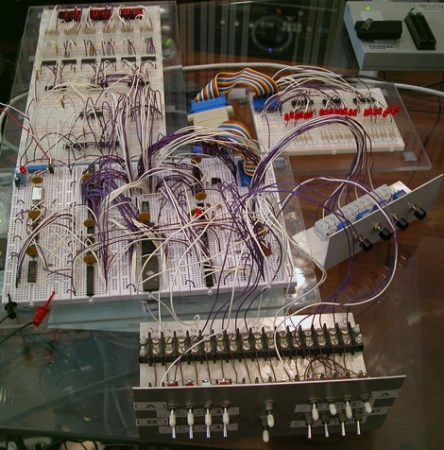
Every year [Len Bales] designs and builds a new clock. His 2006 clock runs on the classic Intel 8008 microprocessor. The design is definitely not for the faint of heart, but he includes all code, diagrams and a good description on his site. The project is an interesting look into the not-so-distant past of computing. While the function of the project is a clock, it is actually a fully programmable 8008 computer running at 500khz with 16k of memory space and 4io ports. [Len] also links a lot of useful 8008 resources for anyone wanting to tackle a project of their own.

AVR Boost Converter

avrboost

Over at SpriteMods, [sprite_tm] realized that a microcontroller could be used as a boost converter to power itself. A boost converter steps up voltage from a battery by switching the output of a coil. First, it is tied to ground so a magnetic field can build up in the coil. It is then released as a higher voltage than the input. Normally dedicated chips do this at an incredibly high frequency, but the PWM signal from an AVR works well enough. This can be used in low-power situations where space is an issue.

[via EMSL]

Various Cantenna Builds

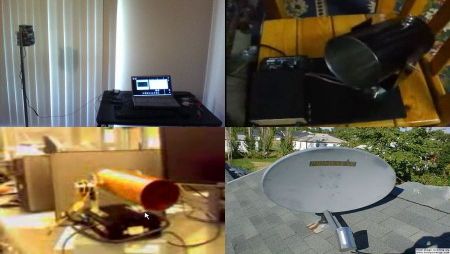
Here is a classic project used to increase wireless signal strength. Cantennas focus using a waveguide very much like a magnifying glass focuses light. [Robert] made a Natural Light beer cantenna, pictured in the upper left. His approach used three beer cans, a paper towel holder, and a shower curtain rod. On the tipline, he noted a signal boost from 11Mbps to 54Mbps. This is certainly something we can hack together if our room lacks adequate signal. Read about parabolic and seeking versions after the break.

Continue reading “Various Cantenna Builds” →

Tiny Medical Bot

blood-robot-8gwd4

This tiny bot wants to go inside your body. That’s right, it was designed to travel through veins. The little bot has no on board propulsion system. It is controlled by a magnet outside the body. See those little spines? Those straighten out to keep the bot in place when it isn’t supposed to move.  Creepy right? In all the articles we’ve seen on this bot, there aren’t any details about what actually is on board. They mention adding a camera in the near future, but why are they calling it a robot? Surely there’s something cool in that little body. This is a quite practical application of a project we covered recently. Commenters weren’t impressed with the external control system, likening it to the old vibrating football player game. Well, here’s where it could be usefull.