Buy An Oil Cooled PC For $11k

For roughly $11,000 you cold have this awesome oil cooled computer rig. This system was designed specifically to be able to keep the electronics submerged in oil. The system uses SSD for storage, so everything can be submerged. Check out the pictures of the top panel, what is going on there?

If $11,000 is too much for you to spend, you could always do it yourself with an old aquarium, like this one, but be careful, that oil can get pretty messy. There is also a happy medium too, check out this method. Its nice, clean and not too expensive.

[via DVICE]

Keyless Entry Using Touch Sensing

[Alex] sent us this slick little keyless entry system. He wanted a discreet way to trigger the door to unlock. Knocking was too loud, and would give away his secret access code. He decided that touch sensors would be the best. Initially he planned on using the doorknob itself, which would have been awesome, but it was just too much surface area for his touch sensor. Ultimately, he settled for a wire he could touch.  An Arduino detects whether or not the correct code has been put in and initializes a high torque servo which turns the doorknob from the inside.  In the video, after the break, you can see that it works fairly well.

Continue reading “Keyless Entry Using Touch Sensing”

Parts: Chip Sockets For Dual In-line Package (DIP)

DIP through-hole chips are an old package with instantly recognizable dual in-line pin rows.  Beginners love these chips because they’re large and look easy to solder; we abhor them because we hate messing around with the drill. Whatever your motivation for using a through-hole chip, use a socket whenever possible. A circuit board with socketed chips is easy to test without endangering the parts, and ICs can be removed, tested, and replaced, without resorting to a soldering iron. This week, by request, we looked at several common through-hole chip sockets. Continue reading “Parts: Chip Sockets For Dual In-line Package (DIP)”

Lasercut RepRap Kit

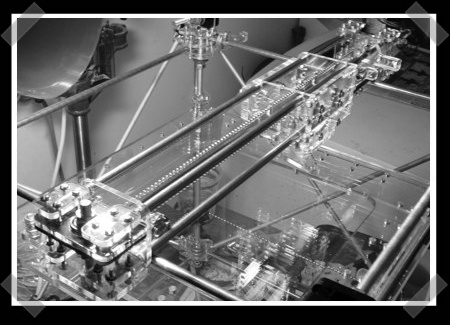
The RepRap is a self-copying 3D printer. The project has published plans for creating a lasercut acrylic version of the device. They call it a RepStrap since once assembled it could produce printed plastic versions of the machine components, bootstrapping true RepRaps. The plans are available for Ponoko an on-demand product service, and it would cost ~$380 if you used their service. The plans are free, so you could get them manufactured by other means. [vik] is still putting together the assembly instructions. He hopes to have an all inclusive electronics kit at some point too. This is another great step towards putting desktop manufacturing within reach of everyone.

Arduino Duemilanove

The latest generation of Arduino hardware has been released. The Arduino Duemilanove (2009 in Italian) has the same form factor as previous generations. The specs are essentially identical to the Diecimila, but there have been a few changes to the hardware. The power source is no longer chosen using a jumper. A MOSFET and dual OPAMP have been added to the board to automatically selected between USB power and the external plug. Automatic hardware resets are optional now. Next to the USB port are two solder pads labeled RESET-EN. Cut the trace between them to kill the reset. If you ever want it back, just bridge the pads. The hardware was updated to correspond with the release of Arduino cofounder [Massimo Banzi]’s new book.

Jar Of Fireflies

[Randomskk] has been attempting to make electronic fireflies for quite some time and finally settled on a design he liked. His jar of fireflies uses an ATtiny13 to control a set of 12 matrixed LEDs. The green SMD LEDs are each soldered to a pair of thin wires that hang down into the jar. The software picks an LED at random to flash and then flashes it 1-3 times. The random seed is incremented each time the jar is turned on, so you’ll get 255 different patterns. The power is just a standard coin cell. The project is fairly simple electrically, but the LED soldering could prove difficult. It was inspired by this firefly jar project. Check out [Alex]’s synchronizing fireflies too. A video of the jar is available below. Continue reading “Jar Of Fireflies”