Electric Wind-Up Plane Uses Supercapacitors For Free Flight Fun

There’s something to be said for a simple wind-up, free flight model airplane. With no controls, it must be built very well to fly well, and with only the limited power of a rubber band, it needs a good, high-lift design without much superfluous drag to maximize flight time. There’s also something to be said for modernity though, and prolific hacker [Tom Stanton] puts them together with this supercapacitor plane.

If that sounds familiar, it’s because [Tom] did this before back in 2023. But for that first attempt he converted a commercial R/C toy rather than a plane optimized for low-power free flight. Just like with the best rubber-band machines, his goal for the new production is more flight time than winding time. Plus lots of views on YouTube, but that goes without saying.

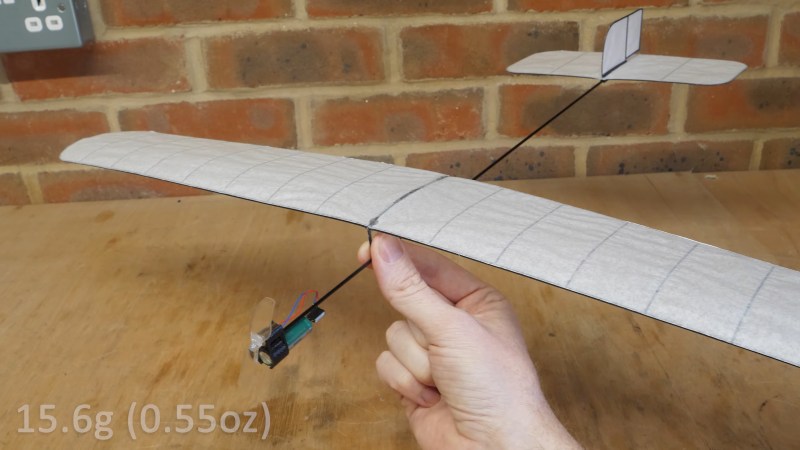
Thus this machine is smaller and lighter than the previous iteration. Rather than balsa and tissue like the free-flight aircraft of our youths, [Tom] is using 3D printed plastic for the structure. But he’s got a neat hack built in: he’s printing the wings and control surfaces directly onto tissue paper, eliminating the bonding step. Of course that means his wings are printed flat, but a bit of heat and some bending and he has a single-surface airfoil. Single-surface airfoils are normal in this application, anyway: closed wings add too much weight for too little gain. If you want to try the technique, he’s got files on Printables.

Another interesting factoid [Tom] discovered is that the energy density of supercapacitors decreases sharply below 10 F. As you might imagine by the square-cubed law, bigger is better, but the sharp drop-off dictated he use a single 10 F cap for this build, along with a micro motor. Using the wind-up generator from his previous build, he’s able to get 45 seconds of flight out of just 4 seconds of cranking, a good ratio indeed.

[Tom] seems to like playing with different ways to power his toys; aside from supercapacitors, we’ve also seen him finessing aircraft air motors — including an attempt at a turbine for a model helicopter.

Continue reading “Electric Wind-Up Plane Uses Supercapacitors For Free Flight Fun”

Battle Born Explains How Its Battery Thermal Safety Works

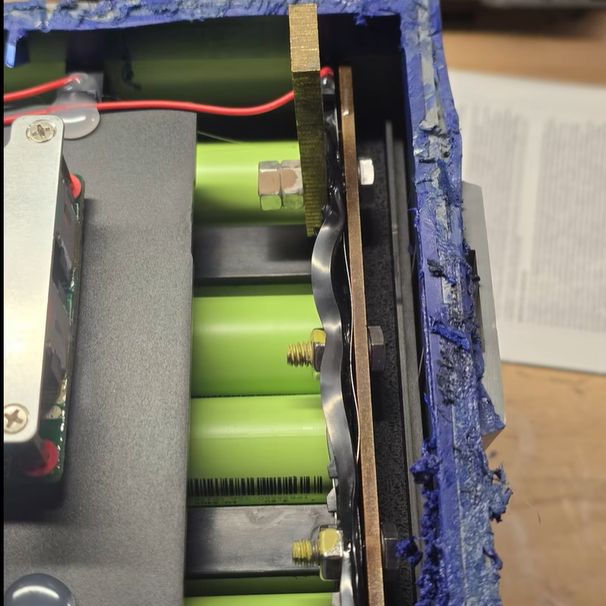
Autopsy of Battle Born LFP battery with the 'thermal safety' on the bus bar. (Credit: Will Prowse)
Autopsy of Battle Born LFP battery with the ‘thermal safety’ on the bus bar. (Credit: Will Prowse)

After users of Battle Born LFP batteries encountered issues such as a heavily discolored positive terminal and other signs of overheating, multiple autopsies showed that the cause appeared to be the insertion of a thermoplastic between the bus bar and the terminal. Over time thermal creep loosened the connections, causing poor contact and melting plastic enclosures. According to Battle Born, this is actually part of an ingenious thermal safety design, and in a recently published article they explain how it works.

The basic theory appears to be that if there’s a thermal event, the ABS thermoplastic will soften and reduce the pressure on the bolted-together copper bus bar and brass terminal. This then allows for an aluminium-oxide layer to form on the aluminium connecting bolt courtesy of the dissimilar copper/aluminium interface. Aluminium-oxide is non-conductive and thus interrupts the flow of current.

Of course, there are countless issues with that theory, least of all the many reports of in-field failures. We recently covered [Will Prowse] studying the death of one of these 100 Ah LFP batteries from brand-new to failure under controlled circumstances. This clearly shows the thermal creep loosening up the connection and causing poor contact between the bus bar, the bolt and the terminal, with poor contact and thermal issues resulting.

Continue reading “Battle Born Explains How Its Battery Thermal Safety Works”

Post-Failure Autopsy And Analysis Of An LFP Battery

Recently [Kerry Wong] had one of his Cyclenbatt LiFePO4 batteries die after only a few dozen cycles, with a normal voltage still present on the terminals. One of the symptoms was that as soon as you try to charge it, the voltage goes up very rapidly to above 14 V due to what appears to be high internal resistance, and vice versa for discharging. In addition, the Bluetooth feature of the BMS appeared to have died as well, making non-invasive diagnostics somewhat tricky.

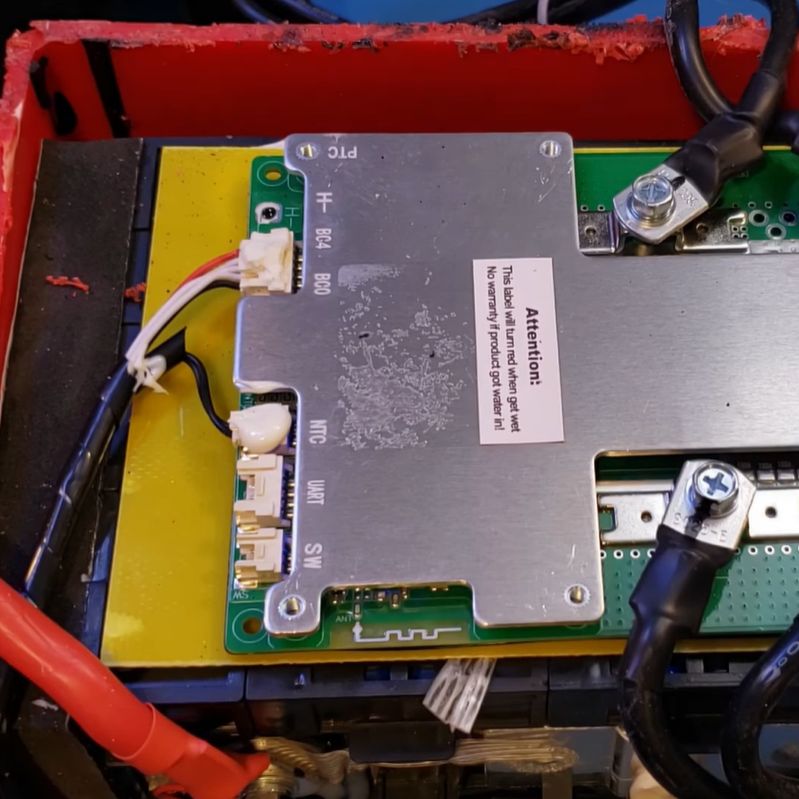
Close-up of the BMS. (Credit: Kerry Wong, YouTube)

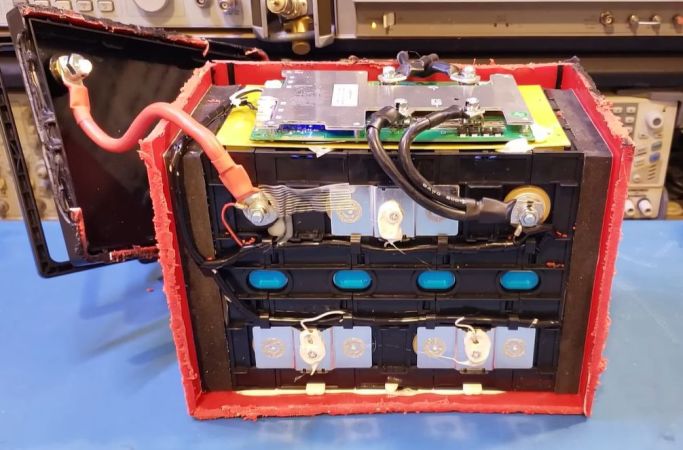
After gently cutting open the plastic case, [Kerry] was greeted by the happily blinking blue LED of the Bluetooth module and deepening the mystery. Overall the build quality looks to be pretty good, with no loose cables as seen with certain other LFP batteries.

Cell voltages measured normal, with no significant imbalance. Next was measuring the internal resistance, which showed a clear issue. One of the cells was reading over 3 Ohms, whereas the others were in the milli-Ohm range. This would definitely explain the issues with charging and discharging, with a single bad cell causing most of the issues.

Of course, why the Bluetooth feature failed remains a mystery, and there’s still a lingering question on whether the BMS practiced proper balancing between the cells, as this can also cause issues over time.

Continue reading “Post-Failure Autopsy And Analysis Of An LFP Battery”

Battery Tester Outperforms Cheaper Options

Batteries are notoriously difficult pieces of technology to deal with reliably. They often need specific temperatures, charge rates, can’t tolerate physical shocks or damage, and can fail catastrophically if all of their finicky needs aren’t met. And, adding insult to injury, for many chemistries, the voltage does not correlate to state of charge in meaningful ways. Battery testers take many efforts to mitigate these challenges, but often miss the mark for those who need high fidelity in their measurements. For that reason, [LiamTronix] built their own.

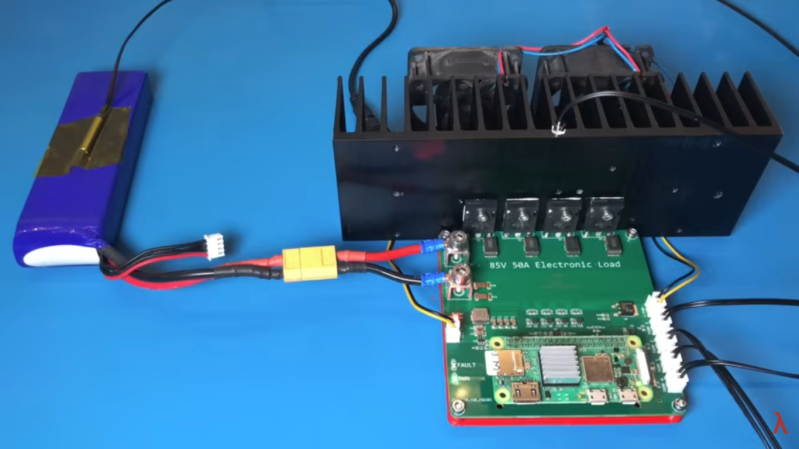
The main problem with the cheaper battery testers, at least for [LiamTronix]’s use cases, is that he has plenty of batteries that are too large to practically test on the low-current devices, or which have internal battery management systems (BMS) which can’t connect to these testers. The first circuit he built to help solve these issues is based on a shunt resistor, which lets a smaller IC chip monitor a much larger current by looking at voltage drop across a resistor with a small resistance value. The Pi uses a Python script which monitors the current draw over the course of the test and outputs the result on a handy graph.

This circuit worked well enough for smaller batteries, but for his larger batteries like the 72V one he built for his electric tractor, these methods could draw far too much power to be safe. So from there he built a much more robust circuit which uses four MOSFETs as part of four constant current sources to sink and measure the current from the battery. A Pi Zero monitors the voltage and current from the battery, and also turns on some fans pointed at the MOSFETs’ heat sink to keep them from overheating. The system can be configured to work for different batteries and different current draw rates, making it much more capable than anything off the shelf.

Continue reading “Battery Tester Outperforms Cheaper Options”

The Hazards Of Charging USB-C Equipped Cells In-Situ

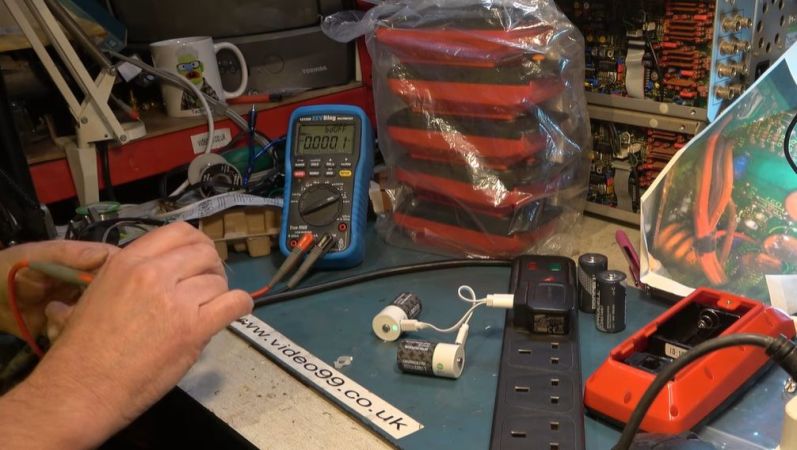
Can you charge those Li-ion based cells with USB-C charging ports without taking them out of the device? While this would seem to be answered with an unequivocal ‘yes’, recently [Colin] found out that this could easily have destroyed the device they were to be installed in.

After being tasked with finding a better way to keep the electronics of some exercise bikes powered than simply swapping the C cells all the time, [Colin] was led to consider using these Li-ion cells in such a manner. Fortunately, rather than just sticking the whole thing together and calling it a day, he decided to take some measurements to satisfy some burning safety questions.

As it turns out, at least the cells that he tested – with a twin USB-C connector on a single USB-A – have all the negative terminals and USB-C grounds connected. Since the cells are installed in a typical series configuration in the device, this would have made for an interesting outcome. Although you can of course use separate USB-C leads and chargers per cell, it’s still somewhat disconcerting to run it without any kind of electrical isolation.

In this regard the suggestion by some commentators to use NiMHs and trickle-charge these in-situ similar to those garden PV lights might be one of the least crazy solutions.

Continue reading “The Hazards Of Charging USB-C Equipped Cells In-Situ”

This Flow Battery Operates With No Pump Required

Flow batteries are rather unique. They generate electricity by the combination of two fluids flowing on either side of a membrane. Typically, this involves the use of some kind of pump to get everything moving. However, [Dusan Caf] has demonstrated another way to make a flow battery operate.

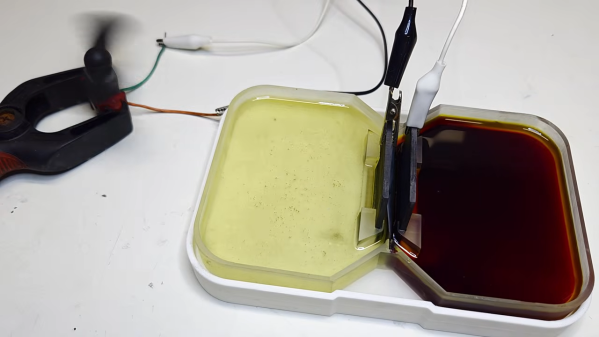
[Dusan]’s build is a zinc-iodide flow battery. It uses two 3D printed reservoirs, each holding a ZnI2 solution and a graphite electrode. Unlike traditional flow batteries, there is no mechanism included to mechanically push the fluid around. Instead, fluid motion is generated by the magnetohydrodynamic effect, which you may know from that Japanese boat that didn’t work very well.

When charging the liquid-based cell, current flows through the conductive electrolyte that sits between both electrodes. This sees zinc electroplated onto the graphite anode, while iodide ions are oxidized at the cathode. There’s also a permanent magnet installed beneath the electrodes, which provides a stable magnetic field. This field, combined with the current flowing through the electrolyte, sees the Lorentz force pushing the electrolyte along, allowing the flow battery to operate. When the cell is being discharged, the reactions happen in reverse, with the flow through the electrodes changing direction in turn. Neatly, as current draw or supply increases, the flow rate increases in turn, naturally regulating the system.

[Dusan] notes this isn’t feasible for large batteries, due to the limited flow rate, but it’s fine for small-scale demos regarding the operation of a flow battery. We’ve featured some more typical flow battery designs in the past, too.

Continue reading “This Flow Battery Operates With No Pump Required”

The Unreasonable Power Density Of Lithium-Ion

We’re all used to it by now, but I’d just like to reflect on how insanely power-packed lithium ion batteries are, and everything that’s afforded us. I’m trying to think of a gadget, a hobby, or nearly anything in my house that’s not touched by the battery chemistry.

I’m looking at my portable wireless keyboard in front of me, with a LiPo pack inside. Oddly enough, I’m charging it with a LiPo-based power bank, simply because the cable to the nearest USB-C adapter is too short. A gaming console, cell phone, and a DSLR camera are all within arms reach and powered with lithium.

It’s not just consumer stuff either. I fly FPV quads and airplanes for fun when I can, and of course those are made entirely possible by the combination of smaller brushless DC motors and their drivers, and the high-power-density LiPo packs that power them. For field recharging, I have a huge self-made LiIon pack that can keep them all in the air all day. These days, LiPo and LiIon tech is the heart of hacker projects big and small. Heck, we even powered this year’s Hackaday Supercon badge with a LiPo that allowed it to run all weekend on a charge for many folks, where in the past swapping out AAs during the event was commonplace.

The application that still blows my mind is that we recently got a solar installation on our roof, which means a huge LiFePO battery in the basement. And while it’s one thing to power noisy little quads on the battery tech, it somehow seems another to power our entire house, for multiple hours per day, from a battery. Granted it’s not a couple of AAA cells in a little black plastic box, but it’s simply amazing to run a washing machine, the fridge, the stove, and even the heating off of what amounts to a battery pack.

Of course, I’m aware of the costs of producing the cells, both in terms of money and the environmental damage. It’s not a free lunch, and I’m looking forward to both cleaner and cheaper energy storage chemistries in the future. But for now, I’m still in awe of the many options that lithium-based battery chemistry has brought us. May your pillows remain non-spicy!