Automated Dice Tester Uses Machine Vision To Ensure A Fair Game

People take their tabletop games very, very seriously. [Andrew Lauritzen], though, has gone far above and beyond in pursuit of a fair game. The game in question is Star War: X-Wing, a strategy wargame where miniature pieces are moved according to rolls of the dice. [Andrew] suspected that commercially available dice were skewing the game, and the automated machine-vision dice tester shown in the video after the break was the result.

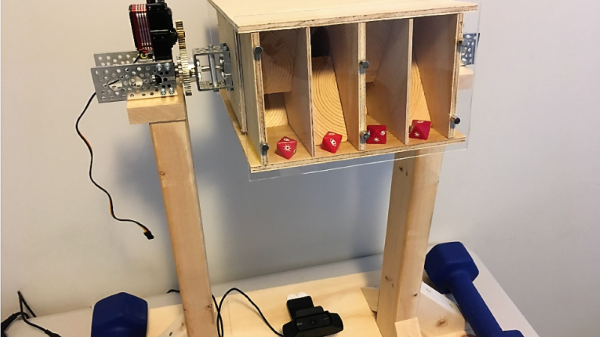
The rig is a very clever design that maximizes the data set with as little motion as possible. The test chamber is a box with clear ends that can be flipped end-for-end by a motor; walls separate the chamber into four channels to test multiple dice on each throw, and baffles within the channels assure randomization. A webcam is positioned below the chamber to take a snapshot of each “throw”, which is then analyzed in OpenCV. This scheme has the unfortunate effect of looking at the dice from the table’s perspective, but [Andrew] dealt with that in true hacker fashion: he ignored it since it didn’t impact the statistics he was interested in.

And speaking of statistics, he generated a LOT of them. The 62-page report of results from his study is an impressive piece of work, which basically concludes that the dice aren’t fair due to manufacturing variability, and that players could use this fact to cheat. He recommends pooled sets of dice to eliminate advantages during competitive play. 

This isn’t the first automated dice roller we’ve seen around these parts. There was the tweeting dice-bot, the Dice-O-Matic, and all manner of electronic dice throwers. This one goes the extra mile to keep things fair, and we appreciate that.

Continue reading “Automated Dice Tester Uses Machine Vision To Ensure A Fair Game”
Game Builder Lets Kids — Even Old Kids — Build Games

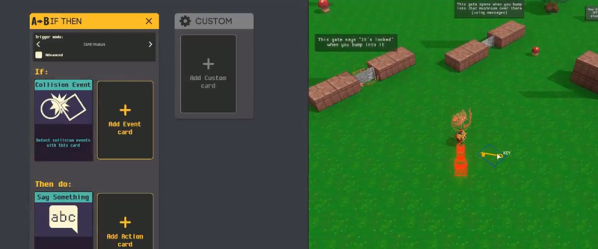
One rite of passage back in the good old days of owning a TRS-80, Commodore 64, or similar vintage computer was writing your own game. It probably wouldn’t be very good, but it wouldn’t be much worse than most of the stuff that was out there, either. Today, trying to get a kid interested in “hunt the wumpus” is probably not going to fly and having them create a modern-looking game is out of the question. Or is it? Disguised as a game itself, Game Builder offers an interactive way to create interesting games without having to get too detailed into programming. On the other hand, it supports JavaScript, so you can get to programming if you need to or want to. We could easily see a kid — or even an adult — easing into programming using this game which is free, from Google.

In the old days, hardware was a limiting factor and Basic made it pretty easy to whip out some text or crude graphics. Our favorite was a high low game that guesses your number. But everyone had some little game they’d create so they said they could. Today’s games, though, have good graphics and music and 3D shapes and a host of other things you didn’t have to contend with back then. Game Builder, though, makes it pretty simple. You can work on a game by yourself, or with friends, or with the general public. Everyone involved can play the game, but they can also edit the game. The tool runs under Steam so even though it is marked for PC or Mac, it will also run on Linux if you have Steam installed properly.

Continue reading “Game Builder Lets Kids — Even Old Kids — Build Games”

Let The Cards Fall Where They May, With A Robotic Rain Man

Finally,  a useful application for machine vision! Forget all that self-driving nonsense and facial recognition stuff – we’ve finally got an AI that can count cards at the blackjack table.

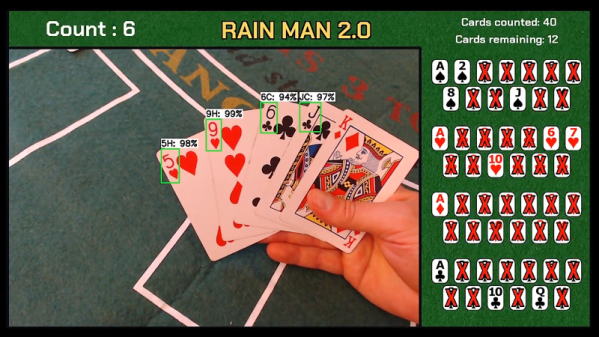
The system that [Edje Electronics] has built, dubbed “Rain Man 2.0” in homage to the classic title character created by [Dustin Hoffman] for the 1988 film, aims to tilt the odds at the blackjack table away from the house by counting cards. He explains one such strategy, a hi-low count, in the video below, which Rain Man 2.0 implements with the help of a webcam and YOLO for real-time object detection. Cards are detected in any orientation based on their suit and rank thanks to an extensive training set of card images, which [Edje] generated synthetically via some trickery with OpenCV. A script automated the process and yielded a rich training set of 50,000 images for YOLO. A Python program implements the trained model into a real-time card counting application.

Rain Man 2.0 is an improvement over [Edje]’s earlier Tensor Flow card counter, but it still has limitations. It can’t count into a six-deck shoe as the fictional [Rain Man] could, at least not yet. And even though cheater’s justice probably isn’t all cattle prods and hammers these days, the hardware needed for this hack is not likely to slip past casino security. So [Edje] has wisely limited its use to practicing his card counting skills. Eventually, he wants to turn Rain Man into a complete AI blackjack player, and explore its potential for other games and to help the visually impaired.

Continue reading “Let The Cards Fall Where They May, With A Robotic Rain Man”

Hail To The King, Baby: Reverse Engineering Duke

If you’re a fan of DOS games from the 1990s, you’ve almost certainly used DOSBox to replay them on a modern computer. It allows you to run software in a virtual environment that replicates an era-appropriate computer. That’s great for historical accuracy, but doesn’t do you much good if you’re trying to leverage modern computing power to breathe some new life into those classic titles. For that, you need to dig in a little deeper.

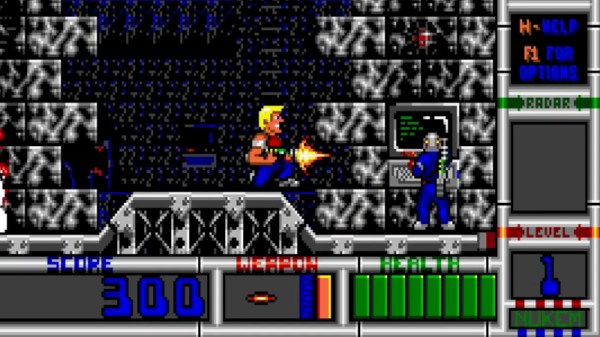
For the last two and a half years, [Nikolai Wuttke] has been doing exactly that for 1993’s Duke Nukem II. The end result is RigelEngine, an open source drop-in replacement for the original game binary that not only runs on a modern Windows, Linux, or Mac OS machine, but manages to improve on the original in a number of ways. An accomplishment made even more impressive once you learn that the original source code for the game has been lost to time, and that he had to do everything blind.

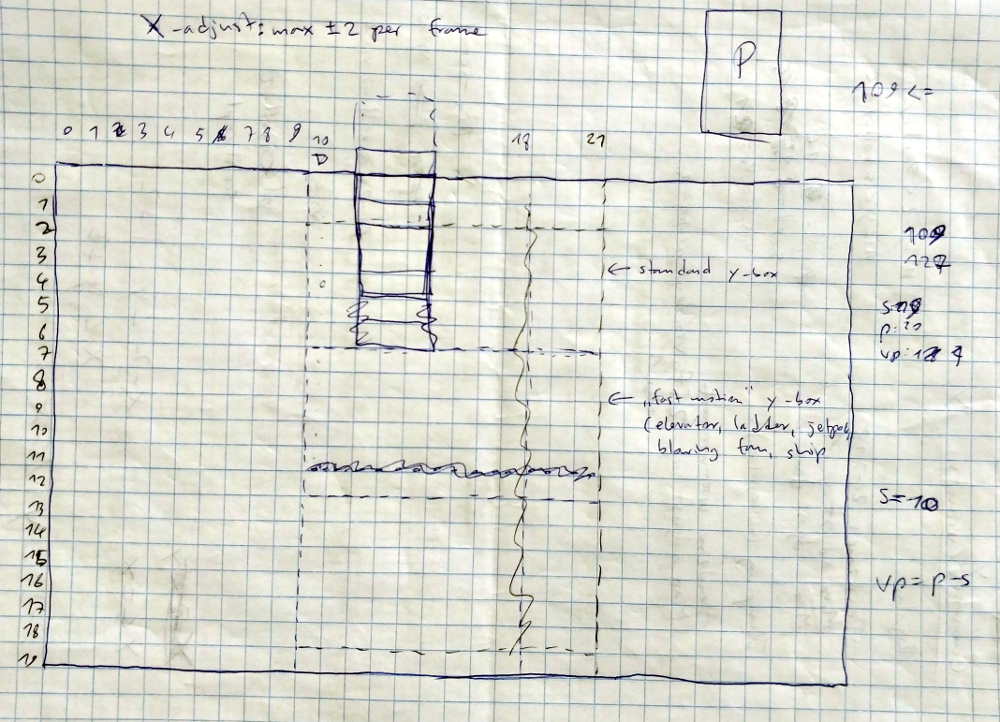
In a blog post chronicling his progress so far, [Nikolai] explains the arduous process he used to make sure his re-implementation was as accurate as possible to the original game. He spent untold hours studying the original game’s disassembled code in Ida Pro, handwriting out pages of notes and pseudocode as he tried to understand what was happening behind the scenes. Once a particular enemy or element of the game was implemented in RigelEngine, he’d record the gameplay from his version and compare it to the original frame by frame so he could fine tune the experience.

So what’s the end result of more than two years of work and over 25K lines of code? Thanks to the incredible advancements in computing power since the game’s release nearly 30 years ago, [Nikolai] has managed to remove the need for loading screens. His engine is also capable of displaying an unlimited number of particle effects on the screen at once, and multiple sound effects can now be played simultaneously. In the future he’s looking to implement smooth character movement (in the original game, movement was in 8 pixel increments) and adaptive volume for sound effects based on their distance from Duke. Ultimately, RigelEngine should be able to replace the original graphics with new high resolution textures once some issues with the rendering buffer gets sorted out.

It’s hard to overstate how important some of these classic games are to those who grew up playing them. With John Romero still releasing DLC for the original DOOM and hackers disassembling nearly 40 year old games to fix bugs, it doesn’t seem like they’re in any danger of being forgotten.

Continue reading “Hail To The King, Baby: Reverse Engineering Duke”

1980s Plotter Plays Flappy Bird

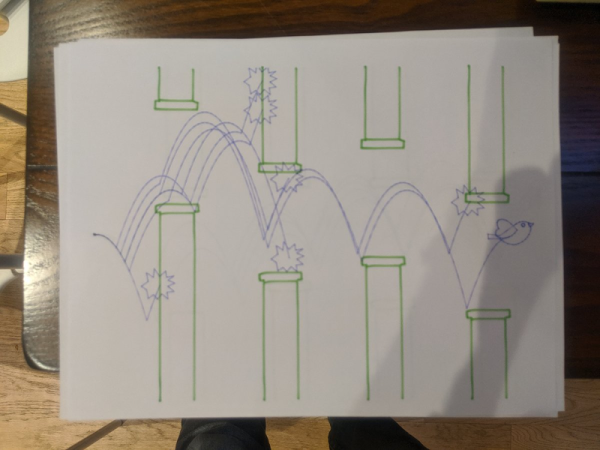
Should you happen to have an HP7440A or similar plotter hanging around, you could have a quick game of Flappy Bird — or Plotty Bird as [WesleyAC] calls it. Just be sure you have some blank paper. The whole thing fits in about 200 lines of Rust code and — according to the author — gets to about 20 frames per second.

Watching the thing go, it appears that it draws a random set of pipes and then traces your flight path on the same page in real time.

Continue reading “1980s Plotter Plays Flappy Bird”

The ArduBoy Community Rolled Their Own Cartridge

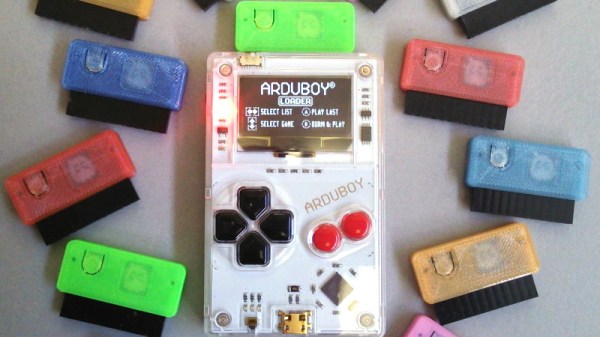
The Arduboy, as you might have guessed from the name, was designed as a love letter to the Nintendo Game Boy that many a hacker spent their formative years squinting at. While the open source handheld is far smaller than the classic DMG-01, it retains the same general form factor, monochromatic display, and even the iconic red LED to the left of the screen. But one thing it didn’t inherit from the original was the concept of removable game cartridges. That is, until now.

Over the last year, [Mr.Blinky] and a group of dedicated Arduboy owners have been working on adding a removable cartridge to the diminutive handheld. On paper it seemed easy enough, just hang an external SPI flash chip off of the test pads that were already present on the Arduboy PCB, but to turn that idea into a practical cartridge required an immense amount of work and discussion. The thread on the Arduboy community forums covers everything from the ergonomics of the physical cartridge design to the development of a new bootloader that could handle loading multiple games.

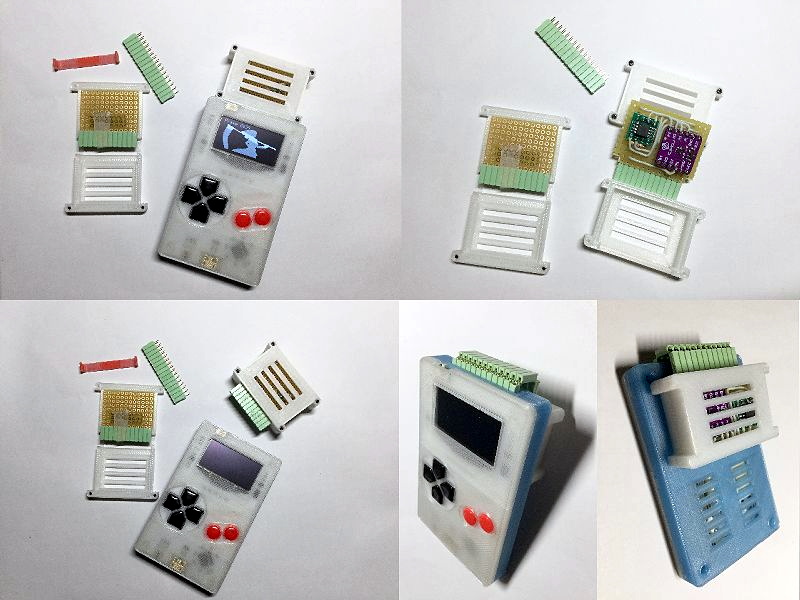
Early cartridge prototypes.

The first problem the group had to address was how small the Arduboy is: there’s simply no room in the back to add in a cartridge slot. So a large amount of time is spent proposing different ways of actually getting the theoretical cartridge attached to the system. There was some talk of entirely redesigning the case so it could take the cartridge internally (like the real Game Boy), but this eventually lost out for a less invasive approach that simply replaced the rear of the Arduboy with a 3D printed plate that gave the modders enough room to add a male header along the top edge of the system.

As an added bonus, the cartridge connector doubles as an expansion port for the Arduboy. While perfecting the design, various forum users have chimed in with different gadgets that make use of the new port, from WS2812B LEDs to additional input devices like joysticks or a full QWERTY keyboard. Even if you aren’t interested in expanding the storage space on your Arduboy, being able to plug in new hardware modules certainly opens up some interesting possibilities.

In fact, the project so impressed Arduboy creator [Kevin Bates] that he chimed in on the topic last month to announce he would start looking into integrating the community’s cartridge modification into the production hardware. If all goes well, pretty soon there might be an official upgrade path for those who want to expand what this tiny nostalgia machine is capable of.

Continue reading “The ArduBoy Community Rolled Their Own Cartridge”

Novice Coders Can Create Classic Game Boy Games

It takes a lot of work to build a modern video game. Typically an entire company will spend months (at least) developing the gameplay, selecting or programming an engine, and working out the bugs. This amount of effort isn’t strictly necessary for older video game systems though, and homebrew developers are quite often able to develop entire games singlehandedly for classic systems. In the past it would have taken some special software, programming knowledge, and possibly hardware, but now anyone can build games for the original Game Boy with minimal barriers of entry.

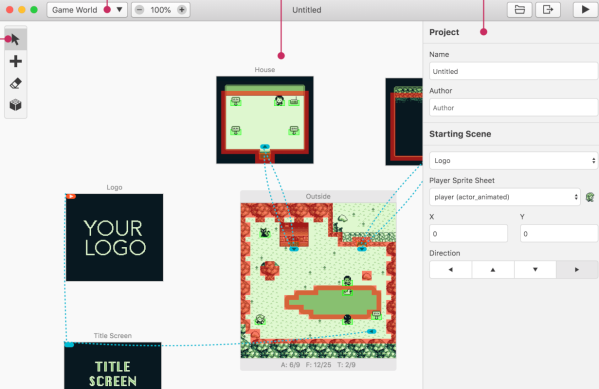
The project is known as GB Studio and allows people to develop homebrew games for the 8-bit handheld system without programming knowledge. Once built, the games can be played on any emulator or even loaded onto a cartridge and played on original hardware if a flash cart is available. Graphics can be created with anything that can create a .png image, and there are also some features that allow the game to be played over a web browser or on a mobile device.

While it seems like the gameplay is limited to RPG-style games, this is still an impressive feat, and highly useful for anyone curious about game development. It could also be an entry into more involved game programming if it makes the code of the games available to the user. It could even lead to things like emulating entire cartridges on the original hardware.

Continue reading “Novice Coders Can Create Classic Game Boy Games”